Wize High School Grade 11 Math Textbook > Trigonometry with Non-Right Triangles
Sine Law - Ambiguous Case
Sine Law - The Ambiguous Case
Try it out!
Draw as many triangles as you can with one side that is 10 cm and another side that is 6 cm, where the angle across from the 6 cm side is .

Since we are able to draw more than one triangle with these given measurements, we say that this is ambiguous.
When we use the sine law to find the missing side and angle measurements in this triangle, we will end up with 2 possibilities, this is called the ambiguous case of the sine law.
Summary
When we are given 2 sides of a triangle ( and ) and one of the opposite angles ( is acute), we have the following cases:


0:00 / 0:00
Example: Sine Law - The Ambiguous Case
Tom lives in an apartment building where a cat has been lost, and Tom knows it is on someone else's balcony.
A firefighter arrives with a 10m ladder and sets it up to reach Tom where it makes a angle with the wall.
Tom yells down: "The cat isn't here! You are exactly 15m away from it."
How far above or below Tom should the firefighter look?
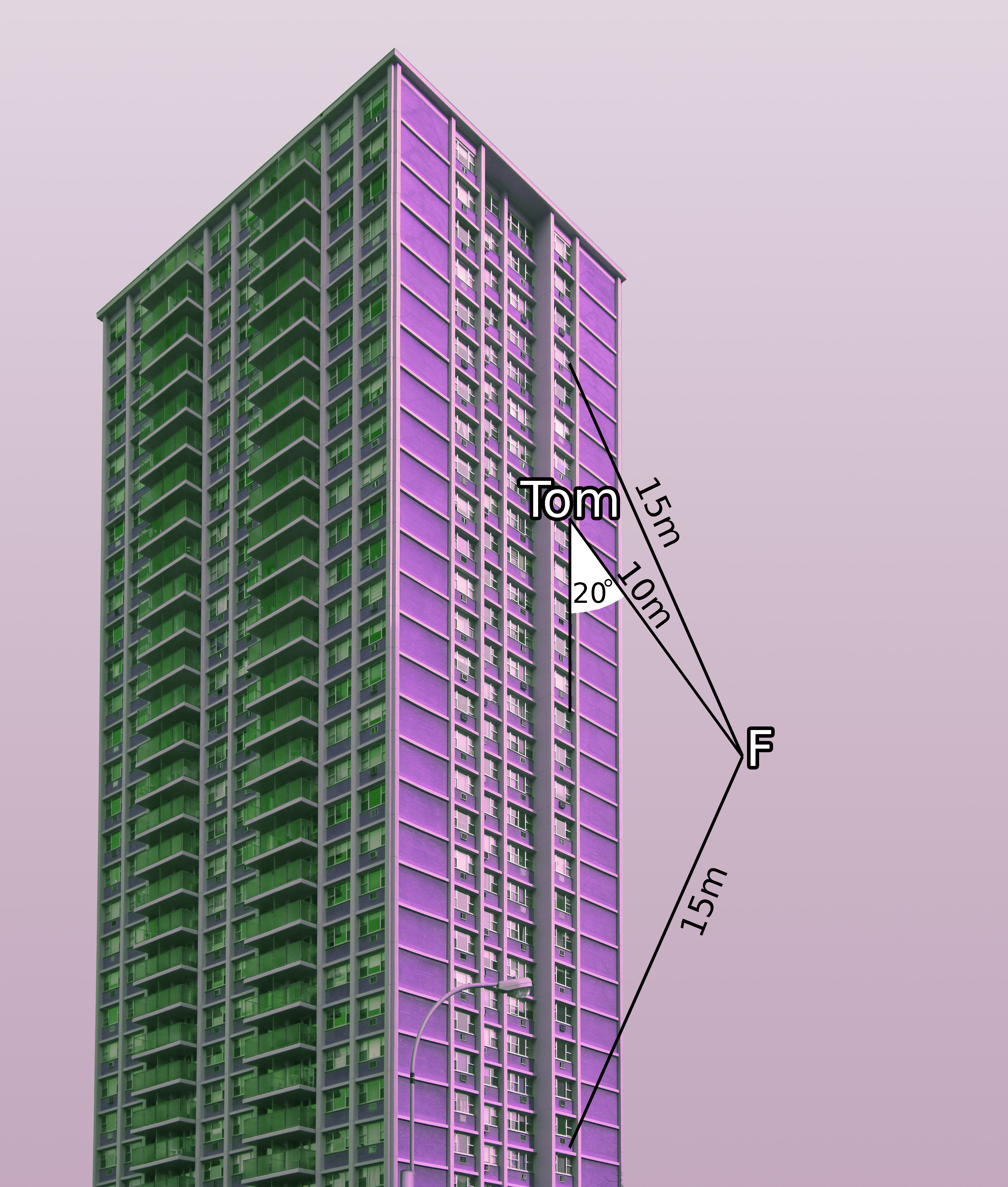
Above Triangle

To start, we can find angle since we can see that
We can use Sine law to find angle :
Now that we know 2 of the 3 angles:
Lastly, we can find the vertical distance using the Sine law again:
Below Triangle
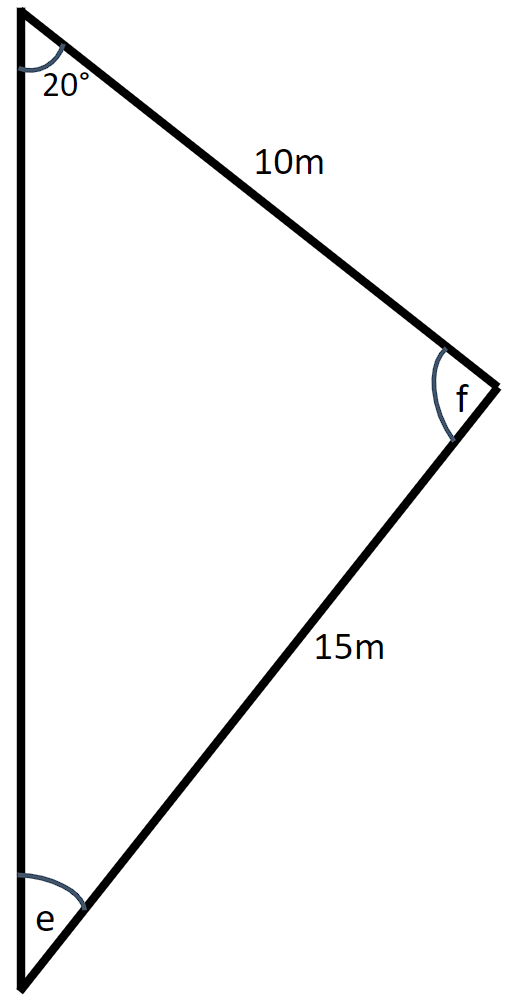
We can use Sine law to find angle :
Notice that this is the same as angle found above!
Now that we know 2 of the 3 angles:
Lastly, we can find the vertical distance using the Sine law again:
Practice: Sine Law - The Ambiguous Case
Alice and Bob are looking up at the CN Tower in Toronto. Alice is 600m from the tip of the tower, and Bob is 700m from the tip, and together they form a straight line through the CN Tower.
If the angle of elevation from Bob's perspective is , how far apart are Alice and Bob?