
The Cosine Law
When we are given a non-right angle triangle, the side lengths and interior angles are related using the Cosine Law:
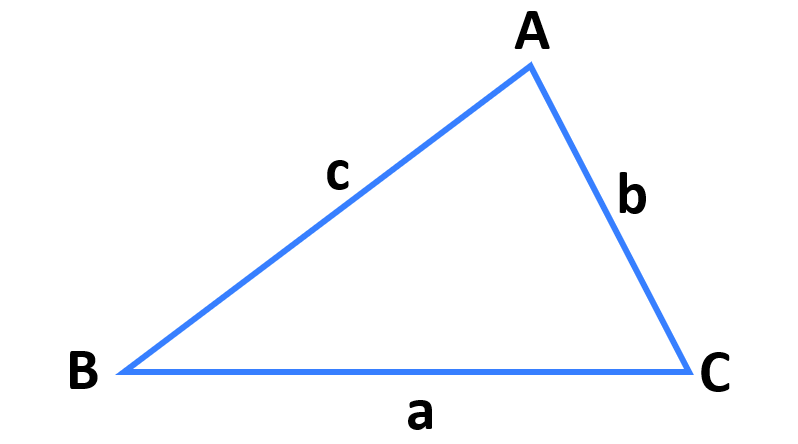
c2=a2+b2−2abcosC or cosC=2aba2+b2−c2
*Note:
The cosine law actually works for right-angle triangles as well, but if you have a right-angle triangle, it's easier to use SOH CAH TOA.
Practice: Simplifying Expressions
Solve for x in the following equations.
a) x2=a2+b2−2abcosC, where a=3, b=4, and ∠C=60°
b) cosx=2aba2+b2−c2, where a=3, b=4, and c=2

Example: Cosine Law
Solve for z in the following triangle.

Since we know two of the side lengths and the contained angle, we can use the Cosine Law.
z2z2z2z2z2z2zz===≈≈≈≈≈x2+y2−2xycos∠Z72+62−2(7)(6)cos50°49+36−84cos50°85−84(0.6428)85−54.0031315.57
So, z≈5.57.

Example: Cosine Law
Solve for ∠Z in the following triangle.

Since we have all 3 sides, we can use the cosine law to find a missing angle.
cos∠Zcos∠Zcos∠Zcos∠Z∠Z∠Z=====≈2xyx2+y2−z22(9)(8)92+82−5214481+64−25144120cos−1(144120)33.56°
Practice: Cosine Law
Solve the following triangle. (find all missing sides lengths and angles)

Practice: Cosine Law
△PQR has angle ∠Q=60°, QP=10, and QR=7. Solve the triangle (find all missing angles and side lengths)