0:00 / 0:00

Investigating Integer Exponents

In the past, we've used exponents to represent repeated multiplication:

bx\Large {\colorTwo{b}^{\colorThree{x}}} means b\Large{\colorTwo{b}} times itself x\large{\colorThree{x}} times

What does it mean when our exponent xx is 0? What if it's a negative integer?

Investigate Integer Exponents
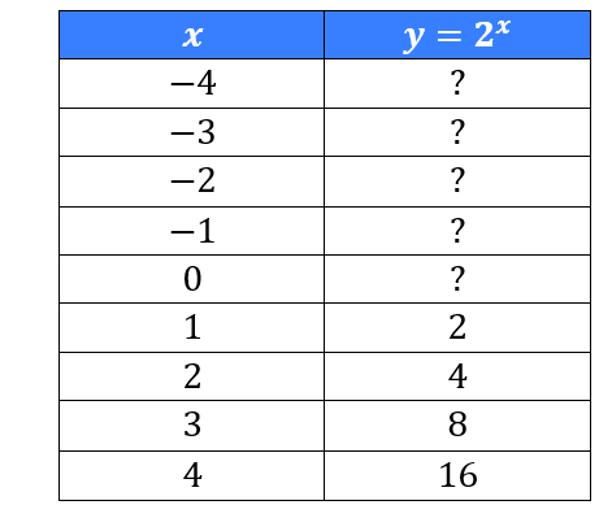

  • What's happening to the y-value as x increases from 1 to 2, from 2 to 3, etc.?
    It is doubling!
  • What's happening to the y-value as x decreases from 3 to 2, from 2 to 1, etc.?
    It is halfing!

According to this pattern:
  • The value of 20=2^0=
    1
  • The value of 21=2^{-1}=
    1/2
  • The value of 22=2^{-2}=
    1/4
  • The value of 23=2^{-3}=
    1/8
  • The value of 24=2^{-4}=
    1/16

Wize Tip
In general, what is the rule for b0b^0 and bnb^{-n}?
  • b0=1\large\boxed{b^0=1}
  • bn=1bn\large\boxed{b^{-n}=\dfrac{1}{b^n}}

PAGE BREAK

Another way to Understand b0\bco{b^0} and bn\bco{b^{-n}}

  • Observe that b0=bnn=bnbn=1\large b^0=b^{n-n}=\dfrac{b^n}{b^n}=1 So, we can confirm that b0=1\large b^0=1
  • Observe that bn=b0n=b0bn=1bn\large b^{-n}=b^{0-n}=\dfrac{b^0}{b^n}=\dfrac{1}{b^n} So, we can confirm that bn=1bnb^{-n}=\dfrac{1}{b^n}
0:00 / 0:00

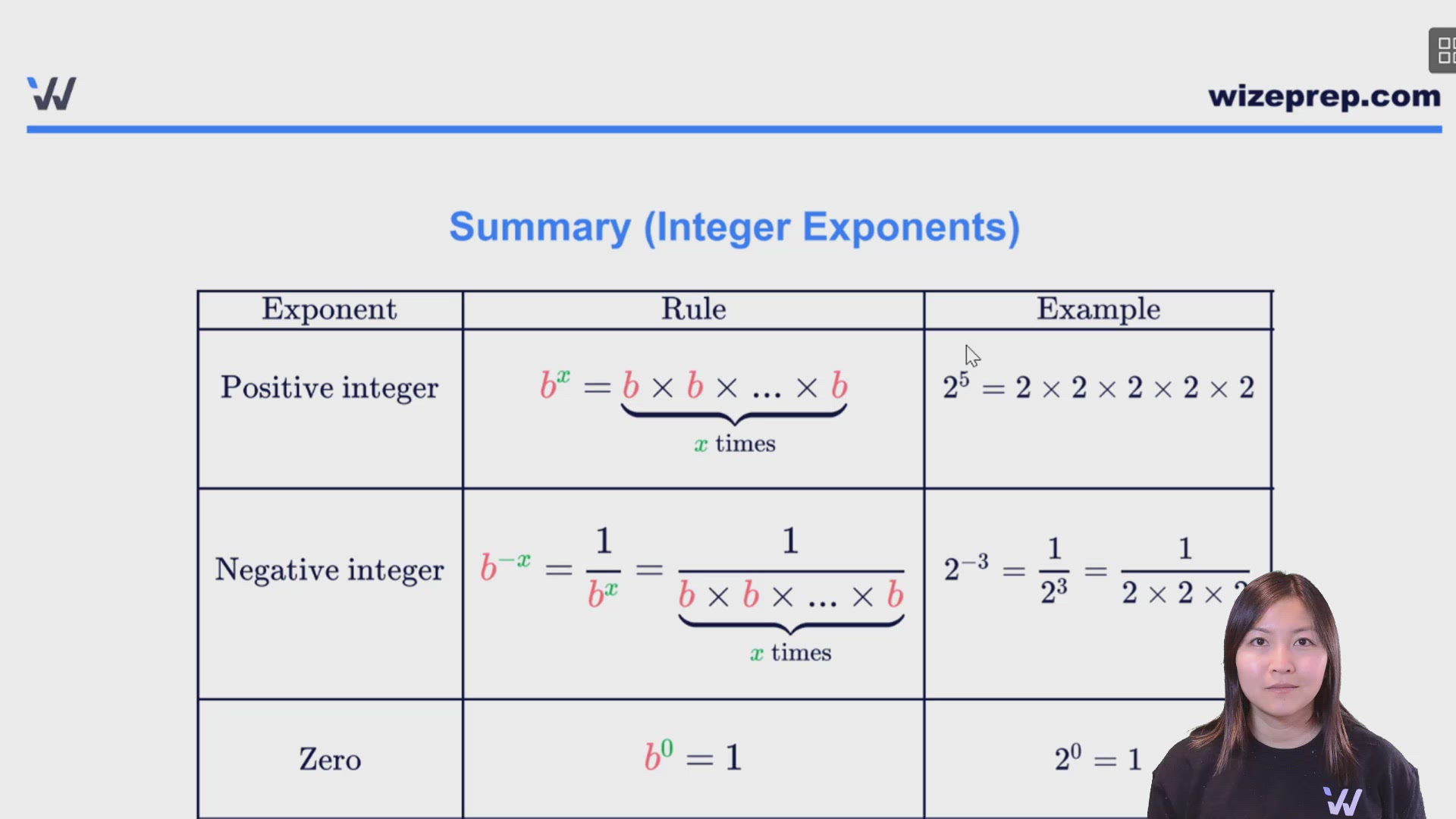
Summary (Integer Exponents)

ExponentRuleExamplePositive integerbx=b×b×...×bx times25=2×2×2×2×2Negative integerbx=1bx=1b×b×...×bx times23=123=12×2×2Zerob0=120=1\begin{array}{|c|c|c|} \hline \text{Exponent}&\text{Rule}&\text{Example}\\ \hline\\ \text{Positive integer}& \large{\colorTwo b^{\colorThree x}}=\underbrace{\colorTwo b\times \colorTwo b\times...\times \colorTwo b}_{\colorThree x~\text{times}}& 2^5=2\times2\times2\times2\times2\\\\ \hline\\ \text{Negative integer}& \large{\colorTwo b^{\colorThree {-x}}}=\dfrac{1}{\colorTwo b^{\colorThree x}}=\dfrac{1}{\underbrace{\colorTwo b\times \colorTwo b\times...\times \colorTwo b}_{\colorThree x~\text{times}}}& 2^{-3}=\dfrac{1}{2^3}=\dfrac{1}{2\times2\times2}\\\\ \hline\\ \text{Zero}& \large{\colorTwo b^{\colorThree 0}}=1& 2^0=1\\\\ \hline \end{array}

Practice: Zero Exponents

Evaluate the following powers.

a) 505^0

b) (5)0\left(-5\right)^0

c) (15)0\left(\dfrac{1}{5}\right)^0

Practice: Negative Exponents

Rewrite the following powers without negative exponents, your final answer should be in rational form (your answer should be a fraction)

a) 343^{-4}

b) 232^{-3}

c) (23)4\left(\dfrac{2}{3}\right)^{-4}

d) (2)3\left(-2\right)^{-3}

Practice: Negative Exponents

What value(s) of nn will make each of the following equations true?

a) 3n=273^n=27

b) 2n=1162^n=\dfrac{1}{16}

c) (4)n=164(-4)^n=-\dfrac{1}{64}