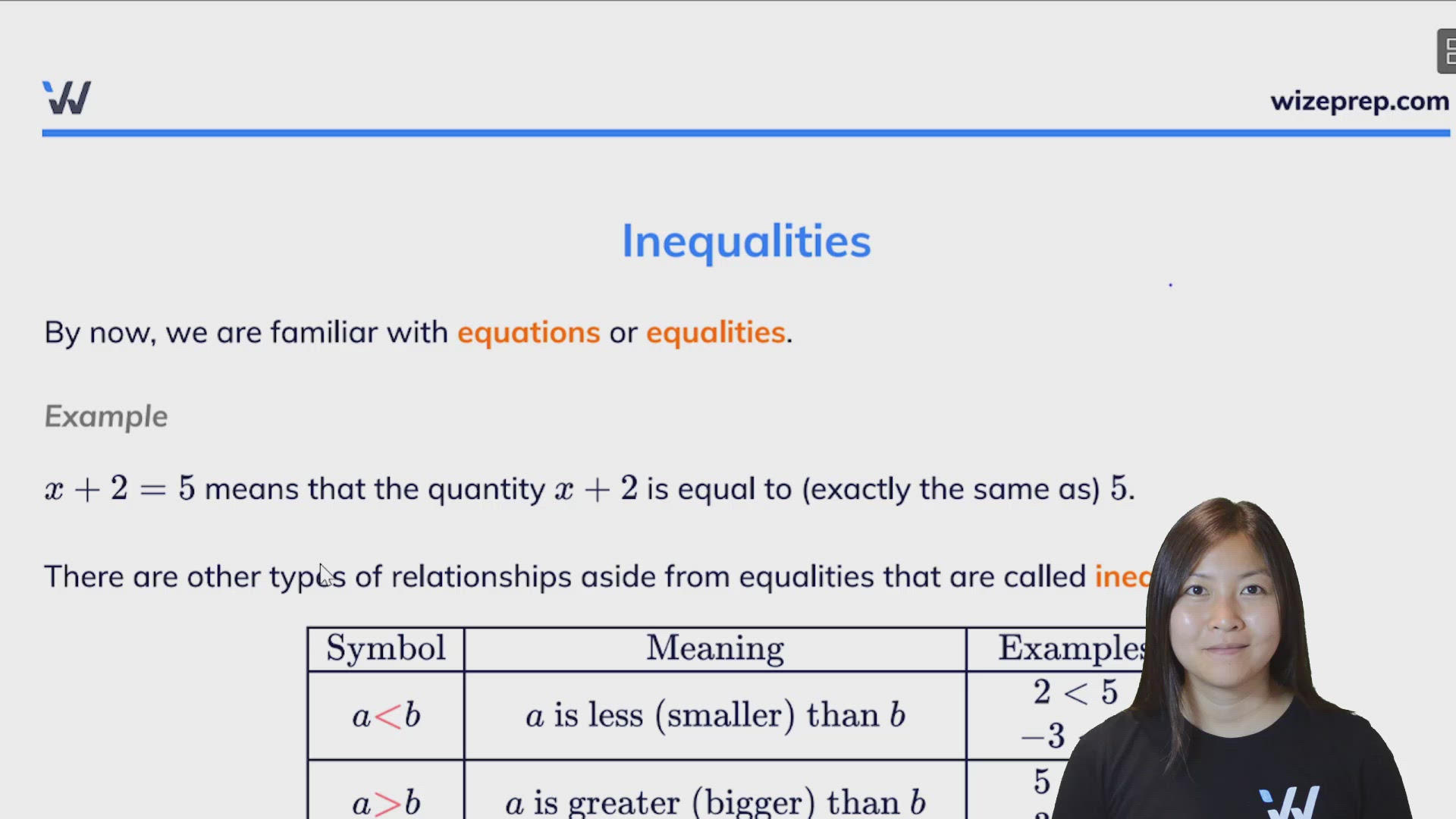
Inequalities
By now, we are familiar with equations or equalities.
Example
means that the quantity is equal to (exactly the same as) .
There are other types of relationships aside from equalities that are called inequalities:
Reading an Inequalities
How can you read the inequalities ?
- "x is greater than or equal to 3" OR
- "3 is less than or equal to x"
Representing (Expressing) Inequalities
There are three ways to express an inequalities: verbally, algebraically, and graphically.
Expressing an Inequality Verbally
We can describe the solutions to an inequality with words such as "less than", "greater than", "less than or equal to", "greater than or equal to" or "not equal to".
Examples
- is less than or equal to
- is greater than 3
- is not equal to
- is greater than 5 but less than or equal to 7
Expressing an Inequality Algebraically
We can describe an inequality algebraically by using inequality symbols
Examples
- ( is less than or equal to )
- ( is greater than 3)
- ( is not equal to )
- ( is greater than 5 but less than or equal to 7)
Expressing an Inequality Graphically
We can describe the solutions to an inequality graphically by using a number line and following these rules
1. Highlight values on the number line that the variable can take on
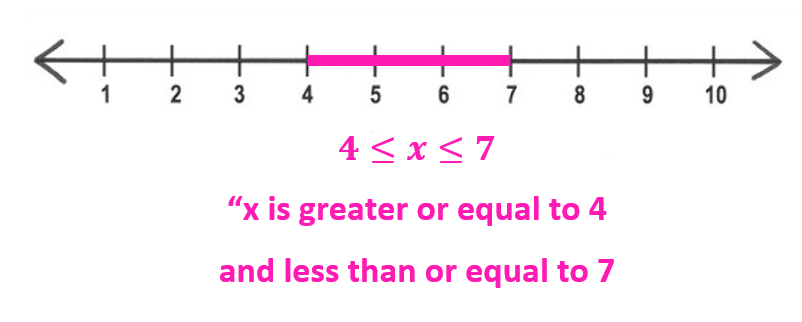
2. Use arrows to show that a value goes on forever in one direction
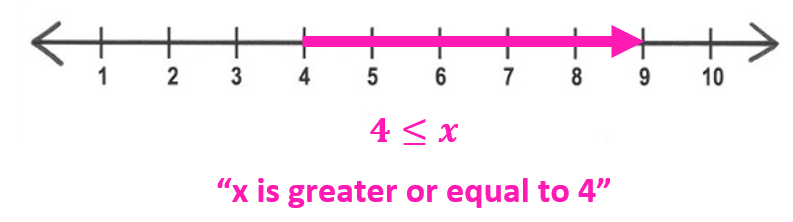
3. Use an open cicle to represent not including the particular value and a closed circle to represent including the particular value
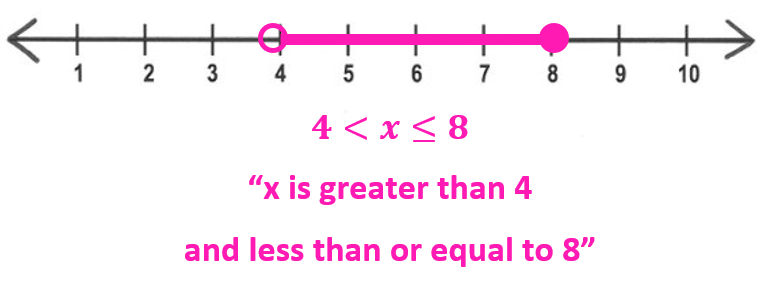
A boundary point is the point that separates the values less than from the values greater than a specified value
- If it's included in the solution to the inequality, we show it using a closed circle
- If it's not included in the solution to the inequality, we show it using an open circle