Activity: Surface Area and Volume of Prisms

a) Draw all the possible square-based prisms with a surface area of 54 m2 that have integer dimensions.

We want square-based prisms with integer dimensions:
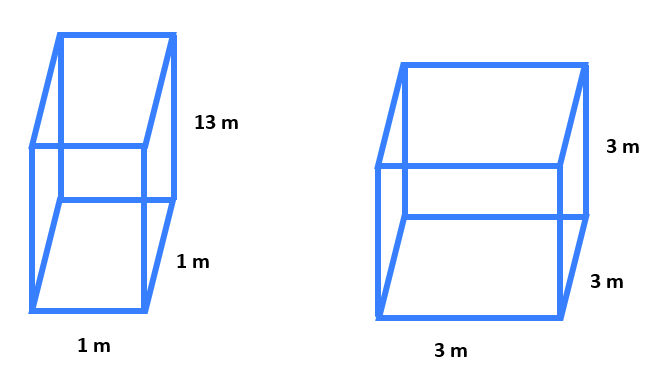
Length of square baseArea of baseArea of side faceHeight of prism1m1×1=1m2(5411)÷4=13m213÷1=13m2m2×2=4m2(5444)÷4=11.5m211.5÷2=5.75mNot integer dimensions!3m3×3=9m2(5499)÷4=9m29÷3=3m4m4×4=16m2(541616)÷4=5.5m25.5÷4=1.375mNot integer dimensions!5m5×4=25m2(542525)÷4=1m21÷4=0.25mNot integer dimensions!\begin{array}{|c|c|c|c|} \hline \text{Length of square base}&\text{Area of base}&\text{Area of side face}&\text{Height of prism}\\ \hline \colorTwo{1m}&1\times1=1m^2&(54-1-1)\div4=13m^2&\begin{array}{l}13\div1=\colorTwo{13m}\end{array}\\ \hline 2m&2\times2=4m^2&(54-4-4)\div4=11.5m^2&\begin{array}{l}11.5\div2=5.75m\\\text{Not integer dimensions!}\end{array}\\ \hline \colorTwo{3m}&3\times3=9m^2&(54-9-9)\div4=9m^2&\begin{array}{l}9\div3=\colorTwo{3m}\end{array}\\ \hline 4m&4\times4=16m^2&(54-16-16)\div4=5.5m^2&\begin{array}{l}5.5\div4=1.375m\\\text{Not integer dimensions!}\end{array}\\ \hline 5m&5\times4=25m^2&(54-25-25)\div4=1m^2&\begin{array}{l}1\div4=0.25m\\\text{Not integer dimensions!}\end{array}\\ \hline \end{array}


b) Which square-based prism has the largest volume?

The largest volume is when the square-based prism is a cube. It has a volume of 3×3×3=27m33\times3\times3=27m^3

c) If you were to guess, what is the largest volume of a square-based prism with a surface area of 96m2?

This should happen when the square-based prism is a cube, meaning that all of the face areas are the same:
96÷6=16m296\div 6=16m^2, so each face should have an area of 16m216m^2, meaning that the dimensions of this cube are 4m×4m×4m4m\times4m\times4m.

So, the volume is 4×4×4=64m34\times4\times4=64m^3

Activity: Surface Area and Volume of Cylinders

a) Draw all the possible square-based prisms with a volume of 64 m2 that has integer dimensions.

Base side lengthBase areaHeight of prismSurface area1m1×1=1m264÷1=64m1+1+4(64×1)=258m22m2×2=4m264÷4=16m4+4+4(16×2)=392m23m3×3=9m264÷97.11mNot an integer value!4m4×4=16m264÷16=4m16+16+4(4×4)=96m25m5×5=25m264÷25=2.56mNot an integer value!6m6×6=36m264÷361.78mNot an integer value!7m7×7=49m264÷491.31mNot an integer value!8m8×8=64m264÷64=1m64+64+4(1×8)=160m2\begin{array}{|c|c|c|c|} \hline \text{Base side length}&\text{Base area}&\text{Height of prism}&\text{Surface area}\\ \hline \colorTwo{1m}&1\times1=1m^2&64\div1=\colorTwo{64m}&1+1+4(64\times1)=258m^2\\\\ \hline \colorTwo{2m}&2\times2=4m^2&64\div4=\colorTwo{16m}&4+4+4(16\times2)=392m^2\\\\ \hline 3m&3\times3=9m^2&\begin{array}{l}64\div9\approx7.11m\\\text{Not an integer value!}\end{array}\\\\ \hline \colorTwo{4m}&4\times4=16m^2&64\div16=\colorTwo{4m}&16+16+4(4\times4)=96m^2\\\\ \hline 5m&5\times5=25m^2&\begin{array}{l}64\div25=2.56m\\\text{Not an integer value!}\end{array}\\\\ \hline 6m&6\times6=36m^2&\begin{array}{l}64\div36\approx1.78m\\\text{Not an integer value!}\end{array}\\\\ \hline 7m&7\times7=49m^2&\begin{array}{l}64\div49\approx1.31m\\\text{Not an integer value!}\end{array}\\\\ \hline \colorTwo{8m}&8\times8=64m^2&64\div64=\colorTwo{1m}&64+64+4(1\times8)=160m^2\\\\ \hline \end{array}

b) Which square-based prism has the smallest surface area?

The smallest surface area corresponds to a cube with side lengths 4m, which has a surface area of 96m2.

c) If you were to guess, what is the smallest surface area of a square-based prism with a volume of 125 m3?

This would happen when we have a cube! The volume of a cube is V=x3V=x^3, where xx is the side length of the cube.

We can now calculate the side length: 125=x31253=x35=x\begin{array}{rcl} 125&=&x^3\\ \sqrt[3]{125}&=&\sqrt[3]{x}\\ 5&=&x \end{array}, so the side length of this cube is 5m.

The surface area will be 6(5×5)=150m26(5\times5)=150m^2.

Optimal Surface Area and Volume of Prisms & Cylinders

Fixed Surface Area

  • If the surface area of a square-base prism is fixed, then the figure with the largest volume is a
    cube

  • If the surface area of a cylinder is fixed, then the figure with the largest volume is the cylinder with
    equal diameter and height

Fixed Volume

  • If the volume of a square-base prism is fixed, then the figure with the smallest surface area is a
    cube

  • If the volume of a cylinder is fixed, then the figure with the smallest surface aree is the cylinder with
    equal diameter and height