Wize High School Grade 9 Math Textbook > Rational Numbers
Roots & Radicals
Popular Courses
DAT
General Course
Grade 9 Math
Canada High School
Grade 9 Math (De-streamed)
Ontario High School
Math 9
Alberta High School
QMS 110
Toronto Metropolitan University
Mathematics 9
British Columbia High School
MA102
Wilfrid Laurier University
MATH-1980
University of Windsor
MTH 116
Michigan State University
MATH 0098
Baton Rouge Community College
0:00 / 0:00
Roots & Radicals
Square Roots
If you take your calculator and enter the square root symbol and then , you get , think about what this means.
Since , it seems like the square root of () gives a number such that the number times itself is .
Example 1
➡ we are trying to find a number such that this number times itself is 25.
So,
5
Example 2
➡ we are trying to find a number such that this number times itself is 49.
So,
7
Cube Roots
If you take your calculator and enter the cube root symbol and then , you get , but what does this mean?
Since , it seems like the cube root of () gives a number such that the number times itself 3 times is 8.
Example 3
➡ we are trying to find a number such that this number times itself 3 times is 27.
So,
3
Example 4
➡ we are trying to find a number such that this number times itself 3 times is 64.
So,
4
General Roots & Radicals
In general the nth root of a number (written as ) gives us a number, such that this number times itself n times is the original number underneath the root.
In math, "roots" are sometimes called "radicals".

0:00 / 0:00
Square Roots of Perfect Squares
Perfect squares are products of a number multiplied by itself.
The square root of a perfect square is a whole number.
Square Roots of Fractions
To find calculate the square root of a fraction, we need to calculate the square root of the numerator and the denominator separately.
Examples
Determine which of the following are perfect square fractions, then find the square roots of those fractions.
a)
The 1 in the numerator and the 4 in the denominator are both perfect squares. So this fraction is a perfect square.
b)
The 49 in the numerator and the 64 in the denominator are both perfect squares. So this fraction is a perfect square.
c)
Even though the 16 in the denominator is a perfect square, the 15 in the numerator is not. So this fraction is NOT a perfect square.
d)
Let's first simplify this fraction by dividing the numerator and denominator by 3:
Now, the 4 in the numerator and the 81 in the denominator are both perfect squares. So this fraction is a perfect square.
Practice: Square Roots of Perfect Squares
Given the following fractions, answer the questions.
A)
B)
C)
D)
E)
F)
Select all of the perfect squares.
0:00 / 0:00
Example: Estimating Non-Perfect Squares
Estimate the value of the following square roots.
a)
Wize Tip
To estimate the square root of a non-perfect square, find the closest perfect square that is smaller and the closest perfect square that is bigger than your number.
Here's what we know:
- 49 is the closest perfect square that is smaller than 60.
- 64 is the closest perfect square that is bigger than 60.
Since 60 is closer to 64, we know that is closer to 8, probably around 7.8
b)
Here's what we know:
- 9 is the closest perfect square that is smaller than 10.
- 16 is the closest perfect square that is bigger than 10.
Since 10 is closer to 9, we know that is closer to 3, probably around 3.1
c)
Wize Tip
To estimate the square root of a fraction that is not a perfect square, find the closest perfect square for the numerator and the denominator.
Here's what we know:
- 4 is the closest perfect square to 3.
- 16 is the closest perfect square to 17.
Since , we know that .
Practice: Estimating Non-Perfect Squares
State the closest whole number that is smaller , and the closest whole number that is bigger .
Practice: Estimating Non-Perfect Squares
State the closest whole number that is smaller than , and the closest whole number that is bigger than .
Practice: Estimating Non-Perfect Squares
State the closest whole number that is smaller than , and the closest whole number that is bigger than .
Practice: Square Roots
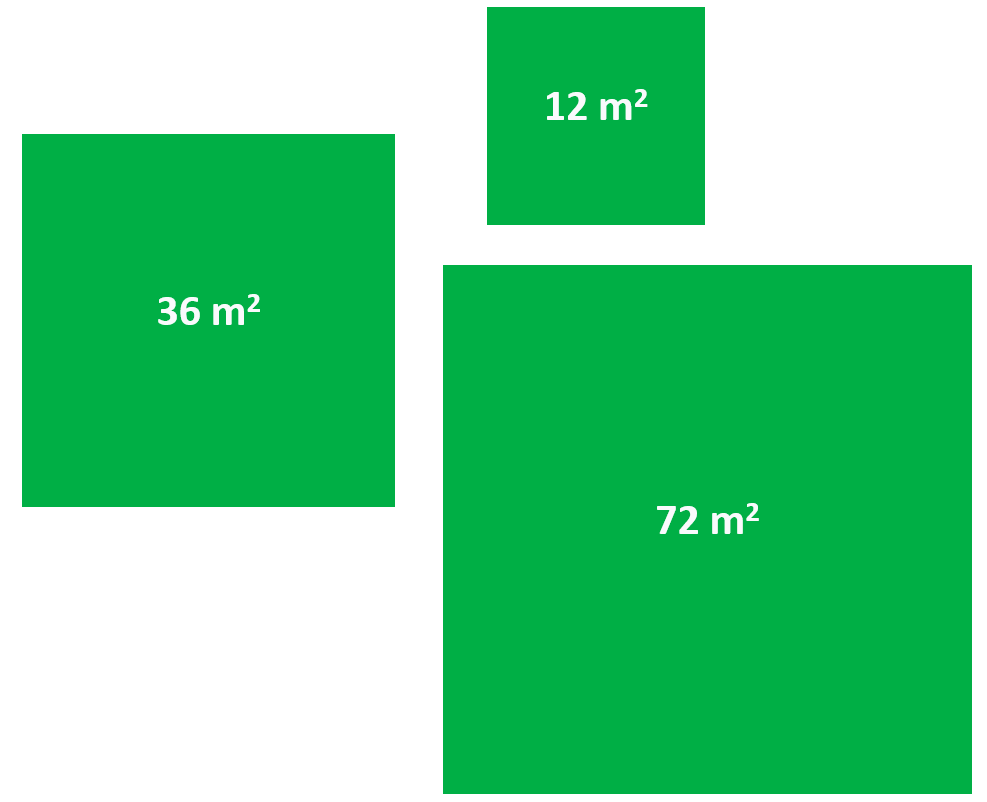
Linda has three grass fields as shown in the picture below. Approximately how many meters of fencing does she need to put up fences around each of her fields?