Wize High School Grade 10 Math Textbook > Analytic Geometry
Pythagorean Therom (Review)
Popular Courses
Grade 10 Math
Canada High School
Grade 9 Math
Canada High School
DAT
General Course
DAT
General Course
Grade 10 Principles of Mathematics
Ontario High School
MATH 206
Concordia University
Grade 9 Math (De-streamed)
Ontario High School
MATH 157
Simon Fraser University
MATH 1314
Tarrant County College District
MATH 1302
University of Texas at Arlington

0:00 / 0:00
Pythagorean Theorem
The side lengths of a right angle triangle have a very special relationship.
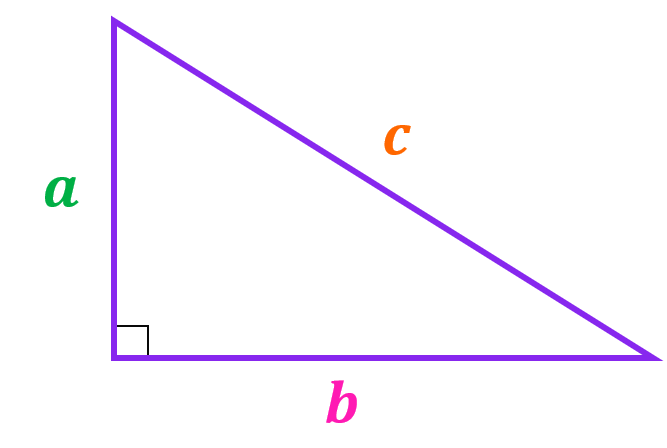
Wize Tip
- is the hypotenuse, which is the longest side in a right angle triangle across from the right angle.
- It does NOT matter which of the other 2 sides you use as or .
We can rearrange this formula to solve for any of the sides:
0:00 / 0:00
Example: Pythagorean Theorem
Determine the missing lengths in each of the following triangles.
a)
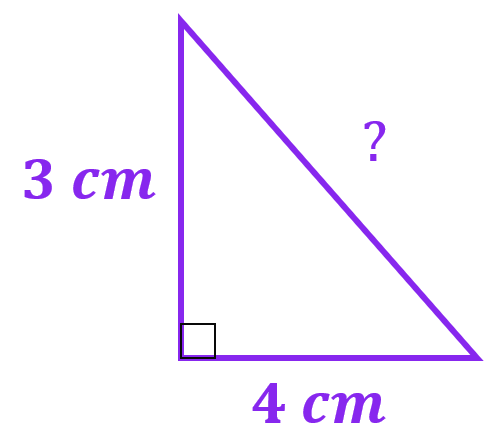
The missing side is the hypotenuse:
Using the Pythagorean Theorem:
This is a special 3-4-5 triangle.
b)
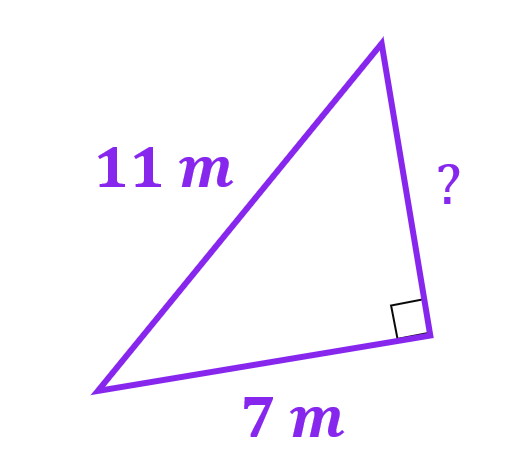
The hypotenuse has length 11m:
Using the Pythagorean Theorem:
Practice: Pythagorean Theorem
Calculate the missing side lengths.
a)
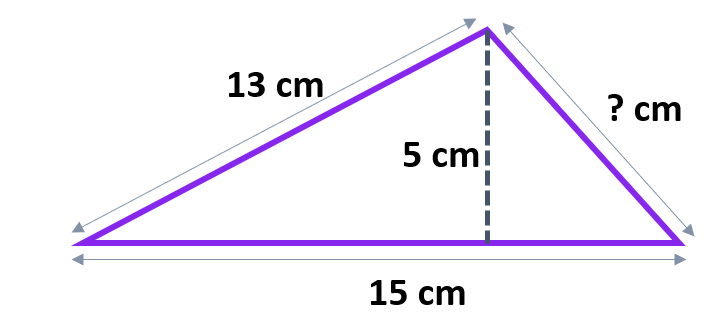
b)