Wize High School Grade 10 Math Textbook > Quadratic Relations
Quadratic vs Exponential Graphs

0:00 / 0:00
Review: Exponent Rules (Laws of Exponents)
- Multiplying powers with the same base:
- Dividing powers with the same base:
- Power of powers:
- Powers of products:
- Powers of quotients:
0:00 / 0:00
Quadratic VS Exponential Graphs
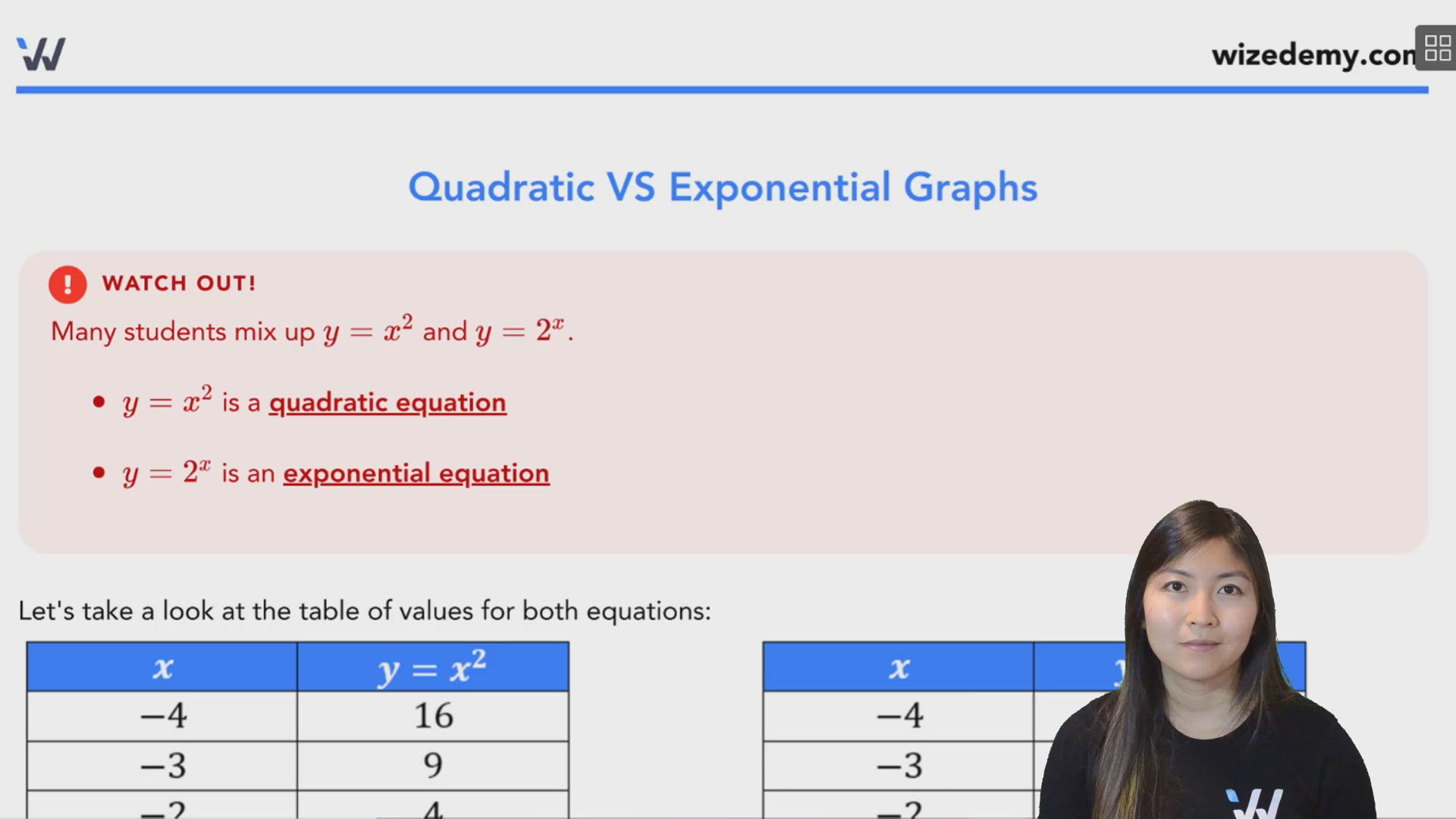
Watch Out!
Many students mix up and .
- is a quadratic equation
- is an exponential equation
Let's take a look at the table of values for both equations:
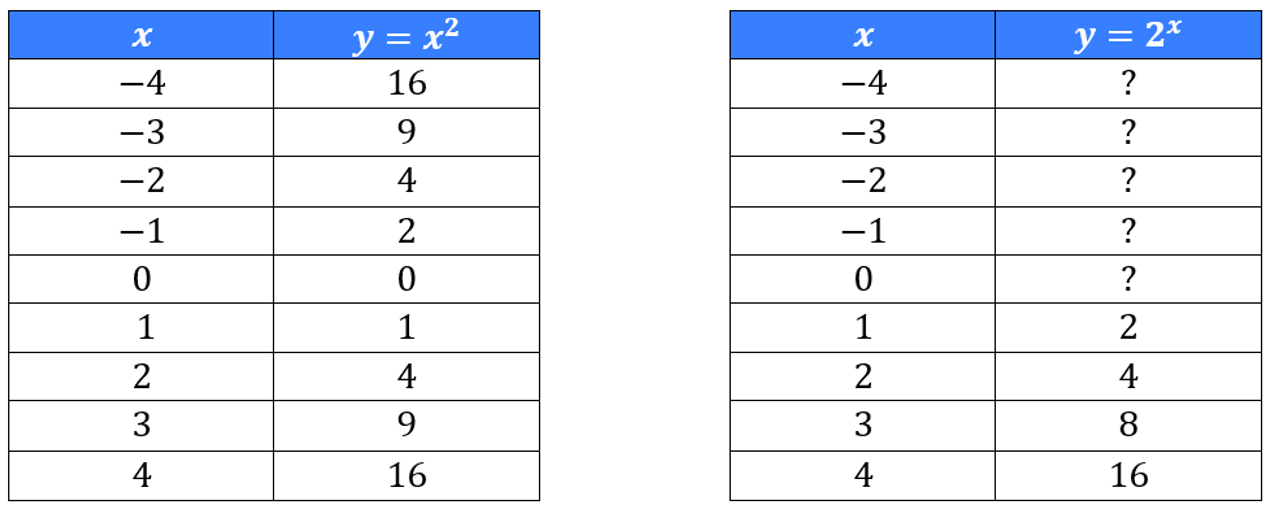
But what about ? ? ? or ?
Let's take a look at the pattern in the table of values for .
- What's happening to the y-value as x increases from 1 to 2, from 2 to 3, etc.?It is doubling!
- What's happening to the y-value as x decreases from 3 to 2, from 2 to 1, etc.?It is halfing!
According to this pattern:
- The value of1
- The value of1/2
- The value of1/4
- The value of1/8
- The value of1/16
Wize Tip
In general, what is the rule for and ?
Another way to Understand and
- Observe that , so we can confirm that
- Observe that , so we can confirm that
Comparing Quadratic VS Exponential Graphs
Here are the table of values for the quadratic and exponential equations:

Here are the graphs for the two equations:
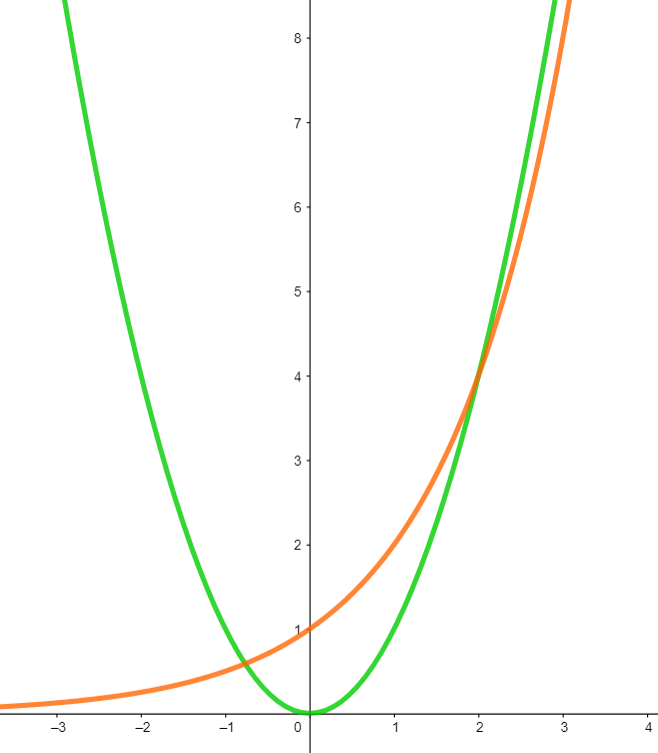
- The graph is symmetric along the axis of symmetry; the graph is not symmetric
- The graph decreases and then increases; the graph is always increasing
- The graph has an x-intercept at ; the graph does not have any x-intercepts
- The graph has a y-intercept at ; the graph has a y-intercept at
Practice: Zero Exponents
Evaluate the following powers.
a)
b)
c)
Practice: Negative Exponents
Rewrite the following powers without negative exponents, your final answer should be in rational form (your answer should be a fraction)
a)
b)
c)
d)
Practice: Negative Exponents
What value(s) of will make each of the following equations true?
a)
b)
c)