Wize High School Grade 10 Math Textbook > Vertex Form of a Quadratic Equation
Determining the Quadratic Equation in Vertex Form

0:00 / 0:00
Example: Deterining the Equation of a Quadratic Graph
Determine the equation of the following graph in vertex form
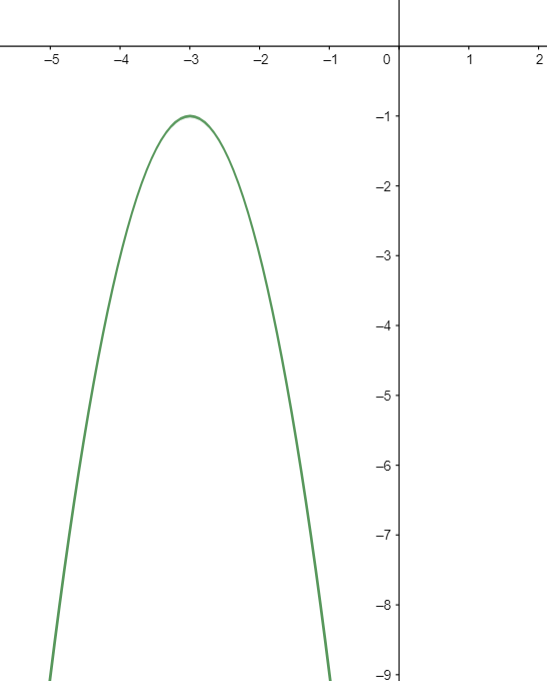
- The vertex is , so
- The parabola opens down, so is negative
- It appears that there is a vertical stretch. From the vertex , we have to "walk" 1 unit to the right, and 2 units down to get to another point on the graph. So,
So, the equation of the graph is
Practice: Determining the Equation of a Quadratic Graph
Determine the equation of the graph that is obtained by applying the following transformations to the graph .
i) A horizontal shift units to the left.
ii) A vertical compression by a factor of .
iii) A vertical reflection along the x-axis.
iv) A vertical shift units down.
Practice: Determining the Equation of a Quadratic Graph
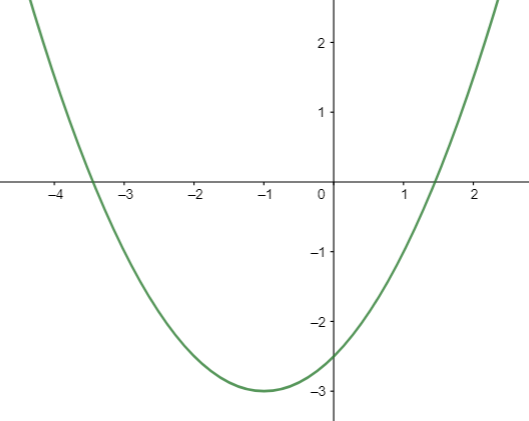
Write the equation of the following graph.
Practice: Determining the Equation of a Quadratic Graph
Express in vertex form
Practice: Determining the Equation of a Quadratic Graph
What is the equation of the graph that has a vertex at and has a y-intercept at .