0:00 / 0:00

The Sine Law

Watch Out!
If you are given a non-right angle triangle, we cannot use SOH CAH TOA to solve for missing side lengths and angles

When we are given a non-right angle triangle, the side lengths and interior angles are related using the Sine Law:
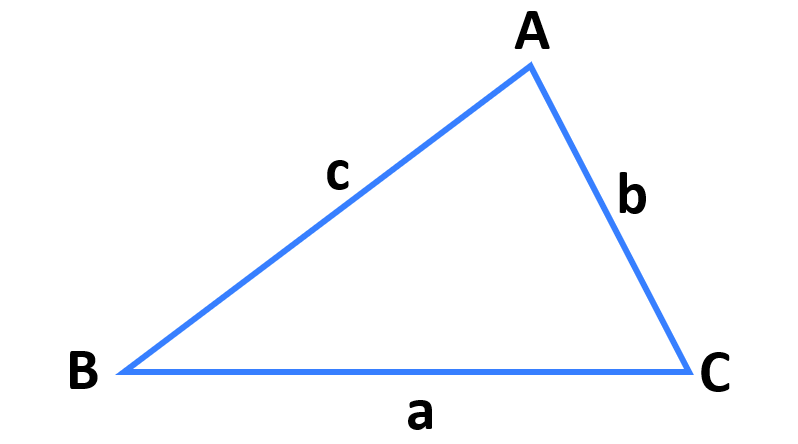

sinAa=sinBb=sinCc  or  asinA=bsinB=csinC\Large\boxed{\dfrac{\sin A}{a}=\dfrac{\sin B}{b}=\dfrac{\sin C}{c}}~~\text{or}~~\Large\boxed{\dfrac{a}{\sin A}=\dfrac{b}{\sin B}=\dfrac{c}{\sin C}}

Wize Tip
  • We want to use the Sine Law when we know the values of an angle and its opposite side
  • Whatever you are trying to solve for should be in the numerator:
  • If you are solving for a missing angle, use sinAa=sinBb=sinCc\dfrac{\sin A}{a}=\dfrac{\sin B}{b}=\dfrac{\sin C}{c}
  • If you are solving for a missing side, use asinA=bsinB=csinC\dfrac{a}{\sin A}=\dfrac{b}{\sin B}=\dfrac{c}{\sin C}
*You can technically use either version of the Sine Law to solve the problem, but picking the correct version will make the calculations simpler.

*Note:
The sine law actually works for right-angle triangles as well, but if you have a right-angle triangle, it's easier to use SOH CAH TOA.

Practice: Sine Law

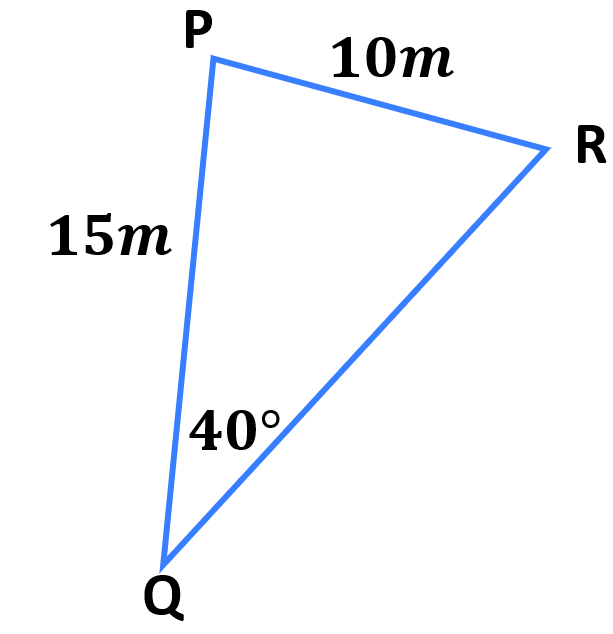
Consider the triangle below:
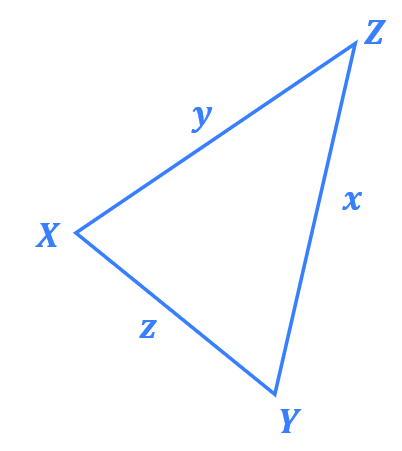
Select ALL of the statements that are true.

Practice: Solving for a Missing Side

Solve for xx in the following equations.

a) 6sin30°=xsin20°\dfrac{6}{\sin 30\degree}=\dfrac{x}{\sin 20\degree}

b) sin30°5=sin60°x\dfrac{\sin 30\degree}{5}=\dfrac{\sin 60\degree}{x}

Practice: Solving for a Missing Angle

Solve for θ\theta in the following equations.

a) sin30°5=sinθ4\dfrac{\sin 30\degree}{5}=\dfrac{\sin \theta }{4}

b) 6sin30°=7sinθ\dfrac{6}{\sin 30\degree}=\dfrac{7}{\sin \theta}
0:00 / 0:00

Example: Sine Law - Solving for a Missing Angle

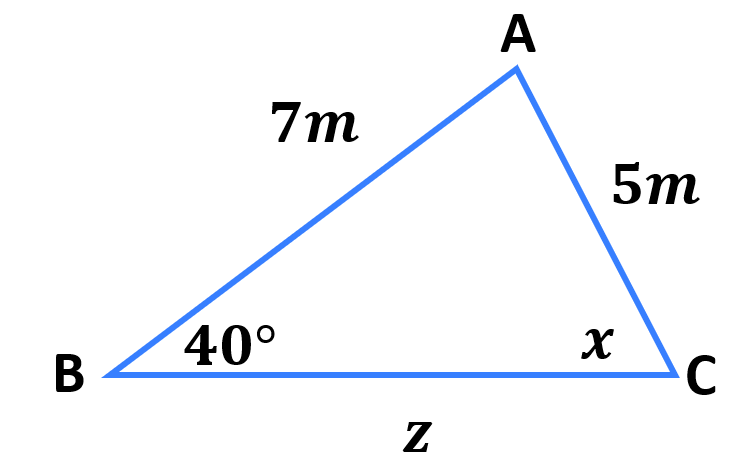
Solve for xx in the following triangle.
Since we know B\angle B and bb, we can use the Sine Law.

Finding x\bco x

Since xx is a missing angle, let's use
sinAa=sinBb=sinCcsinAz=sin40°5=sinx7\begin{array}{ccccc} \dfrac{\sin A}{a}=\dfrac{\sin B}{b}=\dfrac{\sin C}{c}\\\\ \dfrac{\sin A}{z}=\dfrac{\sin 40\degree}{5}=\dfrac{\sin x}{7} \end{array}

We want to find xx, so let's only focus on the last 2 fractions:
sin40°5=sinx7sin40°5×7=sinx7×7sin40°5×7=sinx0.8999sinxsin1(0.8999)x64.14xx64.14\begin{array}{ccc} \dfrac{\sin 40\degree}{5}&=&\dfrac{\sin x}{7}\\\\ \dfrac{\sin 40\degree}{5}\colorTwo{\times 7}&=&\dfrac{\sin x}{7}\colorTwo{\times 7}\\\\ \dfrac{\sin 40\degree}{5}\times 7&=&\sin x\\\\ 0.8999&\approx&\sin x\\\\ \sin^{-1}(0.8999)&\approx&x\\\\ 64.14&\approx&x\\\\ x&\approx&64.14 \end{array}
So, x64.14°\boxed{x\approx 64.14\degree}.


Alternative method

We could have also used asinA=bsinB=csinC\dfrac{a}{\sin A}=\dfrac{b}{\sin B}=\dfrac{c}{\sin C} instead, but the calculations would be a bit messier.
asinA=bsinB=csinCzsinA=5sin40°=7sinx\begin{array}{ccccc} \dfrac{a}{\sin A}&=&\dfrac{b}{\sin B}&=&\dfrac{c}{\sin C}\\\\ \dfrac{z}{\sin A}&=&\dfrac{5}{\sin 40\degree}&=&\dfrac{7}{\sin x}\\\\ \end{array}
Let's focus on the last 2 fractions:
5sin40°=7sinx5sin40°×sinx=7sinx×sinx5sin40°×sinx=75sin40°×sinx5sin40°=75sin40°sinx=7×sin40°5sinx7×0.64285sinx0.8999xsin1(0.8999)x64.14°\begin{array}{ccc} \dfrac{5}{\sin 40\degree}&=&\dfrac{7}{\sin x}\\\\ \dfrac{5}{\sin 40\degree}\colorTwo{\times \sin x}&=&\dfrac{7}{\sin x}\colorTwo{\times \sin x}\\\\ \dfrac{5}{\sin 40\degree}\times\sin x&=&7\\\\ \dfrac{\dfrac{5}{\sin 40\degree}\times\sin x}{\scriptsize\colorTwo{\dfrac{5}{\sin 40\degree}}}&=&\dfrac{7}{\scriptsize\colorTwo{\dfrac{5}{\sin 40\degree}}}\\\\ \sin x&=&7\times\dfrac{\sin 40\degree}{5}\\\\ \sin x&\approx&7\times\dfrac{0.6428}{5}\\\\ \sin x&\approx&0.8999\\\\ x&\approx&\sin^{-1}(0.8999)\\\\ x&\approx&64.14\degree \end{array}
0:00 / 0:00

Example: Sine Law - Solving for a Missing Side

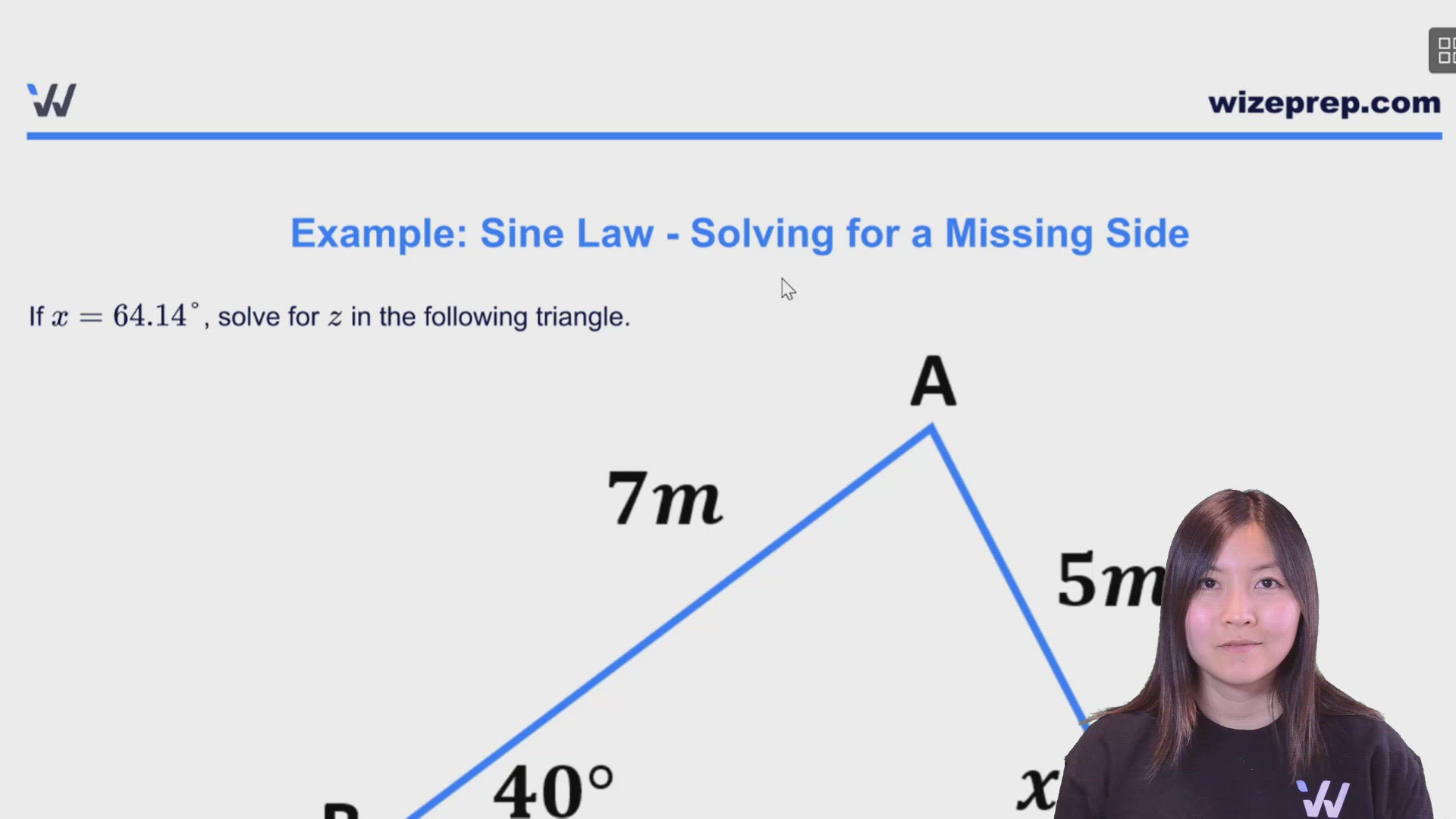
If x=64.14°x=64.14\degree, solve for zz in the following triangle.
Since we know B\angle B and bb, we can use the Sine Law.

Finding z\bco z

Since zz is a missing side, let's use
asinA=bsinB=csinCzsin(180°40°64.14°)=5sin40°=7sin64.14°\begin{array}{ccccc} \dfrac{a}{\sin A}&=&\dfrac{b}{\sin B}&=&\dfrac{c}{\sin C}\\\\ \dfrac{z}{\sin(180\degree-40\degree-64.14\degree)}&=&\dfrac{5}{\sin 40\degree}&=&\dfrac{7}{\sin 64.14\degree} \end{array}

We want to find zz, so let's only focus on the first 2 fractions:
zsin(75.86°)=5sin40°zsin(75.86°)×sin(75.85°)=5sin40°×sin(75.86°)z=5sin40°×sin(75.86°)z50.6428×0.9697z7.54\begin{array}{ccc} \dfrac{z}{\sin(75.86\degree)}&=&\dfrac{5}{\sin 40\degree}\\\\ \dfrac{z}{\sin(75.86\degree)}\colorTwo{\times\sin(75.85\degree)}&=&\dfrac{5}{\sin 40\degree}\colorTwo{\times\sin(75.86\degree)}\\\\ z&=&\dfrac{5}{\sin40\degree}\times\sin(75.86\degree)\\\\ z&\approx&\dfrac{5}{0.6428}\times0.9697\\\\ z&\approx&7.54 \end{array}
So, z7.54m\boxed{z\approx 7.54 m}

Practice: Sine Law

Solve the following triangle for all of the missing side lengths and angles.

Practice: Sine Law

Triangle ABC is an acute triangle with B=30°\angle B=30\degree, A=70°\angle A=70\degree, and side AC=5mAC=5m. Find the length of side ABAB.

Sine Law - The Ambiguous Case

Try it out!

Draw as many triangles as you can with one side that is 10 cm and another side that is 6 cm, where the angle across from the 6 cm side is 33°33\degree.


Since we are able to draw more than one triangle with these given measurements, we say that this is ambiguous.

When we use the sine law to find the missing side and angle measurements in this triangle, we will end up with 2 possibilities, this is called the ambiguous case of the sine law.
PAGE BREAK

Summary

When we are given 2 sides of a triangle (aa and bb) and one of the opposite angles (A\angle A is acute), we have the following cases: