Wize High School Grade 10 Math Textbook > Algebra - Factors & Multiples of Numbers

The Greatest Common Factor (GCF) & Least Common Multiple

Create a free account to get started

Unlock full course notes by signing up

  • Video lessons taught by top educators
  • Practice questions with guided solutions
  • Written review notes for reference
  • Expert answers anytime from course tutors

The Greatest Common Factor (GCF)

The greatest common factor of two numbers is the largest number that "goes into" both numbers.


Example

The GCF of 42 and 70 is 14, because 14 is the largest number that goes into both 42 (42÷14=342\div14=3) and 70 (70÷14=570\div14=5).


How to Find the GCF?

Method 1

List out all factors of both numbers (numbers that go into both numbers), then find the largest one -- that's the GCF.


Example

The factors of 42 are________


1×422×213×146×7\begin{array}{c} 1\times42\\ 2\times21\\ 3\times14\\ 6\times7 \end{array}


The factors of 70 are ________


1×702×355×147×10\begin{array}{c} 1\times70\\ 2\times35\\ 5\times14\\ 7\times 10 \end{array}


The largest number that both lists of factors have in common in ________, so the GCF is ________.


Method 2

Write out the prime factorization of both numbers, then write down everything that they have in common -- that's the GCF.


Example

The prime factorization of 42 is ________


Image illustrating The Greatest Common Factor (GCF)


The prime factorization of 70 is ________
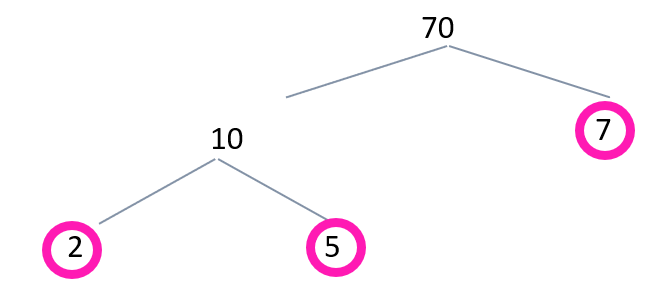

Image illustrating The Greatest Common Factor (GCF)


The two factorizations have ________ in common, so the GCF is ________

Practice: Greatest Common Factor (GCF)

Determine the GCF of the following numbers:


a) 756 and 1575

[write out the all factors for both numbers to find the GCF]


b) 3300 and 2520

[write the prime factorizations for both numbers to find the GCF]

Your answers

Create a free account to get started

Unlock full course notes by signing up

  • Video lessons taught by top educators
  • Practice questions with guided solutions
  • Written review notes for reference
  • Expert answers anytime from course tutors

The Least Common Mulitple (LCM)

The least common multiple of 2 numbers is the smallest number that is a multiple of both numbers.


Example

The LCM of 12 and 15 is 60, because 60 is the smallest number that is a multiple of both 12 (12×5=6012\times5=60) and 15 (15×4=6015\times4=60).


How to Find the LCM?

Method 1

List the first few multiples of both numbers to check for overlaps, continue until you find the LCM.

Example

Multiples of 12: ________


Multiples of 15: ________


The smallest number that appears on both lists is ________, so the LCM is ________.


Method 2

Write out the prime factorization of both numbers, then write down the greatest power of each prime in both lists.


Example

The prime factorization of 12:

12=22×312=2^2\times3


The prime factorization of 15:

15=3×515=3\times5


  • The greatest power of 2 is 222^2
  • The greatest power of 3 is 33
  • The greatest power of 5 is 55

So, the LCM of 12 and 15 is 22×3×5=602^2\times3\times5=60

Practice: Least Common Multiples (LCM)

Find the LCM of the following numbers:


a) 24 and 60

[List out the multiples of each number to find the LCM]


b) 72 and 120

[Write out the prime factorizations of each numbers to find the LCM]


Your answers

Create a free account to get started

Unlock full course notes by signing up

  • Video lessons taught by top educators
  • Practice questions with guided solutions
  • Written review notes for reference
  • Expert answers anytime from course tutors

Practice: GCF and LCM

Nimi is tiling her bathroom.


a) If she is using tiles that measure 12cm by 16cm, what is the area of the smallest square that she can tile?


b) If she wants to tile an area measuring 240cm by 600cm, what is the side length of the largest square she can use to tile this area with? (Assuming that Nimi wants to cover this area with identical square tiles)


Illustration for practice question: Practice: GCF and LCM


Your answers

Create a free account to get started

Unlock full course notes by signing up

  • Video lessons taught by top educators
  • Practice questions with guided solutions
  • Written review notes for reference
  • Expert answers anytime from course tutors