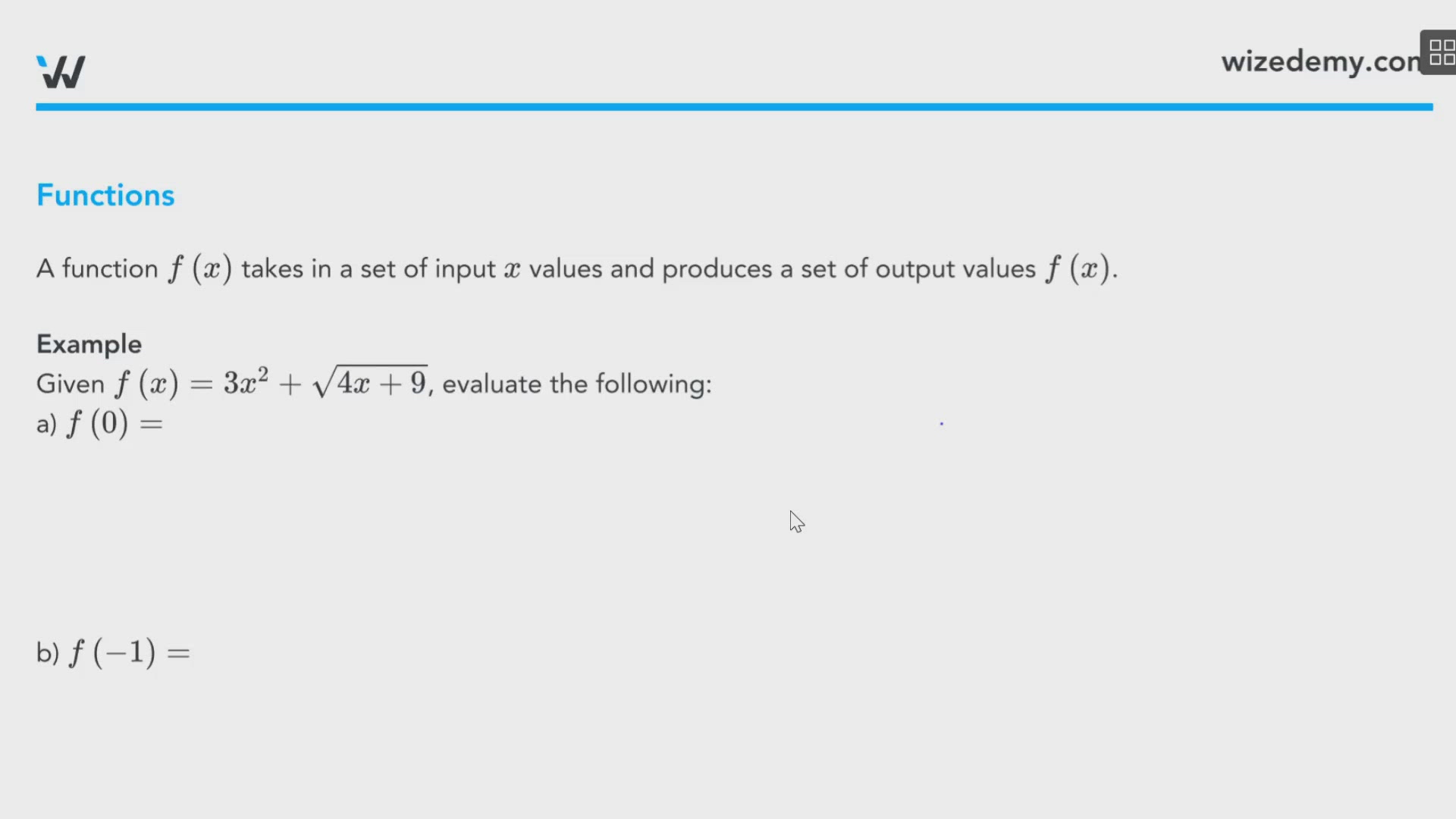
Functions
A function takes in a set of input values and produces a set of output values .
Example
Given , evaluate the following:
a)
b)
c)
d)
e)
Domain: The set of possible input values
Range: The set of possible output values
Example
Find the domain and range of the following functions:
a)
- Domaine: we can input any value → D:
- Range: we can get any output value → R:
b)
- Domain: we can input any value → D:
- Range: since , the value must be → Range:
c)
This is a circle with radius 2
- D:
- R: