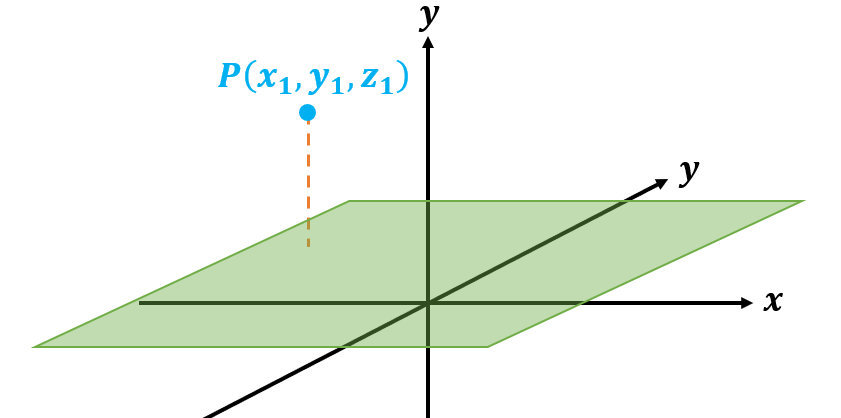
Distance From a Point to a Plane in R3

If Ax+By+Cz+D=0Ax+By+Cz+D=0 is a plane in R3R^3, then the shortest distance between a point P(x1,  y1, z1)P\left(x_1,\ \ y_1,\ z_1\right) and this plane is d=∣Ax1+By1+Cz1+D∣A2+B2+C2\displaystyle d=\frac{\left|Ax_1+By_1+Cz_1+D\right|}{\sqrt{A^2+B^2+C^2}}

Example
Find the distance between the point (1, −3,0)\left(1,\ -3, 0\right) and the plane2x−y+z−3=02x-y+z-3=0

A=2,  B=−1,  C=1,  D=−3A=2,\ \ B=-1,\ \ C=1,\ \ D=-3

Use the distance formula:
d=∣Ax1+By1+Cz1+D∣A2+B2+C2\displaystyle d=\frac{\left|Ax_1+By_1+Cz_1+D\right|}{\sqrt{A^2+B^2+C^2}}

d=∣2(1)−1(−3)+1(0)−3∣22+(−1)2+12=26\displaystyle d=\frac{\left|2\left(1\right)-1\left(-3\right)+1\left(0\right)-3\right|}{\sqrt{2^2+\left(-1\right)^2+1^2}}=\frac{2}{\sqrt{6}}


Practice: Distance between a point and a plane

Find the distance between the point 𝑃(2,3,1)𝑃(2,3,1) and the plane 𝑥+2𝑦−𝑧=10.𝑥+2𝑦−𝑧=10.
0:00 / 0:00

Example: Distance b/t 2 Parallel Planes

a) Find the distance between the two planes Π1: x−y+2z−4=0\Pi_1:\ x-y+2z-4=0 and Π2: x−y+2z+4=0\Pi_2:\ x-y+2z+4=0.
b) Find the equation of the plane that is equidistance between Π1\Pi_1 and Π2\Pi_2.

a) The planes are parallel and distinct. So the distance from any point in plane 1 to plane 2 is the same throughout plane 1.

Find a point on plane 1:
Let x=y=0x=y=0, then 2z−4=0  → z=22z-4=0\ \ \to\ z=2
So, the point (0, 0, 2)\left(0,\ 0,\ 2\right) is on plane 1.

Let's find the distance between (0,0,2)\left(0,0,2\right) and plane 2:
d=∣0−0+2(2)+4∣12+(−1)2+22\displaystyle d=\frac{\left|0-0+2\left(2\right)+4\right|}{\sqrt{1^2+\left(-1\right)^2+2^2}}
d=86\displaystyle d=\frac{8}{\sqrt{6}}
d=86×66\displaystyle d=\frac{8}{\sqrt{6}}\times\frac{\sqrt{6}}{\sqrt{6}}
d=866\displaystyle d=\frac{8\sqrt{6}}{6}
d=463\displaystyle d=\frac{4\sqrt{6}}{3}

b)
We know that the point (0,0,2)(0,0,2) is on plane 1, in fact, it is the z-intercept of plane 1.

We do the same to find the z-intercept of plane 2:
Let x=y=0x=y=0, then 2z+4=0 → z=−22z+4=0\ \to\ z=-2
So, the point (0, 0, −2)\left(0,\ 0,\ -2\right) is on plane 2 and is the z-intercept

The plane that is equidistance between plane 1 and plane 2 will contain the midpoint between (0, 0, 2)\left(0,\ 0,\ 2\right) and (0, 0, −2)\left(0,\ 0,\ -2\right): (0, 0, 0)\left(0,\ 0,\ 0\right)

This desired plane is also parallel to planes 1 and 2, so it must have normal vector [1, −1, 2]\left[1,\ -1,\ 2\right].

Therefore, the equation of the plane is x−y+2z−[0,0,0]⋅[1,−1,2]=0x-y+2z-\left[0,0,0\right]\cdot\left[1,-1,2\right]=0 → x−y+2z=0x-y+2z=0
0:00 / 0:00

Example: Distance b/t 2 Skewed Lines

Find the distance between the lines r1⃗=[3,1,1]+t[2,−2,6]\vec {r_1}=[3, 1, 1]+t[2, -2, 6] and r2⃗=[0,1,−5]+s[1,−2,3]\vec{r_2}=[0,1,-5]+s[1, -2, 3].

In a previous example, we showed taht these lines are skewed.

To find the distance between them, we construct 2 planes:
  • Plane 1: contains r1⃗\vec{r_1} and is parallel to [1, −2, 3]\left[1,\ -2,\ 3\right]
  • Plane 2: contains r2⃗\vec{r_2} and is parallel to [2, −2, 6]\left[2,\ -2,\ 6\right]
These planes are parallel since they are both parallel to the vectors [2, −2, 6]\left[2,\ -2,\ 6\right] and [1, −2, 3]\left[1,\ -2,\ 3\right].

Normal vector of both planes
n⃗=[2, −2, 6]×[1, −2, 3]\vec{n}=\left[2,\ -2,\ 6\right]\times\left[1,\ -2,\ 3\right]
n⃗=[6, 0, −2]\vec{n}=\left[6,\ 0,\ -2\right]

Plane 1
6x−2z−[3,1,1]⋅[6,0,−2]=06x-2z-\left[3,1,1\right]\cdot\left[6,0,-2\right]=0
Π1: 6x−2z−16=0\Pi_1:\ 6x-2z-16=0

Plane 2
6x−2x−[0,1,−5]⋅[6,0,−2]=06x-2x-\left[0,1,-5\right]\cdot\left[6,0,-2\right]=0
Π2: 6x−2z−10=0\Pi_2:\ 6x-2z-10=0

Now we just have to find the distance between these two planes:
Since point (3,1,1)\left(3,1,1\right) is on plane 1, we can use the formula d=∣Ax0+By0+Cz0+D∣A2+B2+C2d=\frac{\left|Ax_0+By_0+Cz_0+D\right|}{\sqrt{A^2+B^2+C^2}} to find the distance between the two planes.
d=∣6(3)+0(1)−2(1)−10∣62+02+(−2)2\displaystyle d=\frac{\left|6\left(3\right)+0\left(1\right)-2\left(1\right)-10\right|}{\sqrt{6^2+0^2+\left(-2\right)^2}}
d=640\displaystyle d=\frac{6}{\sqrt{40}}
d=6210\displaystyle d=\frac{6}{2\sqrt{10}}
d=310\displaystyle d=\frac{3}{\sqrt{10}}

Therefore, the distance between the two skewed lines is 310\frac{3}{\sqrt {10}}.