Create a free account to get started

Unlock full course notes by signing up

  • Video lessons taught by top educators
  • Practice questions with guided solutions
  • Written review notes for reference
  • Expert answers anytime from course tutors

Trigonometric Ratios in Radians


Let P(x,y)P(x,y) be a point that moves around a circle with radius rr and center (0,0).(0,0).


For any position of P(x,y)P(x,y), the primary trigonometric ratios are:
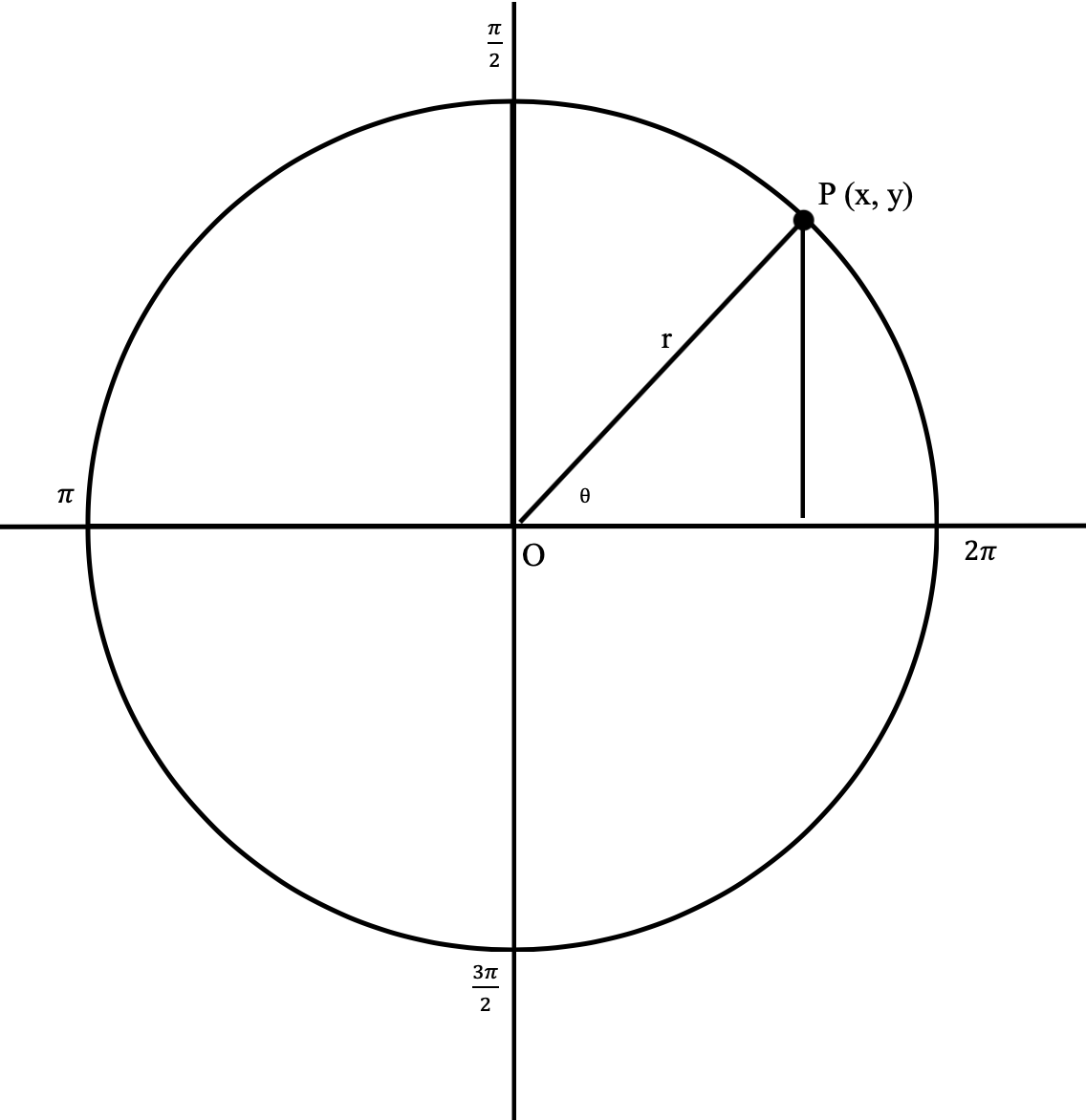

Image illustrating Trigonometric Ratios in Radians cos⁡θ=xrsin⁡θ=yrtan⁡θ=yxr=x2+y2\begin{array}{rcl} \cos{\theta}&=&\displaystyle\frac{x}{r}\\\\ \sin{\theta}&=&\displaystyle\frac{y}{r}\\\\ \tan{\theta}&=&\displaystyle\frac{y}{x}\\\\ r&=&\sqrt{x^2+y^2} \end{array}

  • OP OP~ is the terminal arm.
  • The angle θ \theta~ is in standard position, which means that one side of the angle is fixed along the positive x-axis and the vertex is located at the origin.
  • The reference angle is the smallest angle that the terminal arm can make with the x-axis and can be determined in each quadrant.
  • Quadrant II: π−θ\pi-\theta
  • Quadrant III: π+θ\pi+\theta
  • Quadrant IV: 2π−θ2\pi-\theta
  • All coterminal angles to θ \theta~ can be found by θ±2πn  or  θ±360∘n,   n∈Z\theta\pm2\pi n~~\text{or}~~\theta\pm360^\circ{}n,~~~n\in\mathbb{Z}. Coterminal angles are angles that share the terminal side of an angle occupying the standard position.

Example 1


Let θ=3π5\theta=\displaystyle\frac{3\pi}{5} . Determine:

  1. The reference angle
  2. 4 coterminal angles: 2 positive, 2 negative

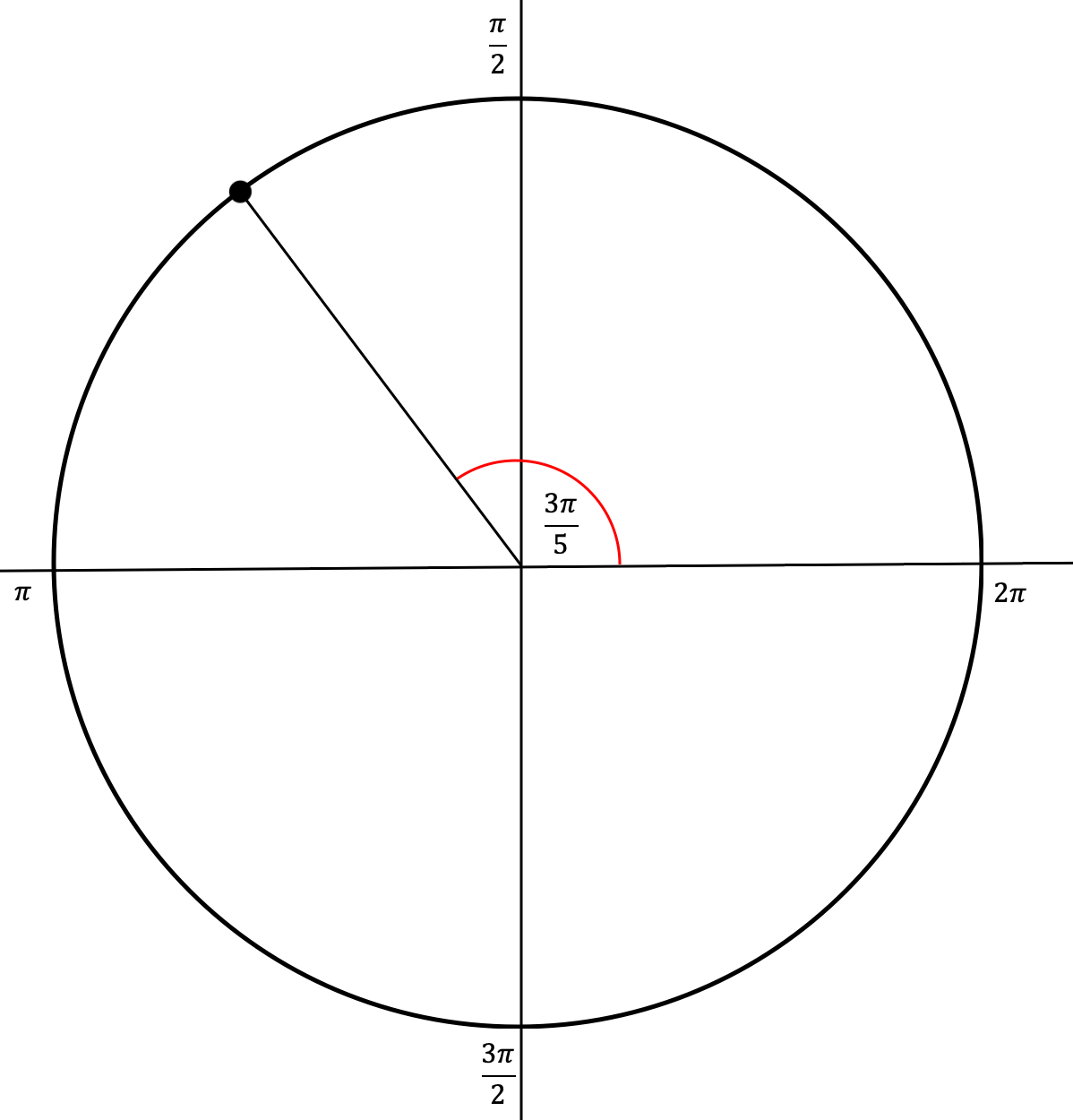
a. Let's sketch where θ=3π5\theta=\displaystyle\frac{3\pi}{5} is.


Image illustrating Trigonometric Ratios in Radians


Therefore, the reference angle is:


π−3π5=2π5\pi-\displaystyle\frac{3\pi}{5}=\boxed{\displaystyle\frac{2\pi}{5}}


b. 2 Positive Coterminal Angles:


3π5+2π=13π53π5+4π=23π5\begin{array}{rcl} \displaystyle\frac{3\pi}{5}+2\pi&=&\boxed{\displaystyle\frac{13\pi}{5}}\\\\ \displaystyle\frac{3\pi}{5}+4\pi&=&\boxed{\displaystyle\frac{23\pi}{5}} \end{array}


2 Negative Coterminal Angles:


3π5−2π=−7π53π5−4π=−17π5\begin{array}{rcl} \displaystyle\frac{3\pi}{5}-2\pi&=&\boxed{\displaystyle-\frac{7\pi}{5}}\\\\ \displaystyle\frac{3\pi}{5}-4\pi&=&\boxed{\displaystyle-\frac{17\pi}{5}} \end{array}


Example 2


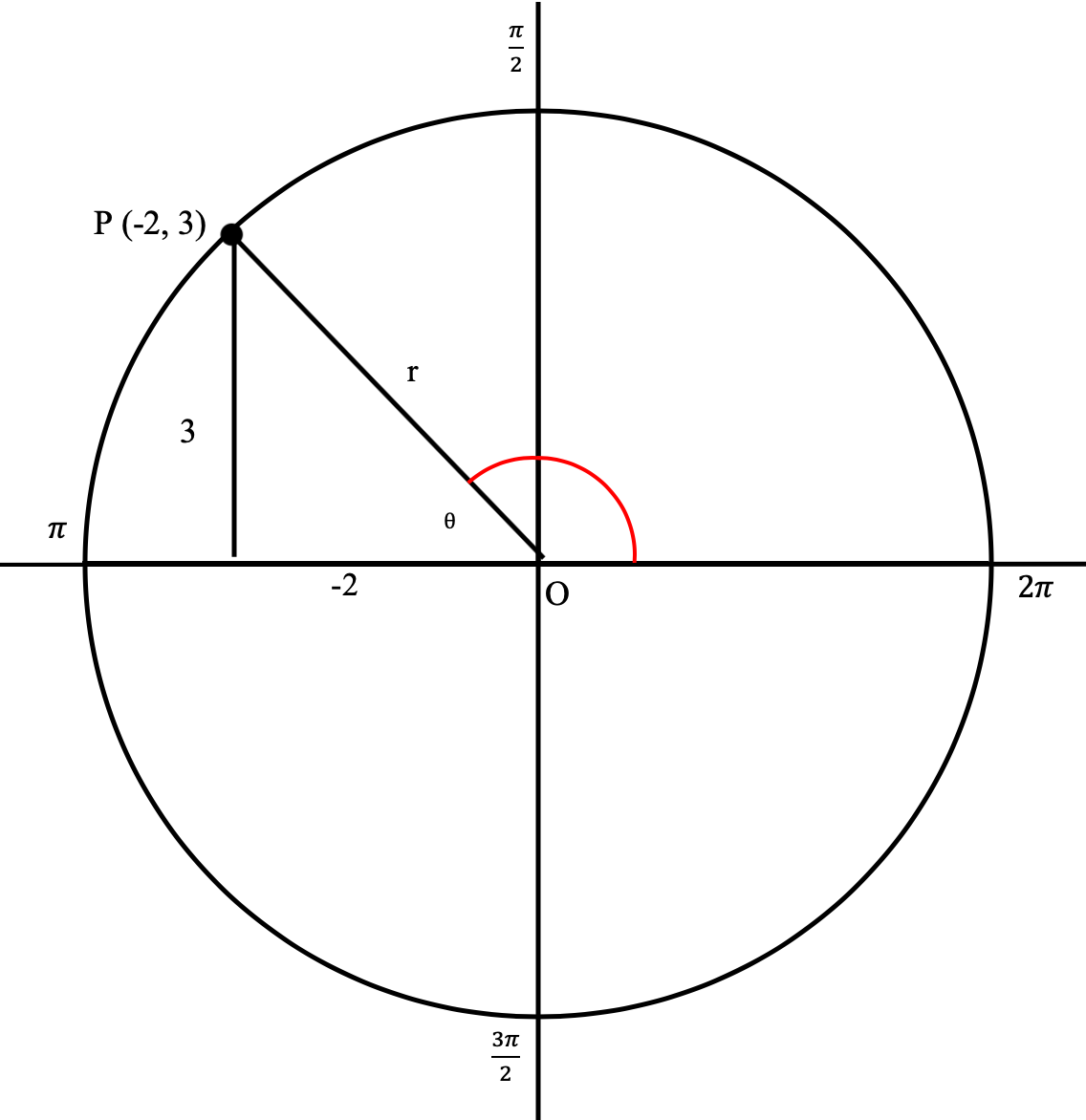
The point P(−2,3) P(-2, 3)~ is on the terminal arm of an angle θ.\theta.


Calculate the values of sin⁡θ, cos⁡θ, tan⁡θ\sin{\theta},~\cos{\theta},~\tan{\theta} and leave in exact form.


Image illustrating Trigonometric Ratios in Radians Find r‾:r=32+(−2)2r=13Find ratios‾:sin⁡θ=313cos⁡θ=−213tan⁡θ=−32\begin{array}{lrcl} \underline{\text{Find r}}:\\\\ &r&=&\sqrt{3^2+(-2)^2}\\\\ &r&=&\sqrt{13}\\\\\\ \underline{\text{Find ratios}}:\\\\ &\sin{\theta}&=&\displaystyle\frac{3}{\sqrt{13}}\\\\ &\cos{\theta}&=&\displaystyle\frac{-2}{\sqrt{13}}\\\\ &\tan{\theta}&=&-\displaystyle\frac{3}{2} \end{array}


Create a free account to get started

Unlock full course notes by signing up

  • Video lessons taught by top educators
  • Practice questions with guided solutions
  • Written review notes for reference
  • Expert answers anytime from course tutors

Example: Trigonometric Ratios in Radians


Each point P is on the terminal arm of an angle θ.\theta. Find cos⁡θ, sin⁡θ, tan⁡θ\cos{\theta},~\sin{\theta},~\tan{\theta}. Leave in exact form.

  1. P(−3,4)P(-3, 4)
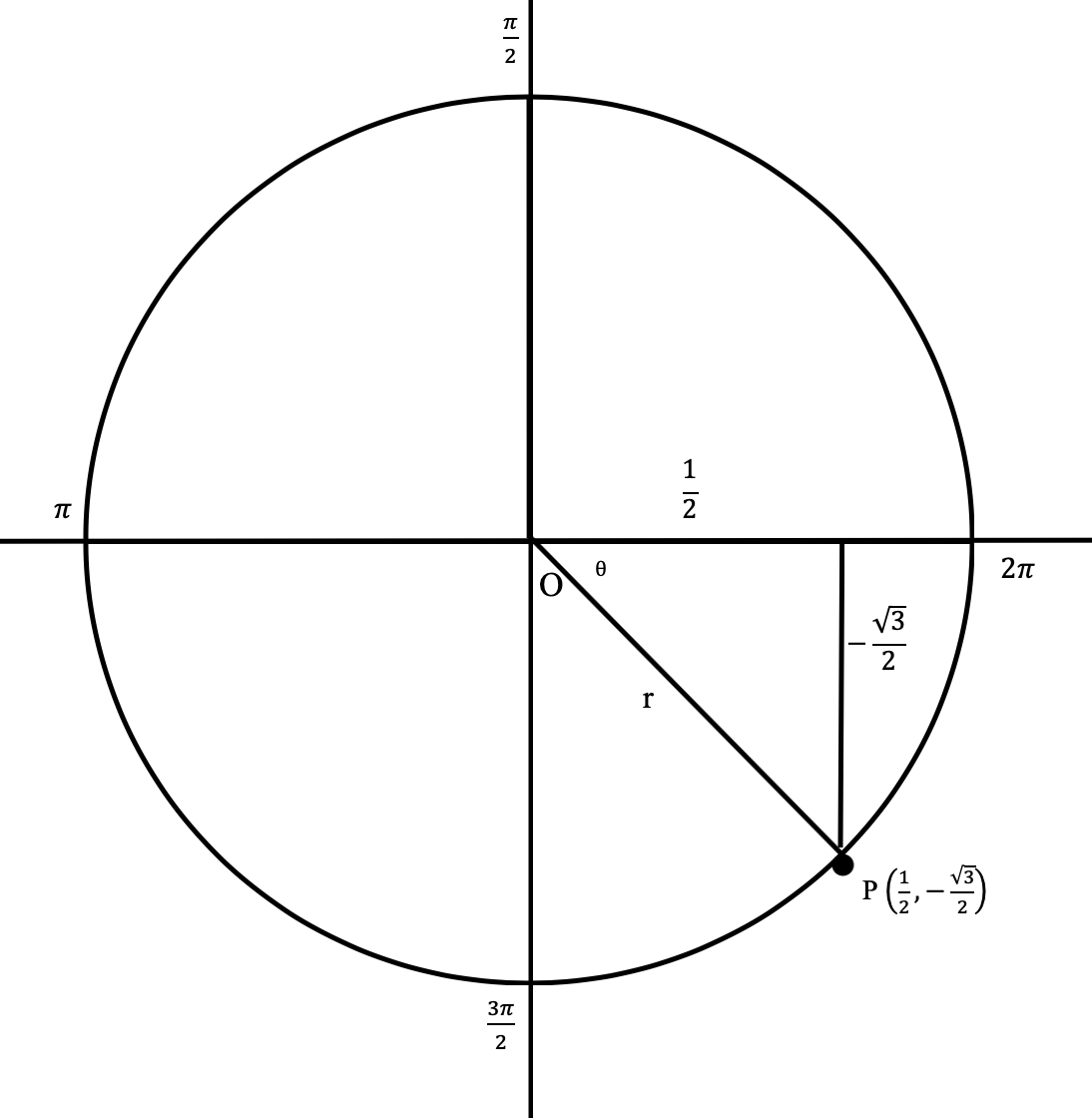
  2. P(12,−32)P\Bigg(\displaystyle\frac{1}{2},\displaystyle-\frac{\sqrt{3}}{2}\Bigg)

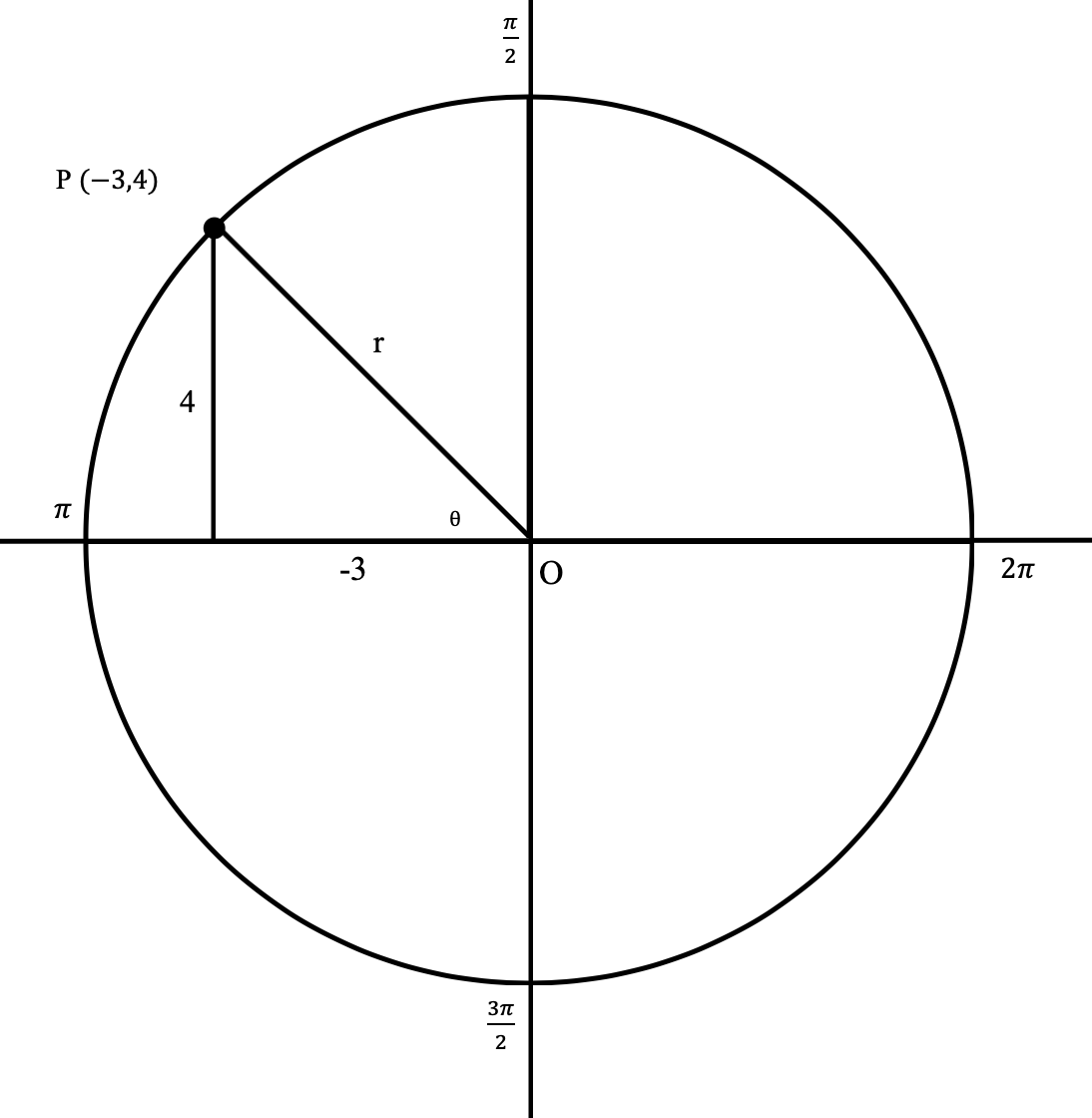
1. P(−3,4)P(-3,4)


Image illustrating Example

Find radius, r:


r=(−3)2+42r=25r=5\begin{array}{rcl} r&=&\sqrt{(-3)^2+4^2}\\\\ r&=&\sqrt{25}\\\\ r&=&5 \end{array}

Find the trigonometric ratios:


cos⁡θ=−35sin⁡θ=45tan⁡θ=−43\begin{array}{rcl} \cos{\theta}&=&\displaystyle-\frac{3}{5}\\\\ \sin{\theta}&=&\displaystyle\frac{4}{5}\\\\ \tan{\theta}&=&\displaystyle-\frac{4}{3} \end{array}


2. P(12,−32)P\Bigg(\displaystyle\frac{1}{2},\displaystyle-\frac{\sqrt{3}}{2}\Bigg)

Image illustrating Example


Find radius r:


r=(12)2+(−32)2r=14+34r=1r=1\begin{array}{rcl} r&=&\sqrt{\Bigg(\displaystyle\frac{1}{2}\Bigg)^2+\Bigg(\displaystyle-\frac{\sqrt{3}}{2}\Bigg)^2}\\\\ r&=&\sqrt{\displaystyle\frac{1}{4}+\displaystyle\frac{3}{4}}\\\\ r&=&\sqrt{1}\\\\ r&=&1 \end{array}

Find the trigonometric ratios:


cos⁡θ=12sin⁡θ=−32tan⁡θ=(−32)(12)=−3\begin{array}{rcl} \cos{\theta}&=&\displaystyle\frac{1}{2}\\\\ \sin{\theta}&=&\displaystyle-\frac{\sqrt{3}}{2}\\\\ \tan{\theta}&=&\displaystyle\frac{\Bigg(\displaystyle-\frac{\sqrt{3}}{2}\Bigg)}{\Bigg(\displaystyle\frac{1}{2}\Bigg)}&=&-\sqrt{3} \end{array}

Practice: Trigonometric Ratios in Radians


Fill in the blanks.

If the initial angle is in radians, answer in radians. If the initial angle is in degrees, answer in degrees.

Do NOT include units in your answer.


Reference AngleCoterminal Angle between−2π≤θ≤2π; −360∘≤θ≤360∘145∘a.b.11π6c.d.−340∘e.f.−5π3g.h.\begin{array}{|c|l|l|}\hline &\textbf{Reference Angle}&\textbf{Coterminal Angle between}\\ &&\footnotesize-2\pi\leq{}\theta{}\leq{}2\pi;~-360^\circ\leq{}\theta{}\leq{}360^\circ\\\hline\\ 145^\circ&\textbf{a.}&\textbf{b.}\\\\\hline\\ \displaystyle\frac{11\pi}{6}&\textbf{c.}&\textbf{d.}\\\\\hline\\ -340^\circ&\textbf{e.}&\textbf{f.}\\\\\hline\\ -\displaystyle\frac{5\pi}{3}&\textbf{g.}&\textbf{h.}\\\\\hline \end{array}

a. b.
c.d.
e.f.
g.h.

Create a free account to get started

Unlock full course notes by signing up

  • Video lessons taught by top educators
  • Practice questions with guided solutions
  • Written review notes for reference
  • Expert answers anytime from course tutors

Practice: Trigonometric Functions of Angles in Standard Position,

Reference & Coterminal Angles


Let P(−x,−x)P(-\sqrt{x},-\sqrt{x}) be a point on the terminal arm of some angle θ.\theta. Find cos⁡θ, sin⁡θ, tan⁡θ\cos{\theta},~\sin{\theta},~\tan{\theta}. Leave answer in exact form.


Your answers

Create a free account to get started

Unlock full course notes by signing up

  • Video lessons taught by top educators
  • Practice questions with guided solutions
  • Written review notes for reference
  • Expert answers anytime from course tutors

Practice: Trigonometric Functions of Angles in Standard Position

Reference & Coterminal Angles

Let sin⁡θ<0\sin{\theta}<0 and tan⁡θ>0\tan{\theta}>0.


If cos⁡θ=−53\cos{\theta}=\displaystyle-\frac{\sqrt{5}}{3}, determine sin⁡2θcos⁡θ−tan⁡θ\sin^2{\theta}\cos{\theta}-\tan{\theta}.

Choose an answer

Create a free account to get started

Unlock full course notes by signing up

  • Video lessons taught by top educators
  • Practice questions with guided solutions
  • Written review notes for reference
  • Expert answers anytime from course tutors

Extra Practice