Wize High School Grade 12 Pre-Calculus Textbook > Trigonometric Ratios (Radians)
Solving Simple Trigonometric Equations
Popular Courses
Grade 12 Advanced Functions
Ontario High School
Grade 12 Pre-Calculus/Functions
Canada High School
Algebra II
US High School
Math 30-1
Alberta High School
Pre-Calculus 12
British Columbia High School
MATH 144
University of Alberta
MATH 139
McGill University
MATH-1760
University of Windsor
MATH 1149
Ohio State University
MAC 1140
University of Florida
MATH 41
Pennsylvania State University
MATH 150
Texas A&M University
MAC 1105
Florida State University
MAT 012
University of California - Davis
MTH 116
Michigan State University
MTH 103A
Michigan State University
MAC 1147
University of Florida
MATH 140
San Diego State University
MAC 1140C
University of Central Florida
MA 15800
Purdue University
0:00 / 0:00
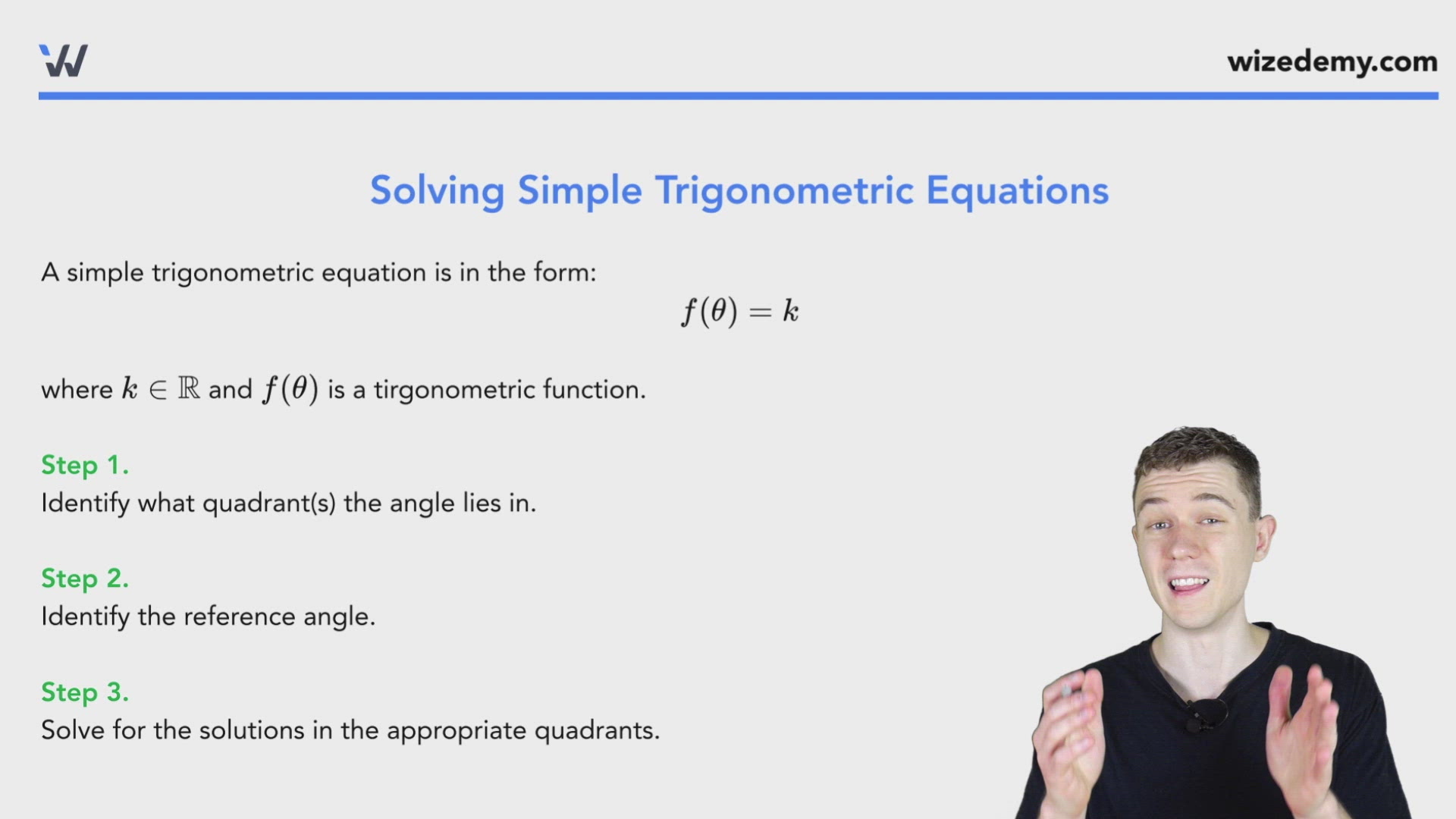
Solving Simple Trigonometric Equations
A simple trigonometric equation is in the form:
where and is a trigonometric function.
Step 1.
Identify what quadrant(s) the angle lies in.
Step 2.
Identify the reference angle.
Step 3.
Solve for the solutions in the appropriate quadrants.
Example 1
Solve for over the domain .
Step 1.
Identify what quadrant(s) the angle lies in.
Since , then is in quadrant I & IV.
Step 2.
Identify the reference angle.
Since , then we need the angle that corresponds to an x-coordinate point of .
The reference angle is .
Step 3.
Solve for the solutions in the appropriate quadrants.
Quadrant I:
Quadrant IV:
The solutions are
0:00 / 0:00
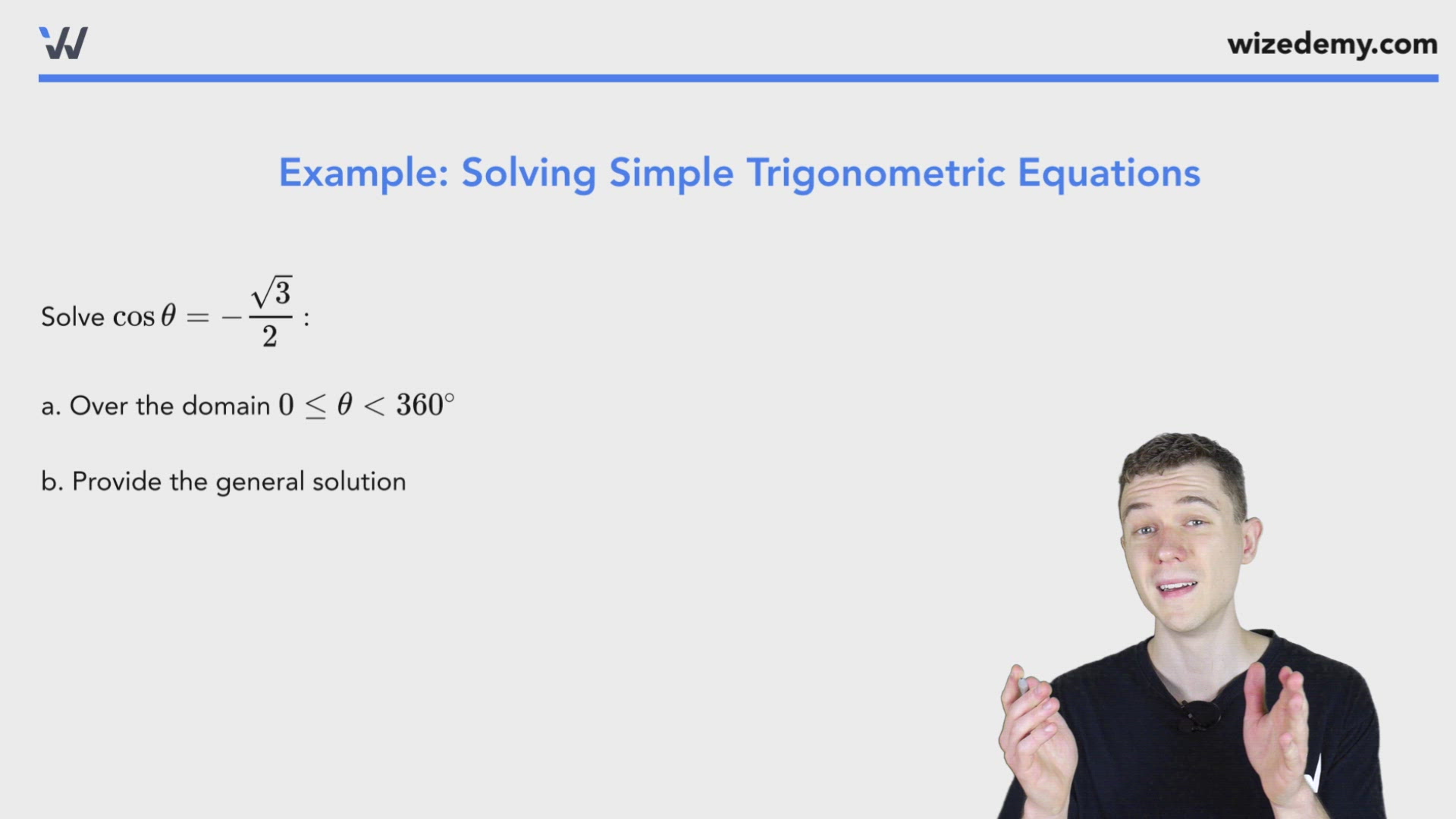
Example: Solving Simple Trigonometric Equations
Solve :
a. Over the domain
b. Provide the general solution
a.
Step 1.
Since then is in quadrant II & III.
Step 2.
The reference angle is
Step 3.
Quadrant II:
Quadrant III;
b.
The general solution is all coterminal angles to the solutions in Step 3.
Therefore,
0:00 / 0:00
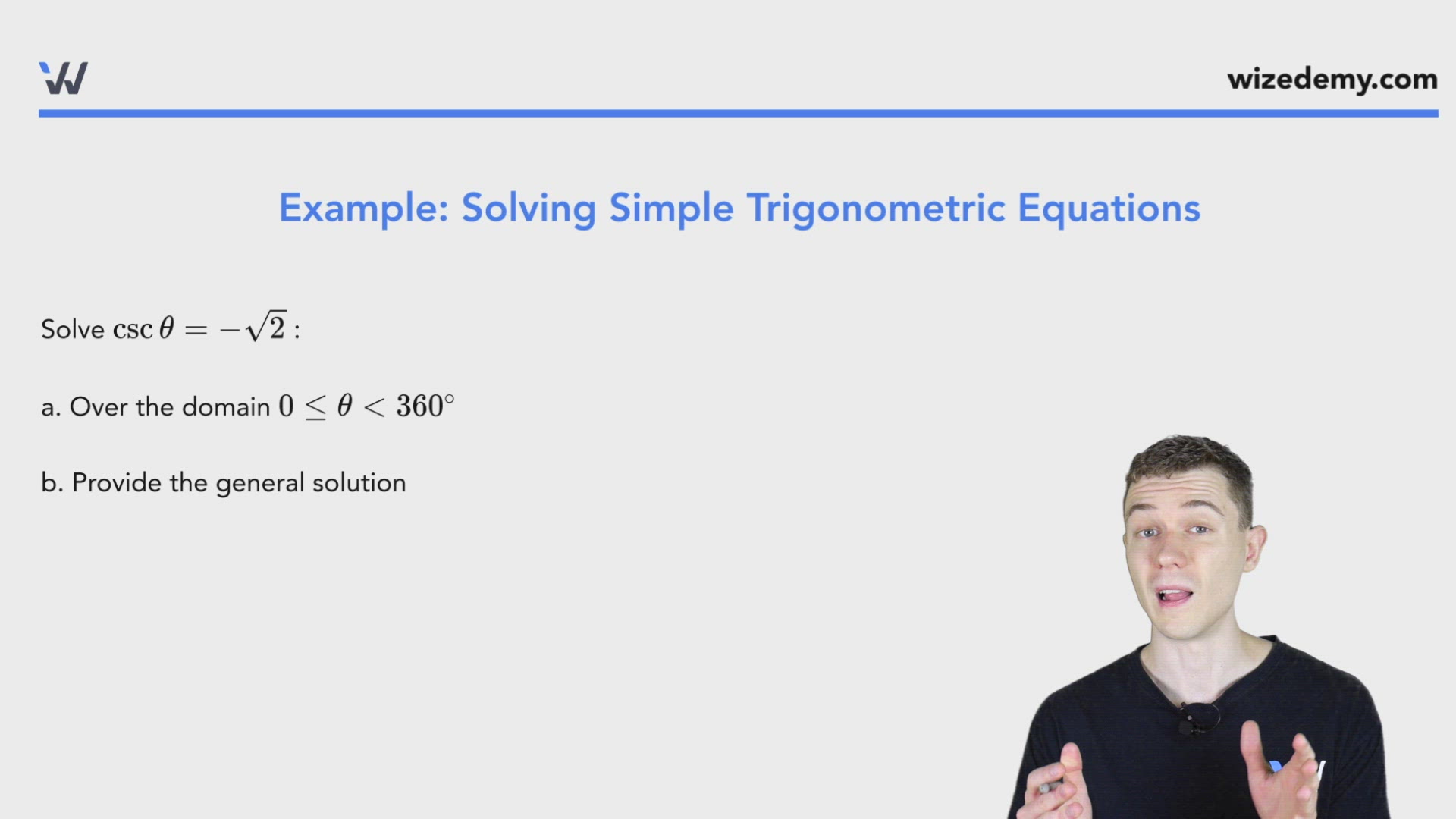
Example: Solving Simple Trigonometric Equations
Solve :
a. Over the domain
b. Provide the general solution
a.
Step 1.
Since then is in quadrant III & IV.
Step 2.
The reference angle is
Step 3.
Quadrant II:
Quadrant III;
b.
The general solution is all coterminal angles to the solutions in Step 3.
Therefore,
Practice: Solving Simple Trigonometric Equations
Solve over the domain .
Practice: Solving Simple Trigonometric Equations
Let . Solve for over the domain .
Practice: Solving Simple Trigonometric Equations
Let . Solve for , providing the general solution.