Popular Courses
Grade 12 Pre-Calculus/Functions
Canada High School
MATH 208
Concordia University
Math 30-1
Alberta High School
Pre-Calculus 12
British Columbia High School
MATH 1314
Tarrant County College District
MAC 1140
University of Florida
MAT 012
University of California - Davis
MAC 1105
Florida State University
MTH 103A
Michigan State University
MAC 1147
University of Florida
MATH 140
San Diego State University
MA 15800
Purdue University
MAC 1140C
University of Central Florida
MATH 102
California State University - Northridge
MATH 1302
University of Texas at Arlington
M 305G
The University of Texas at Austin
MATH 1022
Temple University
MATH 1019
University of Cincinnati
MA 107
North Carolina State University
MATH 1021
University of Cincinnati
0:00 / 0:00
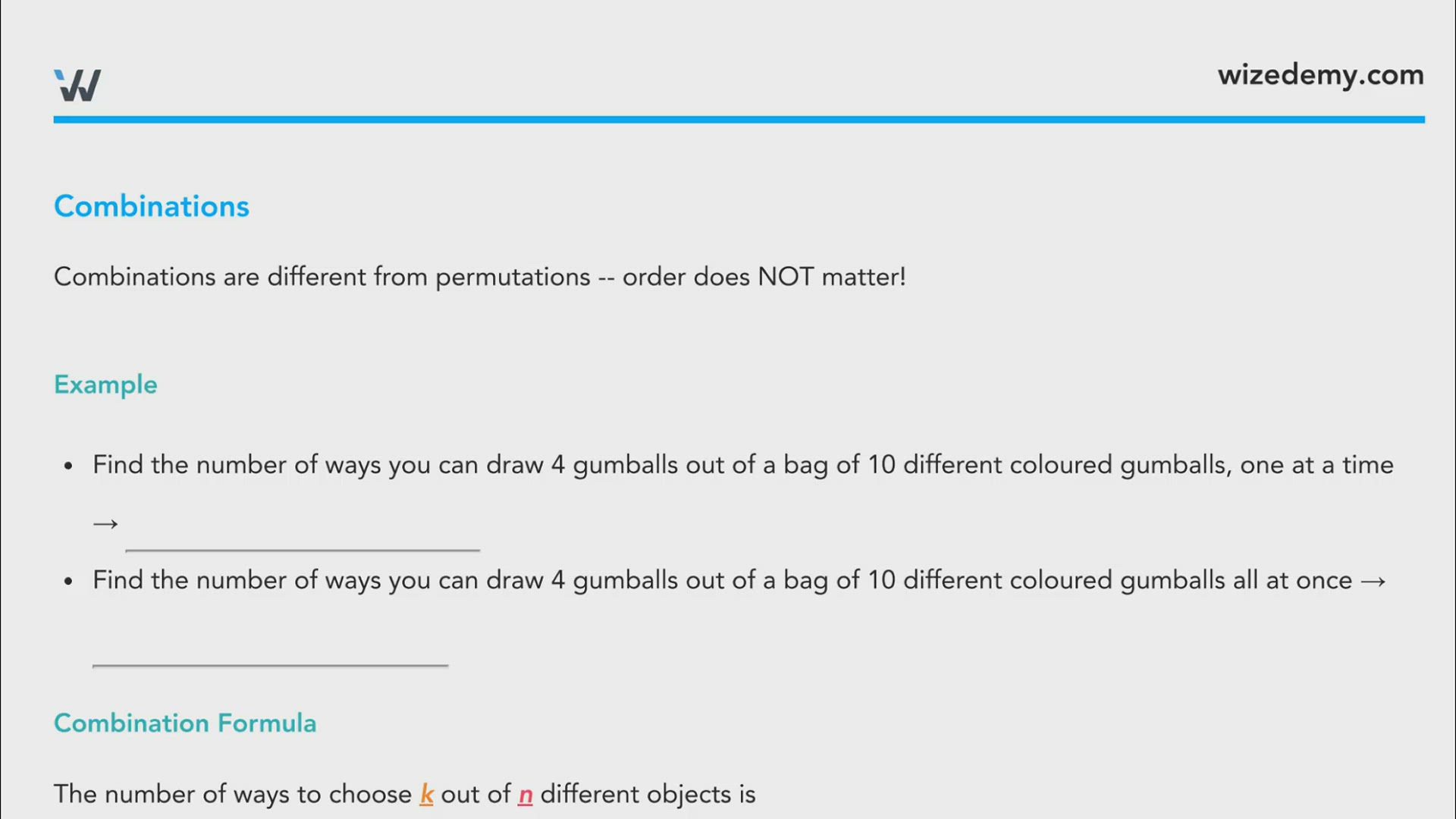
Combinations
Combinations are different from permutations -- order does NOT matter!
Example
- Find the number of ways you can draw 4 gumballs out of a bag of 10 different coloured gumballs, one at a time →permutation question
- Find the number of ways you can draw 4 gumballs out of a bag of 10 different coloured gumballs all at once →combination question
Combination Formula
The number of ways to choose k out of n different objects is
This notation is read as "n choose k".
Properties
Wize Tip
Use some variation of this combination formula if the question involves keywords "choose", "pick", "select" with no order.

0:00 / 0:00
Example: Combination Notation
Evaluate the expression .
Let's first simplify using some of the properties:
Now we simplify the first bracket using the definition of "n choose k"
0:00 / 0:00
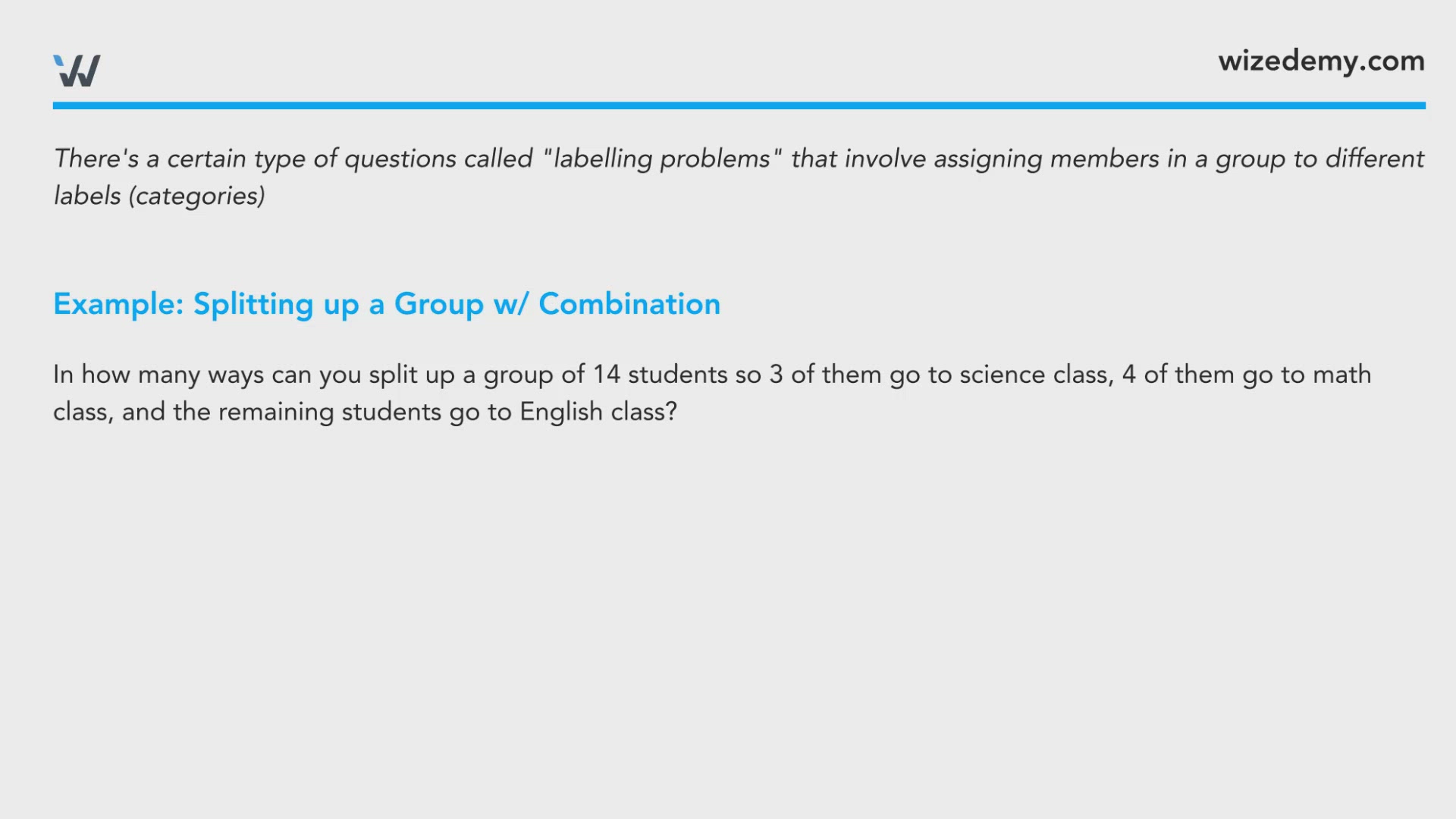
There's a certain type of questions called "labelling problems" that involve assigning members in a group to different labels (categories)
Example: Splitting up a Group w/ Combination
In how many ways can you split up a group of 14 students so 3 of them go to science class, 4 of them go to math class, and the remaining students go to English class?
Since the order in which we assign there students class doesn't matter, it's a combination question.
- Science class:
- Math class: since there are now only 11 students left to choose from--
- English class: the remaining 7 students have to go to English --
Therefore, there are
0:00 / 0:00
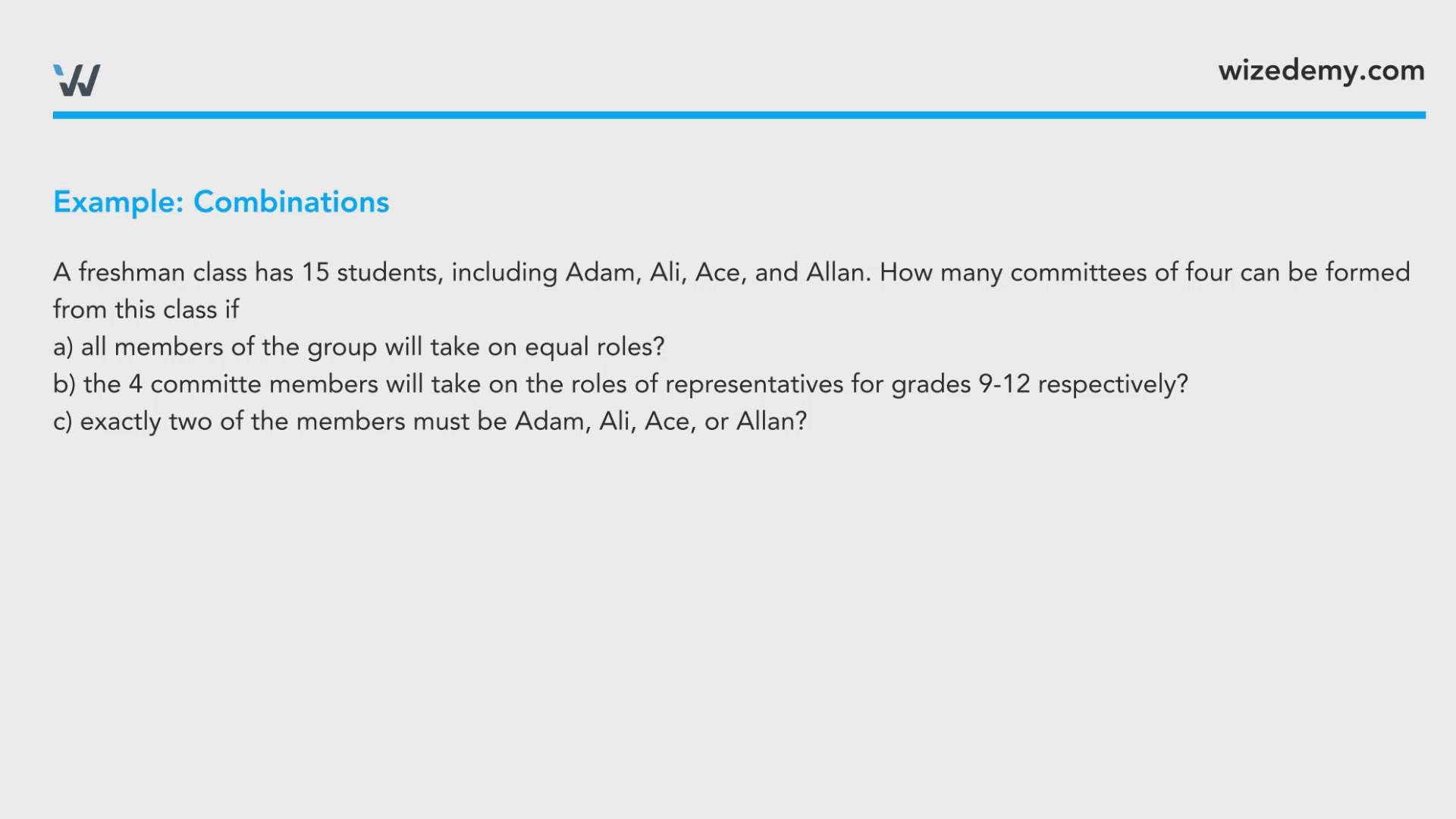
Example: Combinations
A freshman class has 15 students, including Adam, Ali, Ace, and Allan. How many committees of four can be formed from this class if
a) all members of the group will take on equal roles?
b) the 4 committe members will take on the roles of representatives for grades 9-12 respectively?
c) exactly two of the members must be Adam, Ali, Ace, or Allan?
PART a)
If all 4 members will take on the same roles, the order in which they are chosen doesn't matter.
Therefore, there are such ways of forming such committees.
PART b)
Since the 4 roles are distinguishable, we can think of this problem as picking the committee members one at a time and assigning them the roles of representative for grades 9-12 in order. So this is like say "in how many ways can you assign 4 different roles from 15 students?"
Therefore, there are such ways of forming this committee
PART c)
Let's choose our 2 members from the specified subgroup first:
We now have to pick 2 more members from the remaining 11 students:
Therefore, there are ways to form this committee
0:00 / 0:00
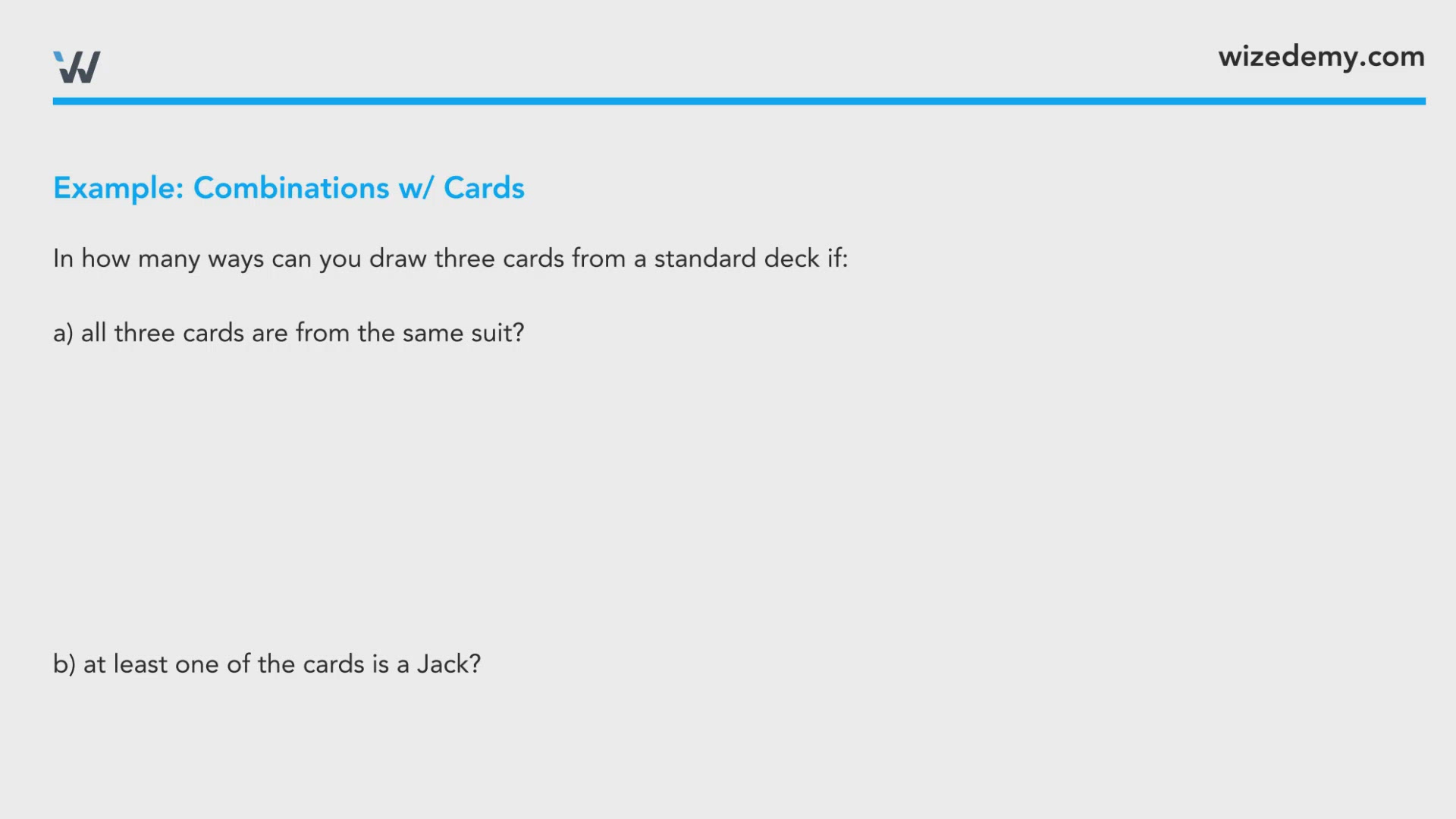
Example: Combinations w/ Cards
In how many ways can you draw three cards from a standard deck if:
a) all three cards are from the same suit?
There are 4 cases here -- all cards of suit type 1 (diamonds), suit type 2 (hearts), suit type 3 (clubs) or suit type 4 (spades). Each case has the same number of outcomes.
For each suit, we need to pick 3 of the 13 cards:
Therefore, there are ways to draw 3 cards like this.
b) at least one of the cards is a Jack?
Let's use the complement.
No restrictions: choose 3 out of 52 cards →
Complement: no jacks (pick 3 out of the remaining 48 cards) →
Therefore, there are ways to draw 3 cards like this.
Practice: Combination Notation
Which of the following is false?
Practice: Combinations
A committee of 7 is formed from a group of 10 men and 9 women. In how many ways can the committee be formed if
a) at least one of the members is male?
b) at least one of the member is male and at least one of the members is female?
a) at least one of the members is male?
Practice: Combinations w/ Cards
A full-house is a 5-card hand that consists of 3 cards of the same value and a pair. For example, 3 kings and 2 fives.
In how many ways can you draw a full-house?
Practice: Combinations
Josh is taking a 10 question test. In how many ways can he get a score of 8 out of 10 if each question on the test is
i) a True/False question, where each answer is either "True" or "False"?
ii) a 5-option multiple choice question, where only 1 of the 5 options is correct?
i) a True/False question, where each answer is either "True" or "False"?