Popular Courses
MCAT
General Course
Intro to Physics
University Study Guides
PHYSICS 1D03
McMaster University
AP Physics C: Mechanics Exam Prep Course
AP Exam Prep
Physics
General Course
PHYS 115
Queen's University
PCS 211
Toronto Metropolitan University
PHYS 204
Concordia University
PHYS*1300
University of Guelph
Intro to Physics
University Study Guides
PHYS*1080
University of Guelph
PHY 1321
University of Ottawa
PHYS 131
McGill University
APSC 111
Queen's University
PHYS 111
University of Waterloo
PCS 120
Toronto Metropolitan University
PHYS 110
University of Victoria
LE/PHYS 1800 3.00
York University
PHYS-1400
University of Windsor
PHY131H1
University of Toronto
0:00 / 0:00
Free Body Diagrams
The study of forces will focus on the application of Newton's Laws and the creation of free-body diagrams (commonly abbreviated as FBD).
What is a Force?
- In the most general possible terms, a force is a push or a pull. (That's it!)
- It's important to remember that force is a vector quantity; that is, it has both magnitude and direction, and all of the operations of vectors can be applied to them. Many problems in dynamics begin by resolving forces into components.
- The unit of force is a Newton [N]. This is a derived unit, with .
What is a Free Body Diagram?
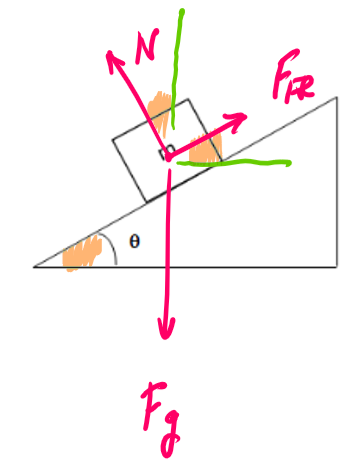
- Free body diagrams are used to show all the forces acting on an object. Drawing a proper free body diagram for each object should be your first instinct when encountering a force-related question.
- Mass (m) is usually represented as a block and the forces acting on the mass are shown as vectors with appropriate relative size and direction.
- Remember to include a coordinate axis to define positive directions
- It’s also a good idea to include an arrow indicating the direction of acceleration so you know which forces add up to ma.
Example:

Watch Out!
A free body diagram accounts for all forces acting ON the object only (not the forces the object may exert on other objects)
A FBD allows you to isolate the object of interest, and observe the forces acting on it.
Exam Tip
For problems involving Forces, you should ALWAYS draw a free body diagram!
Steps to Construct a FBD:
- Decide what you’re interested in, and draw a diagram of it
- Draw and label all forces acting on the body, and indicate angles where necessary
- If you don’t know the direction of a force, assume a direction
- Exaggerate the angles if it helps
3. Define a coordinate system
- This can be the general xyz coordinate system you’re used to
- Or it could be a rotated coordinate system that simplifies the problem
0:00 / 0:00
Example: Free Body Diagram Samples
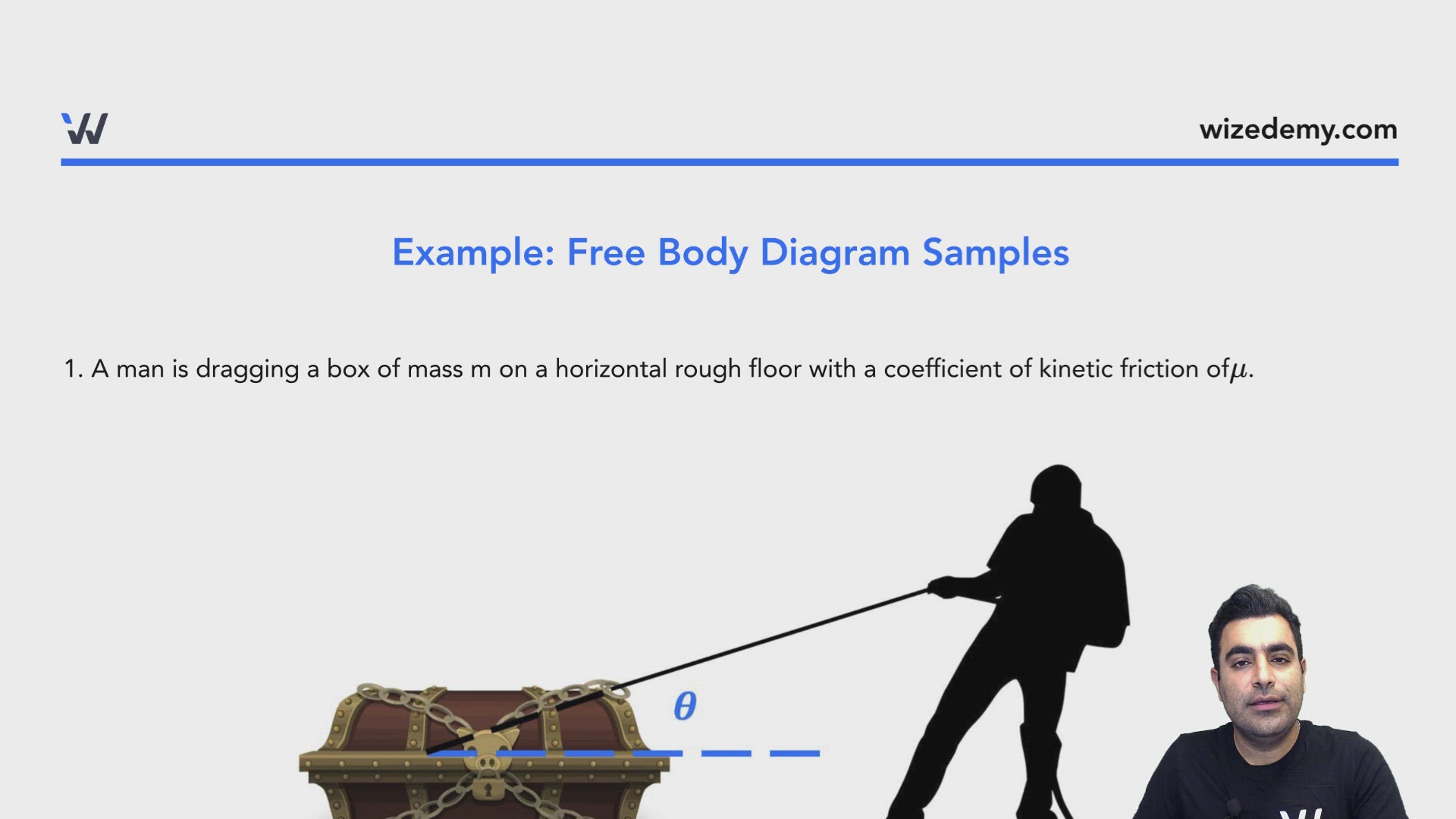
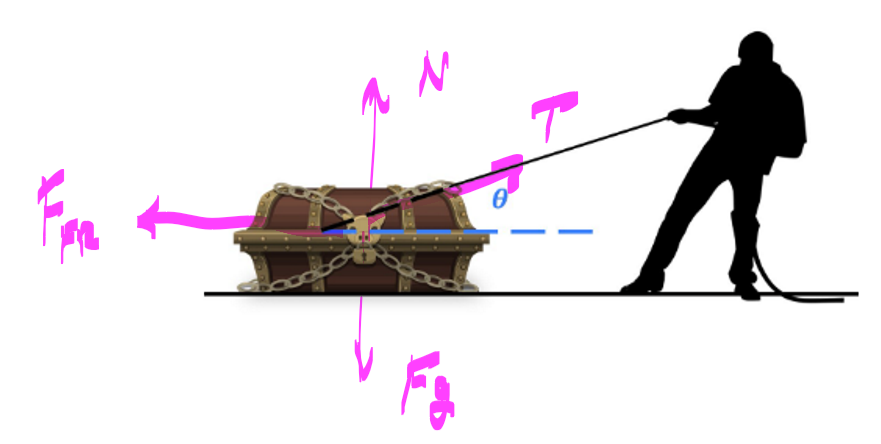
1. A man is dragging a box of mass m on a horizontal rough floor with a coefficient of kinetic friction of.

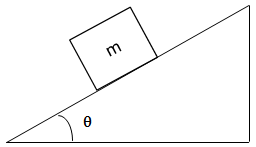
2. A box on a rough inclined plane.
=========================================================================
a)

Mark Yourself Question
- Grab a piece of paper and try this problem yourself.
- When you're done, check the "I have answered this question" box below.
- View the solution and report whether you got it right or wrong.
Two tennis players are rallying a tennis ball.
Describe the forces (draw a FBD) on the ball when it is:
a) In flight
b) Being hit by a racket. How does the force the ball exerts on the racket compared to that of the racket on the ball (>, < or =).
A man pulls 200Kg crate with rope angles 30 o above the horizontal with force 200N. The crate sits on the frictionless surface. Calculate the normal force. Enter answer in N.