Wize University Physics Textbook (Master) > Work and Energy
Conservation of Energy
Popular Courses
MCAT
General Course
PHYSICS 1201A/B
Western University
PHYSICS 1201A/B
Western University
Intro to Physics
University Study Guides
PHYSICS 1D03
McMaster University
AP Physics C: Mechanics Exam Prep Course
AP Exam Prep
Physics
General Course
PHYS 115
Queen's University
PHYS 211
University of Calgary
PHYSICS 1401A/B
Western University
PCS 211
Toronto Metropolitan University
PHYS 204
Concordia University
PHYS*1300
University of Guelph
Intro to Physics
University Study Guides
PHYS*1080
University of Guelph
PHY 1321
University of Ottawa
PHYS 131
McGill University
APSC 111
Queen's University
APSC 111
Queen's University
PHYS 111
University of Waterloo

0:00 / 0:00
Energy Conservation
The total mechanical energy of a system is the sum of kinetic and potential energies at a given time.
Remember that using Work-Energy Theorem. We also remember that for conservative force, . Hence we have:
Solving for we will find:
where is the total work done by non-conservative forces and is the total change in the mechanical energy
Watch Out!
could be positive, negative or zero:
- If it is positive, the mechanical energy is increased (such as pulling force)
- If it is negative, the mechanical energy is decreased (such as friction)
- if it is zero. energy is conserved
The above equation sometimes is written is the following form:
where and indexes refer to initial and final situations respectively. Furthermore, here and are positive and negative non-conservative works respectively.
Energy Conservation
If there is no non-conservative work, and there is no dissipated energy, there is no change in energy:
- This is the conservation of energy: energy is not destroyed or created, but transformed into different forms.
Exam Tip
We can use conservation of energy to solve dynamics problem when we are interested in knowing initial and final conditions, without being too concerned about what happens exactly in between.
0:00 / 0:00
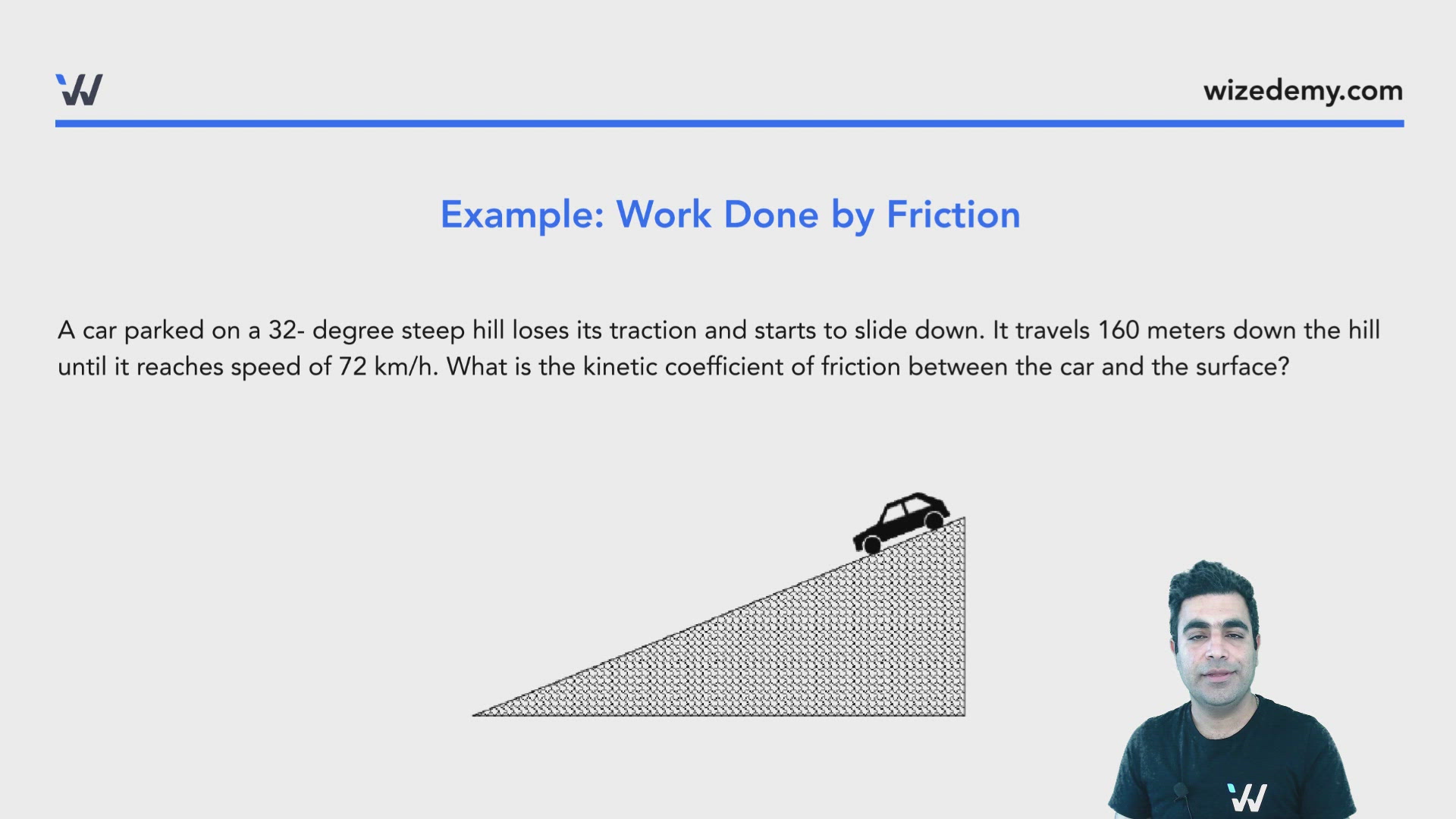
Example: Work Done by Friction
A car parked on a 32- degree steep hill loses its traction and starts to slide down. It travels 160 meters down the hill until it reaches speed of 72 km/h. What is the kinetic coefficient of friction between the car and the surface?

Solution:
The car at the top is at rest, while at the bottom, it reaches the velocity of 72 km/h (20 m/s). The only non conservative force that does work on the car is the friction of the surface which does a negative work. So, the mechanical energy is not conserved.
Thus:
Here we set the zero of gravitational potential energy at the end of the path. Note the negative sign of friction work due to
Furthermore, kinetic friction can be written as:
This is a very important step. What we know is that the car has travelled d meters down the hill. But to find we need to find the vertical change in the position using a little bit of geometry:
Mass is cancelled from both sides of equations. Thus:
A 2.00-kg block is pushed against a spring with negligible mass and force constant k= 400 N/m, compressing it 0.220 m. When the block is released , it moves along a friction-less , horizontal surface and then up a friction-less incline with slope
(a) What is the speed of the block as it slides along the horizontal surface after having lost the contact with the spring?
(b) How far does the block travel up the incline before starting to slide back down?
