Wize University Physics Textbook (Master) > Momentum, Impulse and Collisions
Linear Momentum and Impulse
Popular Courses
MCAT
General Course
PHYSICS 1201A/B
Western University
Intro to Physics
University Study Guides
PHYSICS 1D03
McMaster University
AP Physics C: Mechanics Exam Prep Course
AP Exam Prep
Physics
General Course
PHYS 115
Queen's University
PHYS 211
University of Calgary
PHYSICS 1401A/B
Western University
PCS 211
Toronto Metropolitan University
PHYS 204
Concordia University
PHYS*1300
University of Guelph
Intro to Physics
University Study Guides
PHYS*1080
University of Guelph
PHY 1321
University of Ottawa
PHYS 131
McGill University
APSC 111
Queen's University
PHYS 102A
University of Victoria
PHYS 111
University of Waterloo
PCS 120
Toronto Metropolitan University
0:00 / 0:00
Linear Momentum and Impulse
Linear Momentum
Linear Momentum (or simply Momentum) is defined as the product of mass and velocity of an object.
Momentum is a vector and measured in kg . m/s.
If a force is applied to an object, the Second law of Newton could be written in terms of change in momentum as follows:
Impulse
Impulse is defined as the change in the momentum of the object if a constant external force of F is applied to the object:
Wize Concept
If the net external force is zero, the change in momentum is zero and it remains conserved!
0:00 / 0:00
Linear Momentum and Impulse
Linear Momentum
Linear Momentum (or simply Momentum) is defined as the product of mass and velocity of an object.
- Momentum is a vector and measured in kg . m/s.
If a force is applied to an object, the Second law of Newton could be written in terms of change in momentum as follows:
Impulse
Impulse is defined as the change in the momentum of the object if a constant external force of F is applied to the object:
For a net external force which is changing in time, impulse is defined as below:
Exam Tip
If the plot of Force vs Time is given in the exam, impulse can be found as the area under the curve.
Wize Concept
Note that when the net external force is zero, momentum remains conserved!
Watch Out!
Note that a collection of objects with varying momenta can be described as one system with one center of mass velocity!

0:00 / 0:00
Example: Impulse to a Soccer Ball
A soccer player applies an average force of 180 N during a kick. The kick accelerates a 0.45 kg soccer ball from rest to a speed of 18 m/s. What is the impulse imparted to the ball? What is collision time?
Solution:
We know that impulse is defined as:
Since the ball is at rest before the kick, its initial momentum is zero.
So, we can easily calculate impulse as:
Furthermore, we can find the time duration of the kick again by looking at the definition of impulse:
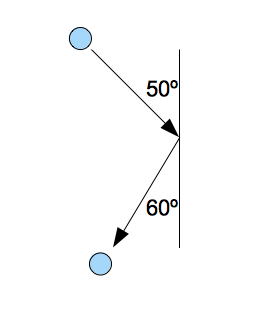
A 2.5 kg Dodge ball hits the back wall of a school gym at 15 m/s at an angle of 50º to the wall. The ball is in contact with the wall for 0.15s before bouncing back at 12 m/s at an angle of 60º to the wall. What average force was exerted by the ball on the wall?
A force is acting on a moving object with mass of 2kg in the direction of its motion for 5 seconds. If the initial speed of the particle is 5m/s.
