Wize University Physics Textbook (Master) > Geometric Optics
Reflection and Refraction of Light
Popular Courses
MCAT
General Course
PHYSICS 1201A/B
Western University
Grade 12 Physics
Canada High School
PHYS 101
McGill University
Physics 30
Alberta High School
PHY 1122
University of Ottawa
PHYS 142
McGill University
ENGG 212
University of Calgary
PHY132H1
University of Toronto
PHY132H1
University of Toronto
PHYS 102B
University of Victoria
PHYS 111
University of Victoria
PHYSICS 1101A/B
Western University
PHYS-1300
University of Windsor
PHY 1121
University of Ottawa
PHYS 121
University of Waterloo
PHYSICS 1102A/B
Western University
PHYS 206
Concordia University
PHYS 227
University of Calgary
SC/PHYS 2020 3.00
York University
0:00 / 0:00
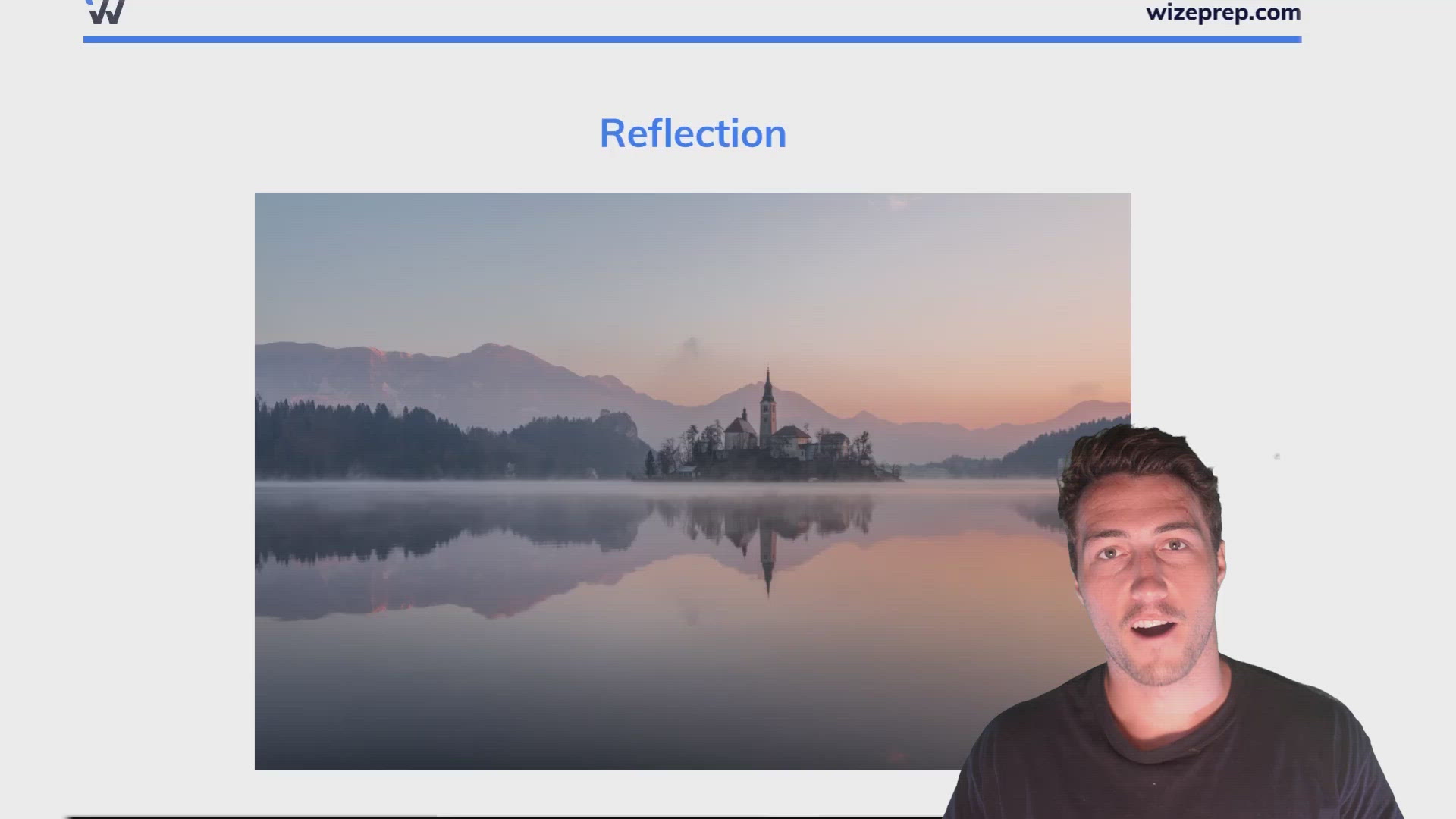
Reflection

- The direction of propagation of light can be identified by drawing light rays.
- They are lines along which energy is emitted from a light source and always travel in straight lines.
- Point sources emit light isotopically in all directions.
Wize Concept
There are two different types of objects that give off light:
- Self-luminous objects are objects that directly create light rays (ie. light bulb).
- Reflective objects reflect light rays from self-luminous objects.
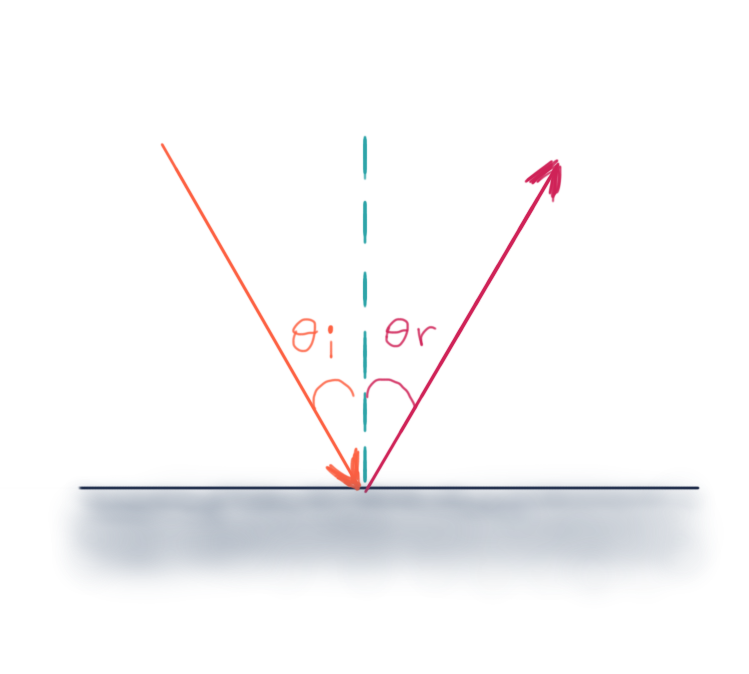
Reflection is the change in direction of a wavefront at the interface between two different media.
- The angle of incidence is always the same as the angle of reflection :
Exam Tip
The angles are always measured relative to the normal (perpendicular) to the surface, so draw the normal line first, then label the angles relative to it.
Specular reflection: reflection off a smooth, regular surface
Diffuse reflection: reflection off an irregular surface
0:00 / 0:00
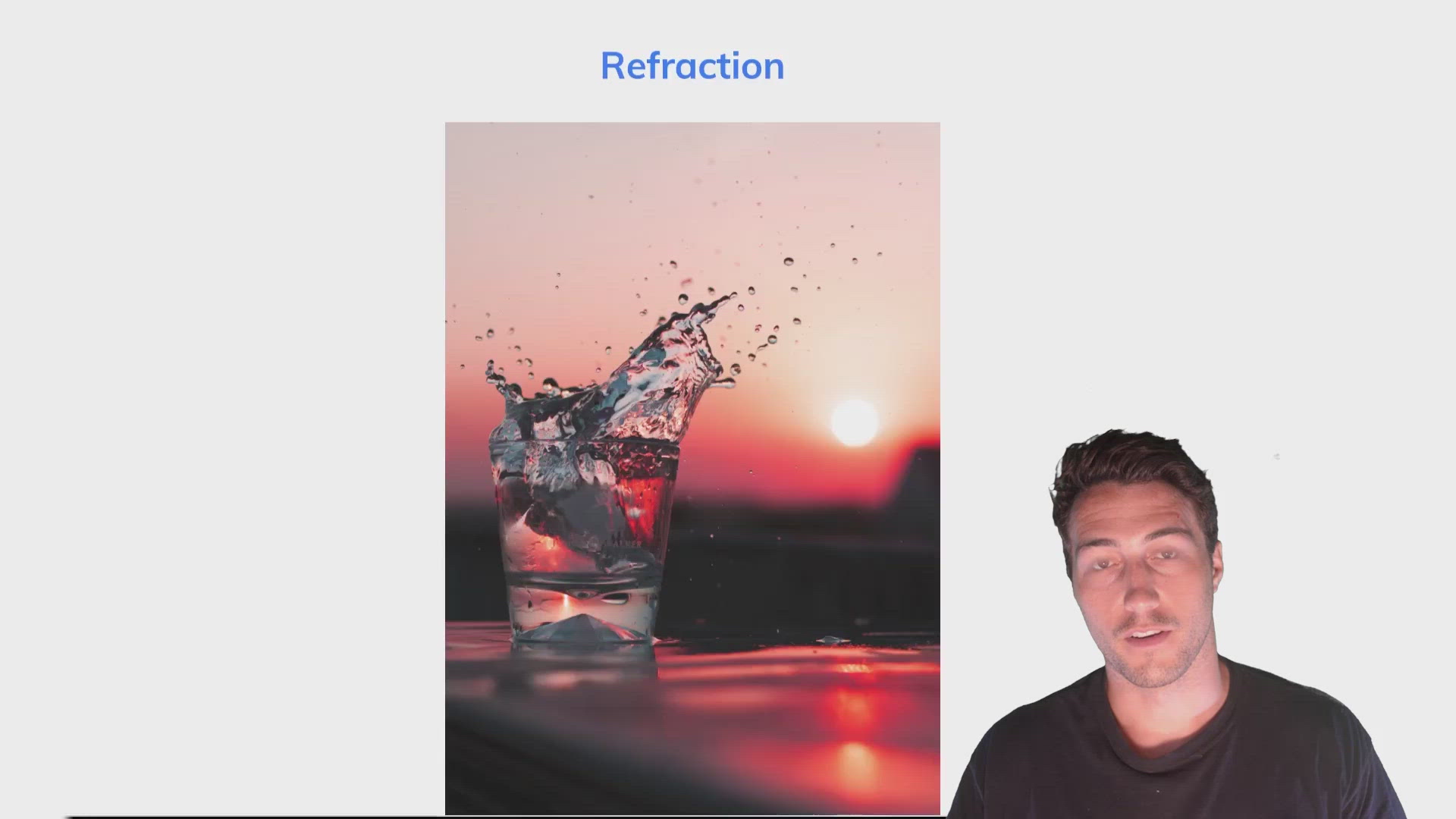
Refraction
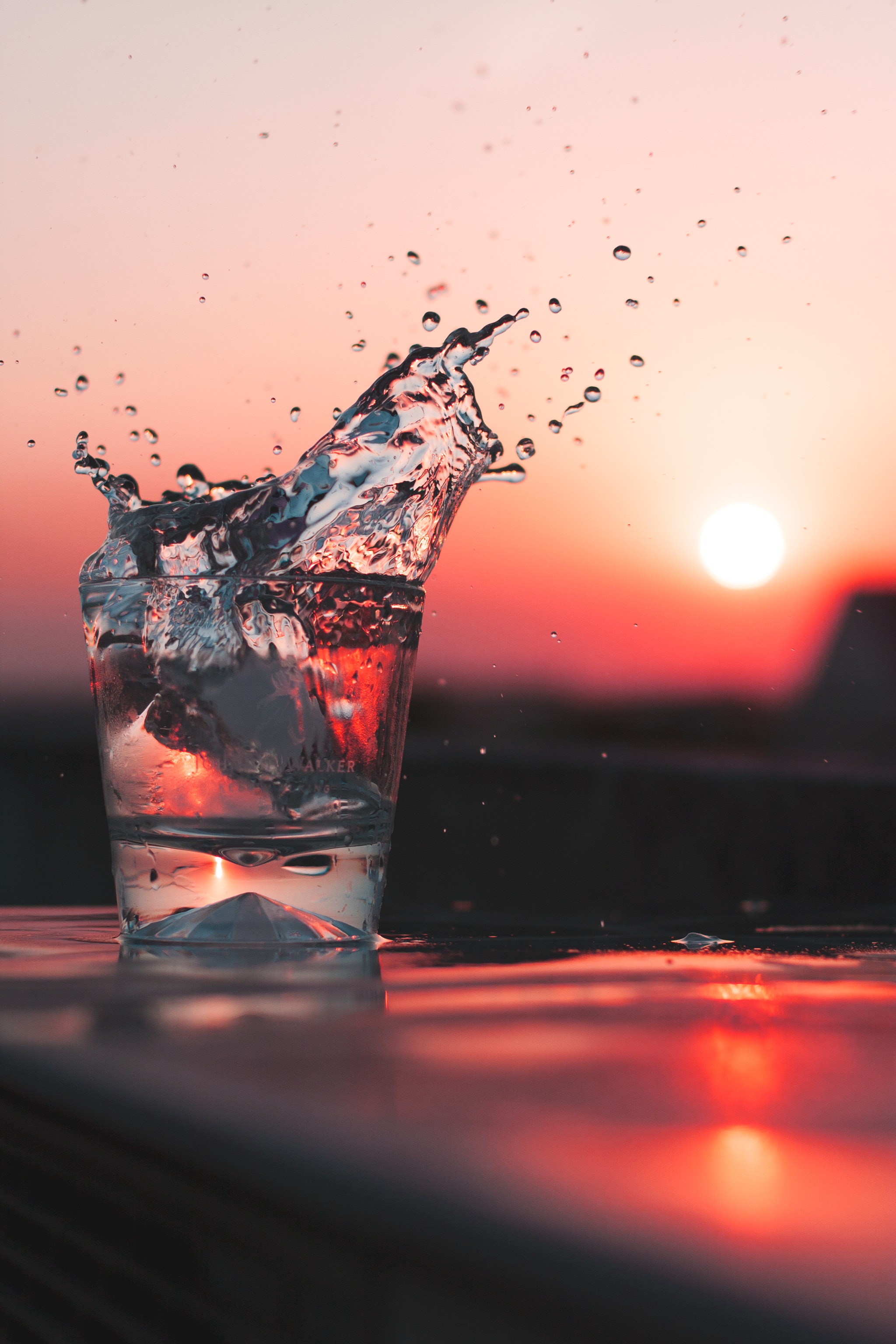
Refraction is the change in direction of a wave due to a change in its transmission medium.
When light travels from vacuum to another medium (or between two media) its frequency (color) stays the same.
Wize Concept
- According to the wave equation , if frequency stays the same then the speed and wavelength will change.
- In this case the speed and wavelength are proportional to each other, so decreasing one will also decrease the other.
The index of refraction tells us how fast light is moving through a medium, and is specific to that medium
- is the speed of light in vacuum
- is the speed of light in the medium
- is the index of refraction ( in vacuum)
Exam Tip
- The index of refraction in a medium is always greater than 1, since the speed through a medium will always be smaller than the speed in vacuum.
- A higher index of refraction corresponds to a slower speed of light in that medium, and shorter wavelength.
Snell's Law:
- and are the speed of light in the first and second medium
- and are the refractive indices in the first and second medium
- and are the wavelengths of light in the first and second medium
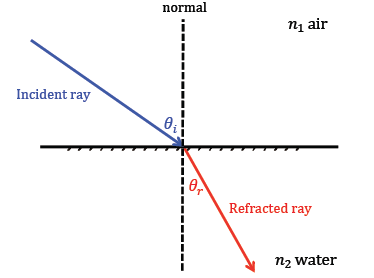
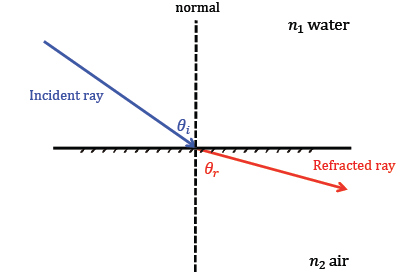
- is the angle of incidence (in the first medium) and is the angle of refraction (in the second medium)
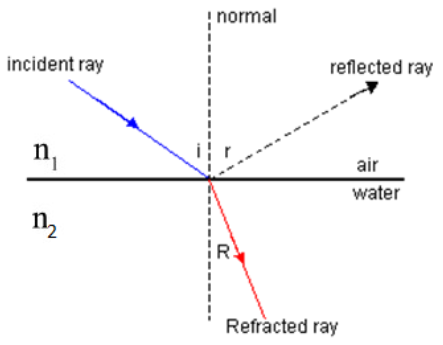
Wize Concept
- If , light will bend towards the normal.
- If , light will bend away from the normal.
Refraction through multiple layers
- If light passes through multiple parallel layers of different media with different indices of refraction, the angle of refraction after one layer becomes the angle of incidence for the next layer.
- When considering parallel layers, you can skip to the layer of interest and write Snell's law for the initial and final layers.
- If light comes out of the same medium into which it entered, the final angle of refraction will be the same as the original angle of incidence.
0:00 / 0:00
Example: Fish Tank
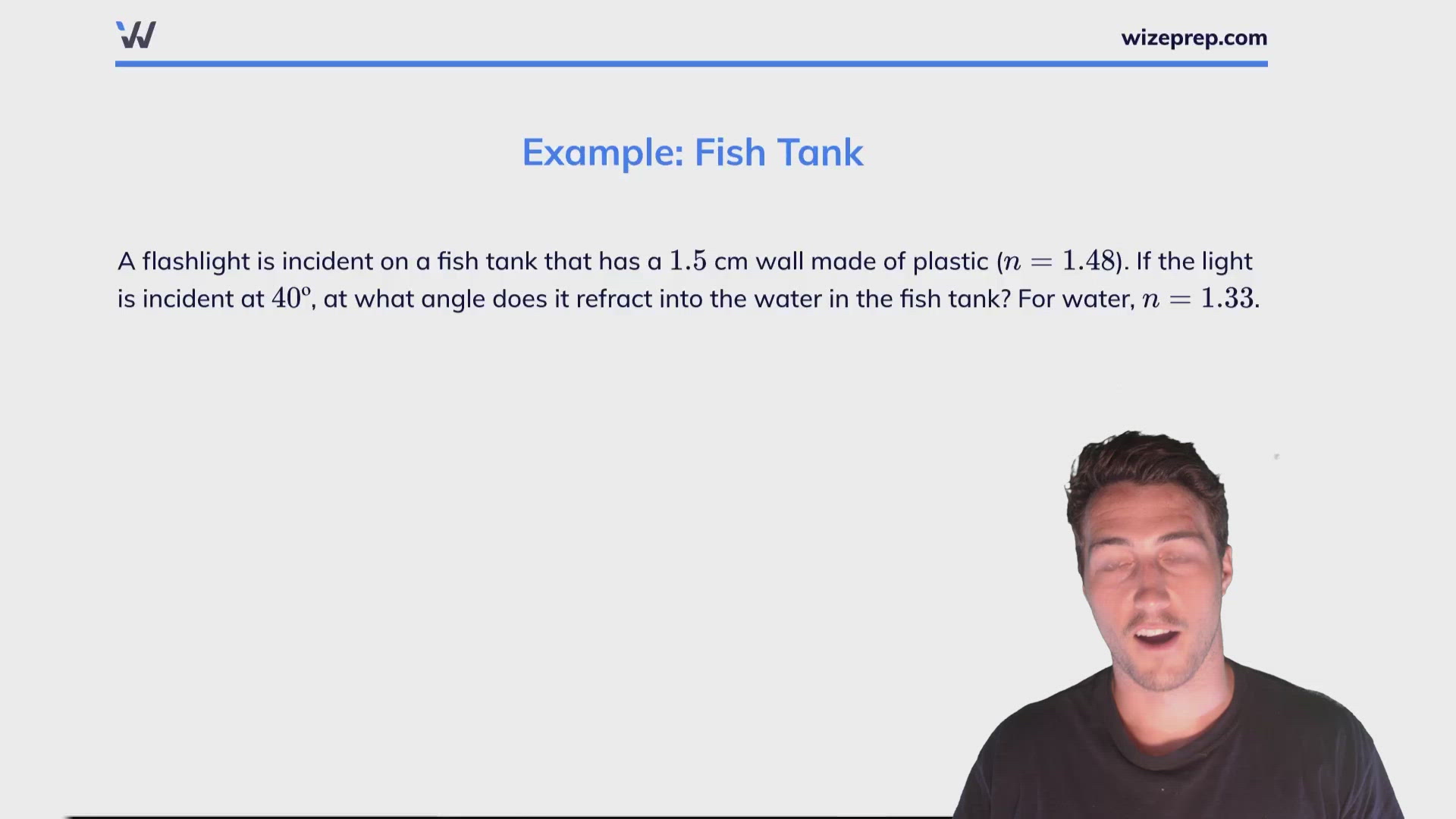
A flashlight is incident on a fish tank that has a cm wall made of plastic (). If the light is incident at , at what angle does it refract into the water in the fish tank? For water, .
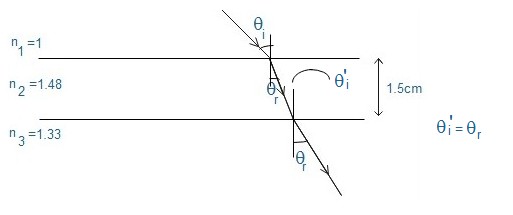
First refraction, from air to plastic:
Second refraction, from plastic to water:
Put the numbers in:
Wize Tip
- We didn't even need the ! That's because we algebraically combined the equations before putting any numbers in. If you do this, you can solve the question even when is not given.
- Physically, this means that the layer of plastic between air and water does not affect the final angle of refraction in water: it's like the plastic isn't even there!
Practice: Fish Hunts an Insect
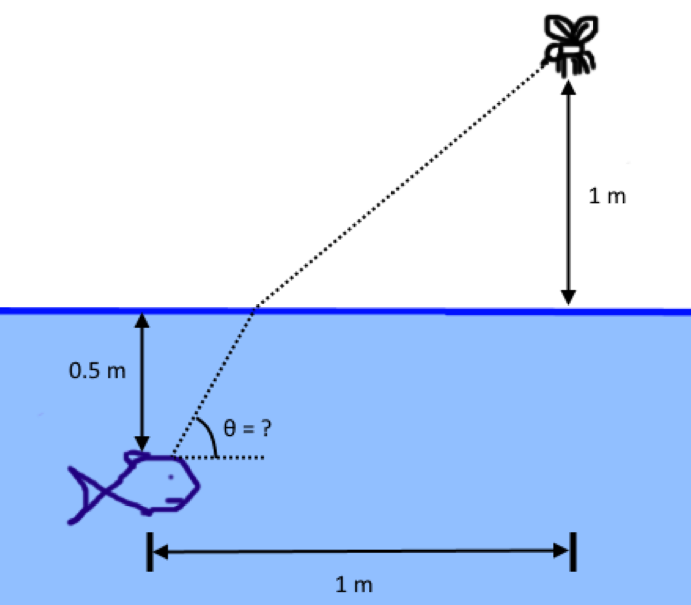
The archerfish can create high-pressure in its mouth and spit out a water gun to shoot down insects that are even a few meters above the water surface. In the following situation, at what angle does the archerfish perceive its prey? (The index of refraction of water is )
Note: You will need to use a graphing or equation-solving software.
Practice: Twins In-front of a Mirror
Two twins are standing 5.2 m apart from each other in front of a mirror comparing outfits. They are 2.5 m from the mirror. At what angle should one of the twins shine a laser so that the reflected beam hits the other twin? Answer in degrees.