Wize University Physics Textbook (Master) > Geometric Optics
Microscopes and Telescopes
Popular Courses
MCAT
General Course
PHYSICS 1201A/B
Western University
Grade 12 Physics
Canada High School
Physics 30
Alberta High School
PHY 1122
University of Ottawa
PHYS 142
McGill University
ENGG 212
University of Calgary
PHY132H1
University of Toronto
PHY132H1
University of Toronto
PHYS 102B
University of Victoria
PHYS 111
University of Victoria
PHYSICS 1101A/B
Western University
PHYS-1300
University of Windsor
PHY 1121
University of Ottawa
PHYS 121
University of Waterloo
PHYSICS 1102A/B
Western University
PHYS 206
Concordia University
PHYS 227
University of Calgary
SC/PHYS 2020 3.00
York University
PHYS 116
Queen's University
Angular Size
The human eye sees a maximum angular size at the near point ( cm):
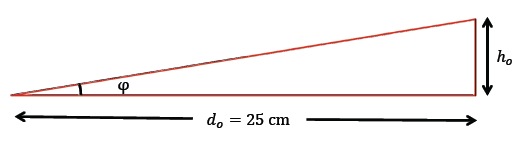
The maximum angular size the eye can focus is:
where we have used , and also the small angle approximation .
The angular magnification is defined as:
Combining this with the thin-lens equation yields:
Microscopes
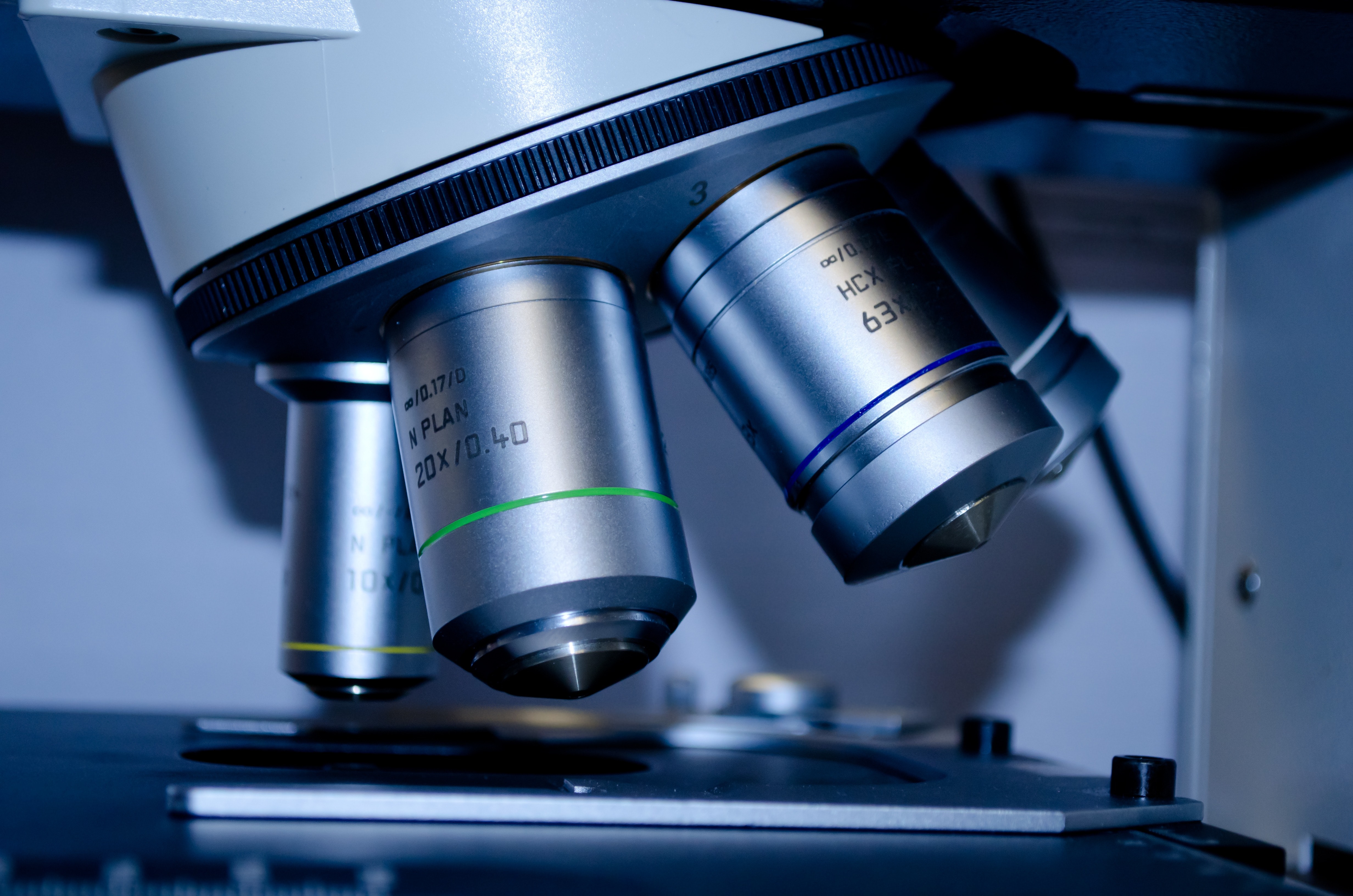
A compound light microscope uses two converging lenses to amplify magnification.
- The first lens (objective) has a short focal length, so that objects placed outside this focal length form a real, inverted, magnified image.
- The second lens (ocular) has a longer focal length.
- The image formed by first lens is located inside the focal length of the second, so the second lens produces a further magnified, virtual image that is then seen by the eye.

The total magnification is the product of the magnifications & produced by the objective & eyepiece lenses:
This can also be written as:
- is the length of the microscope's tube (the distance between the lenses)
- is the focal length of the objective lens
- is the focal length of the eyepiece lens

0:00 / 0:00
Telescopes

Telescopes are optical instruments used to see objects at far distances. Their construction can be of two types: reflecting or refracting.
Refracting telescopes
Refracting telescopes work with the same mechanism as the compound microscope. In this case, the distance between the objective and ocular lens is the length of the telescope tube.
Reflecting telescopes
Reflecting telescopes work by gathering as much light as possible to provide a detailed image. They consist of a large, concave, parabolic mirror. Light from very distant objects is focused in the mirror, producing a magnified, inverted virtual image.
Reflecting telescopes are useful for looking at stars and planets in space, where enough detail cannot be seen with a refracting telescope.
Example: Angular Magnification
Which of the following option improves the largest angular magnification for the compound microscope?
A) Increase the focal length for both the objective and the eyepiece
B) Increase the focal length of the objective, but decrease that of the eyepiece
C) Decrease the focal length of the objective, but increase that of the eyepiece
D) Decrease the focal length of both the objective and the eyepiece
Decreasing either the focal length of the objective or that of the eyepiece increases the magnification. Therefore, decreasing both will improve the magnification is the most.
The answer is D).
Solvia wants her new compound microscope to be able to have a magnification of 100. She already bought an eyepiece with a focal length of 1 cm and an objective of focal length 5 cm. What must be the distance between the two lenses for the maximum magnification to be as she desires?