Wize University Physics Textbook (Master) > Periodic Motion: Oscillations
Basic Concepts of Oscillation
Popular Courses
MCAT
General Course
Intro to Physics
University Study Guides
Grade 12 Physics
Ontario High School
PHYSICS 1D03
McMaster University
AP Physics C: Mechanics Exam Prep Course
AP Exam Prep
Physics
General Course
PHYS 157
University of British Columbia
Grade 12 Physics
Canada High School
PHYS 101
McGill University
PHYS 131
University of British Columbia
PHYS 204
Concordia University
Intro to Physics
University Study Guides
PHYS*1300
University of Guelph
PHYS 131
McGill University
APSC 112
Queen's University
PHYSICS 1402A/B
Western University
LE/PHYS 1800 3.00
York University
PHYS-1400
University of Windsor
PHYS-1400
University of Windsor
PHY131H1
University of Toronto
0:00 / 0:00
Simple Harmonic Motion
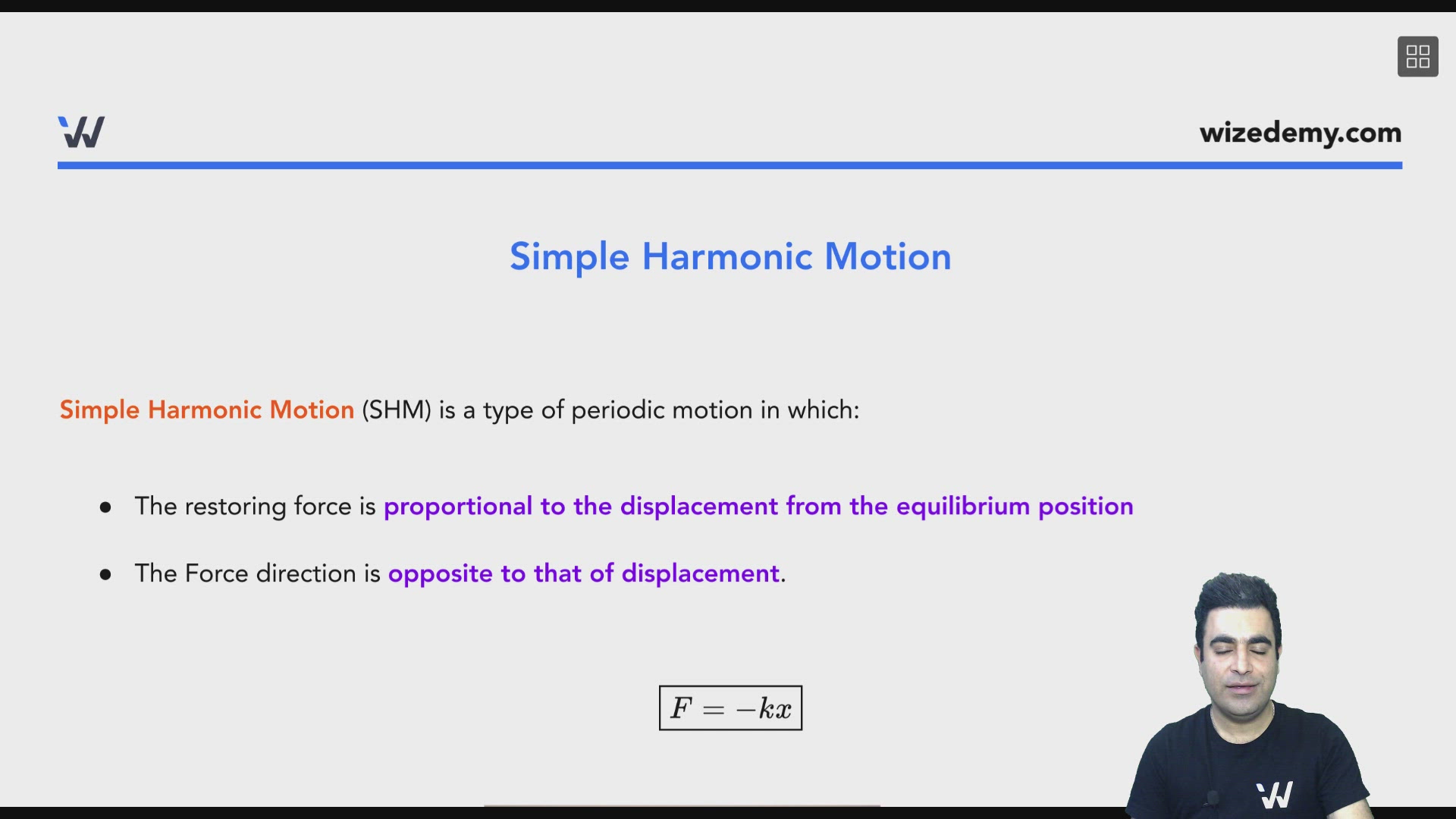
Simple Harmonic Motion (SHM) is a type of periodic motion in which:
- The restoring force is proportional to the displacement from the equilibrium position
- The Force direction is opposite to that of displacement.

Wize Tip
Any physical system with the above type of the force undergoes a Simple Harmonic Motion. Constant in the above equations depends on the physical property of the oscillating system.
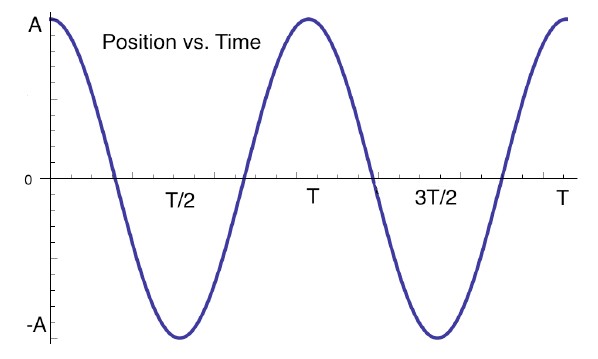
The mathematical description of SHM is a sinusoidal function of time:
Watch Out!
SHM can be described by either sine or cosine function!
These are the parameters we use to describe a simple harmonic motion:
- Amplitude (A): The maximum displacement of the object from the equilibrium.
- Period (T): The time it takes for one complete oscillation (Period is measured in seconds).
- Frequency (f): The number of oscillations per unit of time (Frequency is measured in Hertz (1 Hz=1/s)).
- Angular frequency (): The rate at which argument of sinusoidal function describing oscillation changes in time (Angular frequency is measured in ).
0:00 / 0:00
Simple Harmonic Motion
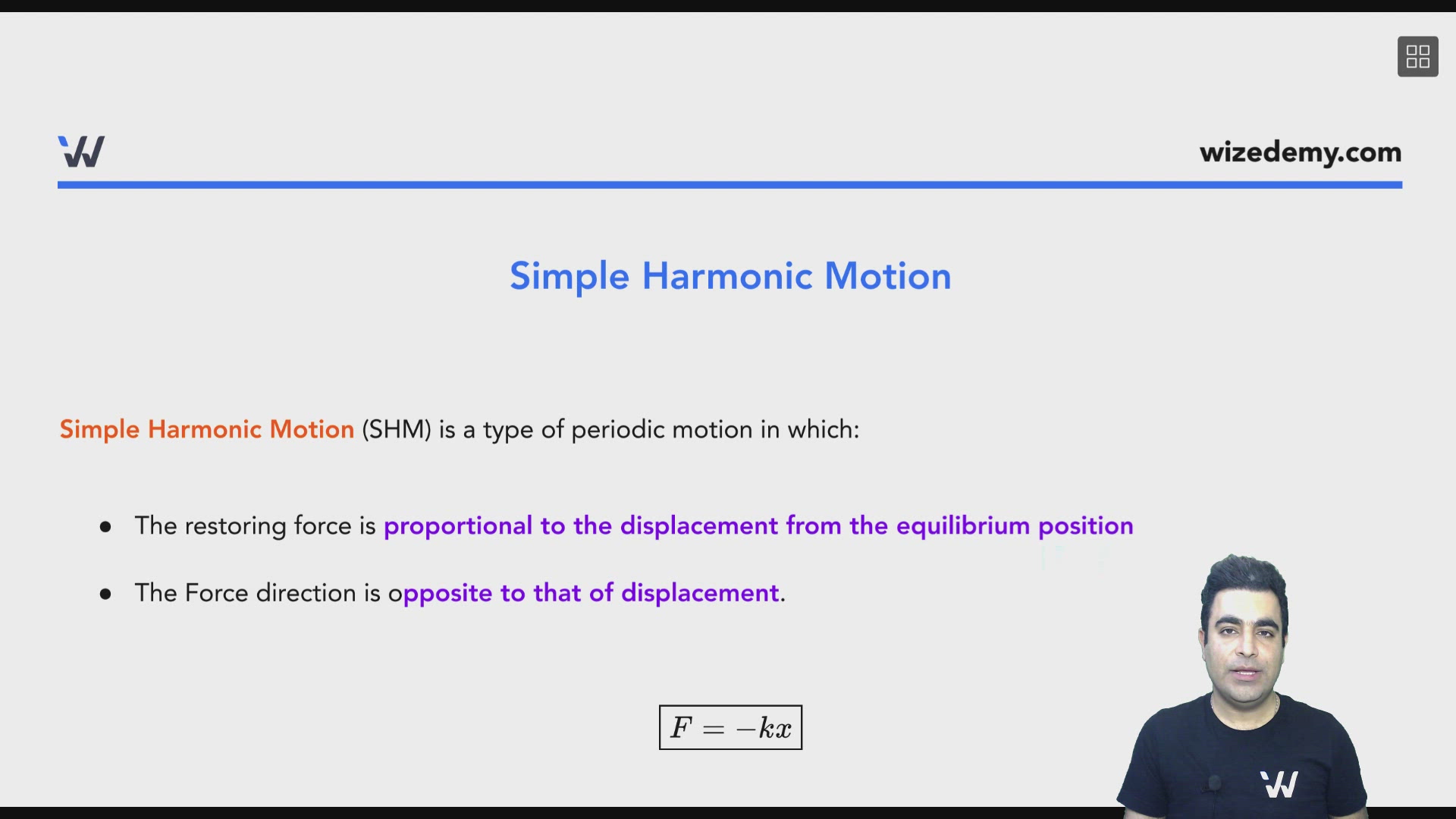
Simple Harmonic Motion (SHM) is a type of periodic motion in which:
- The restoring force is proportional to the displacement from the equilibrium position
- The Force direction is opposite to that of displacement.

Wize Tip
Any physical system with the above type of the force undergoes a Simple Harmonic Motion. Constant in the above equations depends on the physical property of the oscillating system.
The mathematical description of SHM is a sinusoidal function of time:
Watch Out!
SHM can be described by either sine or cosine function!
These are the parameters we use to describe a simple harmonic motion:
- Amplitude (A): The maximum displacement of the object from the equilibrium.
- Period (T): The time it takes for one complete oscillation (Period is measured in seconds).
- Frequency (f): The number of oscillations per unit of time (Frequency is measured in Hertz (1 Hz=1/s)).
- Angular frequency (): The rate at which argument of sinusoidal function describing oscillation changes in time (Angular frequency is measured in ).
- Phase Constant (): A term which determines the initial condition of oscillation (Phase constant is measured in ).
Phase constant causes a shift in the oscillating function which changes the starting point of oscillation:

Exam Tip
To calculate the phase constant , we need to solve this equation:
Watch Out!
It is important to know that solving above equation for the phase constant will give two answers between and :
We need to choose between these two values based on the other information of the problem.
Write the equation of motion for a 2.3 kg mass attached to a spring with constant 8.0 N/m, when the mass is released from rest at 0.15 m from equilibrium.
x(t) = A cos (wt)
A = 0.15 m
m = 2.3 kg
k = 8.0 N/m
w = sqrt (k/m) = sqrt (8.0/2.3) = 1.9 rad/s
x(t) = 0.15 cos (1.9t)
A girl on a swing is pushed such that she oscillates with a frequency of 2.3 Hz and an amplitude of 1.7 m. (Mass of the girl is 60kg)
Write an equation (position as a function of time) to describe the motion of the girl on the swing assuming that she starts at amplitude.