Wize University Physics Textbook (Master) > Magnetic Induction
Faraday's Law of Induction
Popular Courses
Grade 12 Physics
Ontario High School
High School Physics
US High School
Grade 12 Physics
Canada High School
PHYSICS 1202A/B
Western University
PHYSICS 1E03
McMaster University
Physics 30
Alberta High School
PHYS 223
University of Calgary
APSC 112
Queen's University
PHYSICS 1402A/B
Western University
PHYS 205
Concordia University
Physics 12
British Columbia High School
PHYS 118
University of British Columbia
PHYS 142
McGill University
ENGG 212
University of Calgary
PHY132H1
University of Toronto
PHY132H1
University of Toronto
PHYS 102B
University of Victoria
PHYS-1300
University of Windsor
PHY 1121
University of Ottawa
PHYS 121
University of Waterloo

0:00 / 0:00
Faraday's Law
In this section, we finally reveal the connection between electricity and magnetism!
- Faraday’s Law states that, for a given region, if the magnetic flux changes, there will be an induced electromotive force (emf).
- The magnitude of the induced emf is equal to the rate of change of magnetic flux.
- There are three ways to change the magnetic flux through a region:
- Change the magnetic field strength,
- Change the surface area,
- Change the angle between the magnetic field and the area,
Wize Tip
When it comes to induction, you can usually think of emf as another word for voltage. The difference between emf and voltage is more important when we are talking about batteries with some internal resistance - which is not the case here.

0:00 / 0:00
Example: Faraday's Law
Consider a magnetic field of strength 4.0 T passing through a circular wire loop of radius 2.0 m. The magnetic field passes perpendicularly through the plane of the wire loop.
a) If the magnetic field strength cuts in half over a 1.0 second time interval, what is the induced emf in the wire loop?
b) If you wanted this same magnitude of induced emf from the original setup by changing the radius instead of the magnetic field strength, what would be the new radius of the circle after 1.0 seconds? (Hint: there are two possible answers!)
c) If you wanted this same amount of induced emf from the original setup, but you wanted to keep the magnetic field strength at 4.0 T and keep the wire at 2.0 m, how would you do it (assume a change over 1.0 seconds)?
Part a)
The induced emf is found as follows (only the magnetic field strength is changing):
That is, the induced emf magnitude is volts, or 25.1 V.
Part b)
We need to find the change in radius that will give us the same induced emf. Note that we can either increase or decrease the size of the circle since we are just asking about the magnitude of induced emf.
The original area of the circle is . The new area of the circle is therefore either or . We can find the radius of these circles as follows:
Smaller circle:
Larger circle:
Part c)
We have already changed the magnetic field strength and the area. Time to change the angle!
Note, there's no way for us to make the angle any lower (it is already at zero degrees, with ). Let's find the angle that corresponds to an increase in the cosine by 0.5:
That is, the ring must be rotated so that the area and magnetic field vectors are at an angle of 60 degrees to each other (this is equivalent to saying that the magnetic field forms a 30 degree angle with the plane of the ring).
0:00 / 0:00
Motional EMF
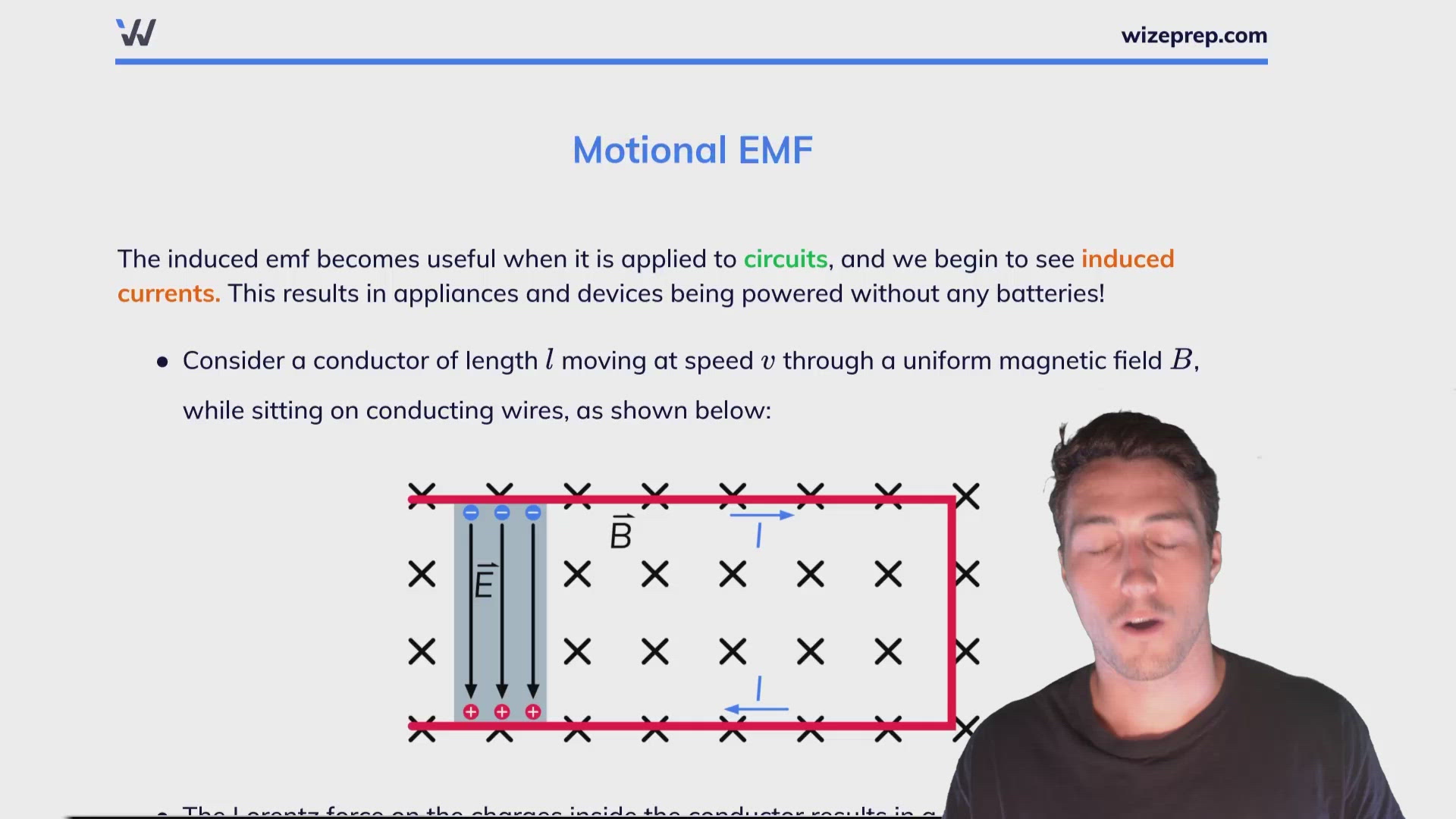
The induced emf becomes useful when it is applied to circuits, and we begin to see induced currents. This results in appliances and devices being powered without any batteries!
- Consider a conductor of length moving at speed through a uniform magnetic field , while sitting on conducting wires, as shown below:
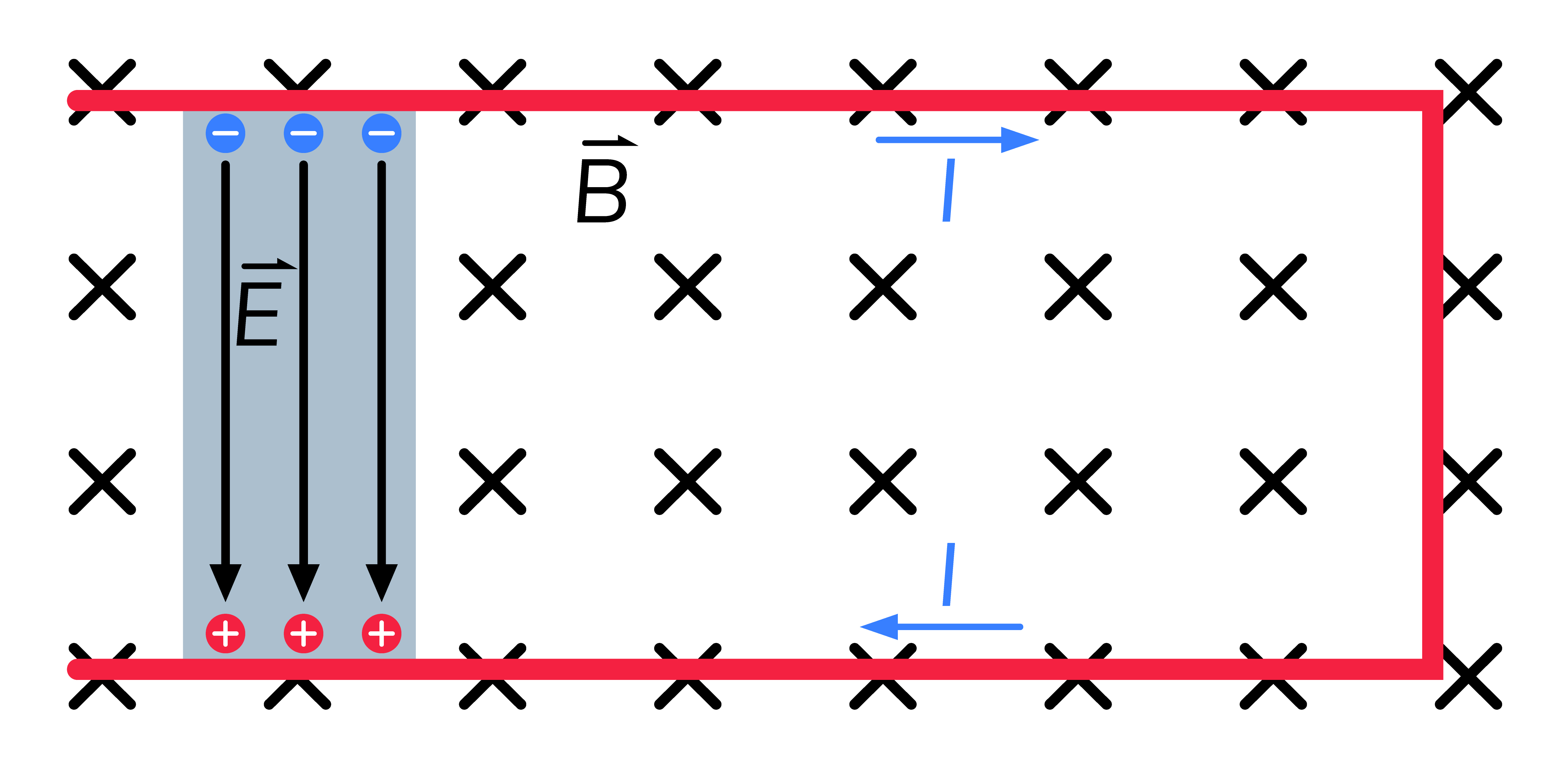
- The Lorentz force on the charges inside the conductor results in a separation of charge that results in a potential difference across the conductor.
- This potential difference is exactly equal to the induced emf in the circuit, and is sometimes called motional emf because it arises due to the motion of the conductor:
- If there are no other circuit elements present, we can use Ohm's Law () to determine the induced current in the circuit, noting that the induced emf and circuit voltage are equal:
0:00 / 0:00
Example: Conductor on Rails
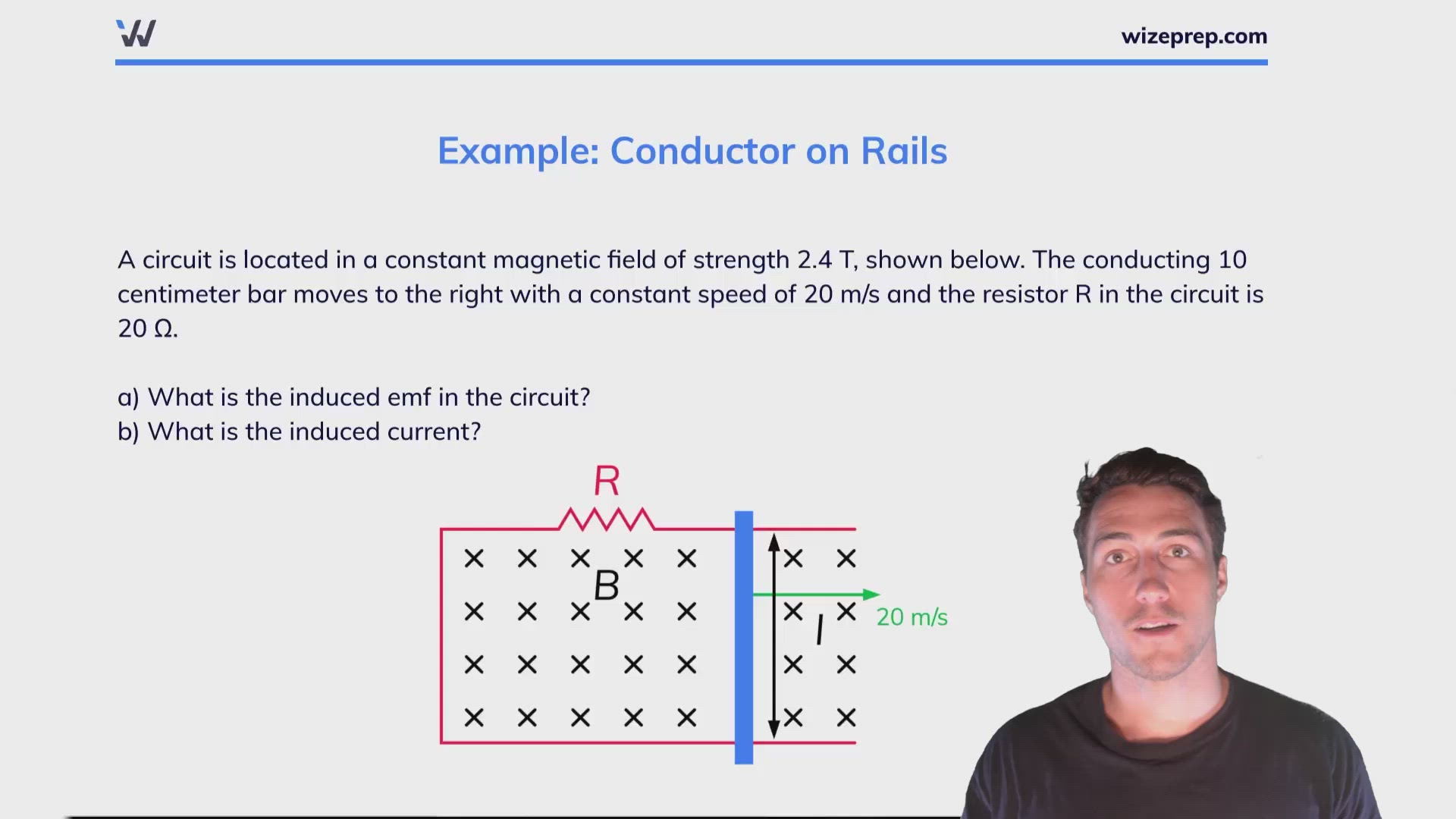
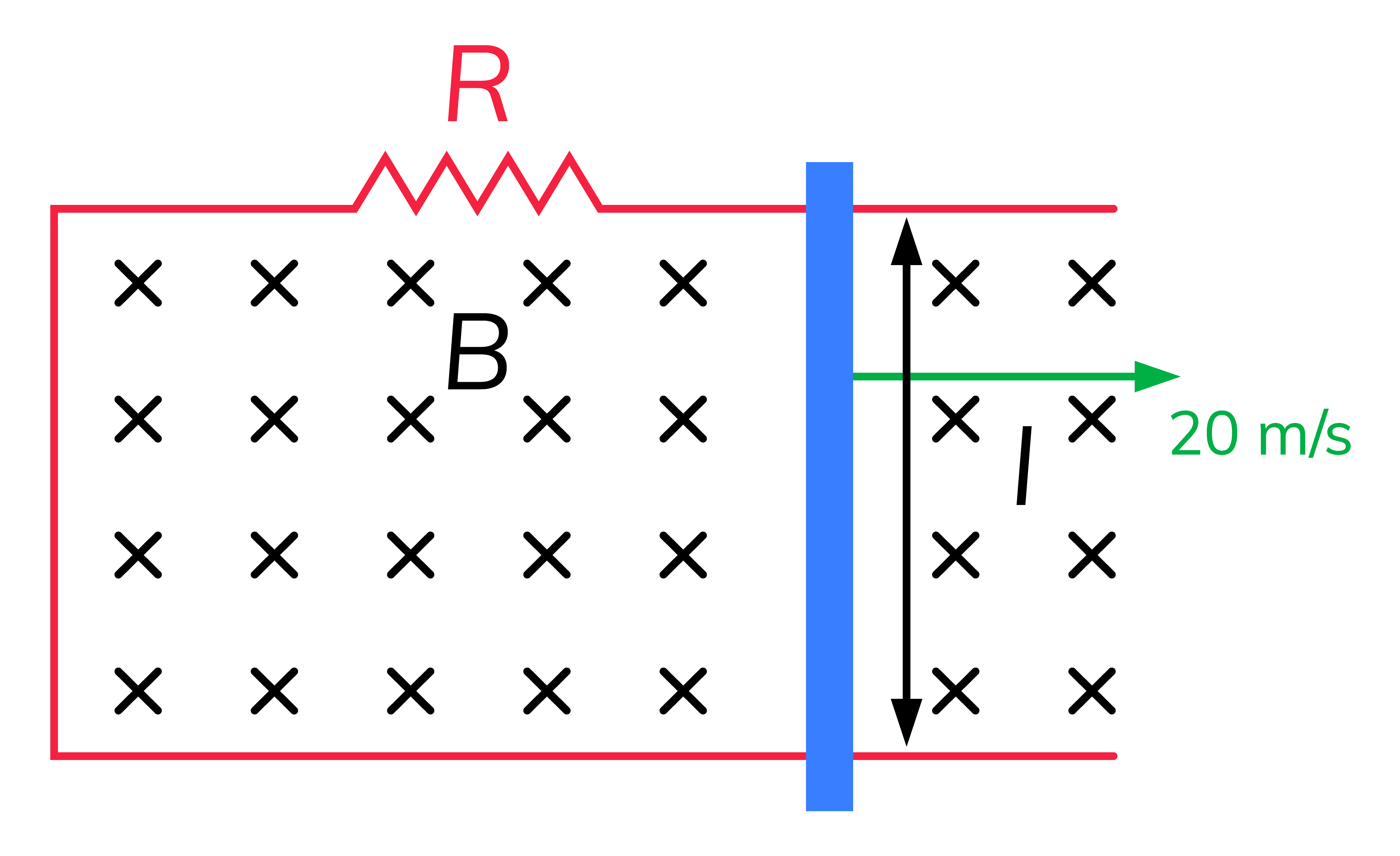
A circuit is located in a constant magnetic field of strength 2.4 T, shown below. The conducting 10 centimeter bar moves to the right with a constant speed of 20 m/s and the resistor R in the circuit is 20 Ω.
a) What is the induced emf in the circuit?
b) What is the induced current?
Part a)
The induced emf can be found with the usual formula:
Part b)
The current is found using Ohm's Law:
Practice: Motional EMF
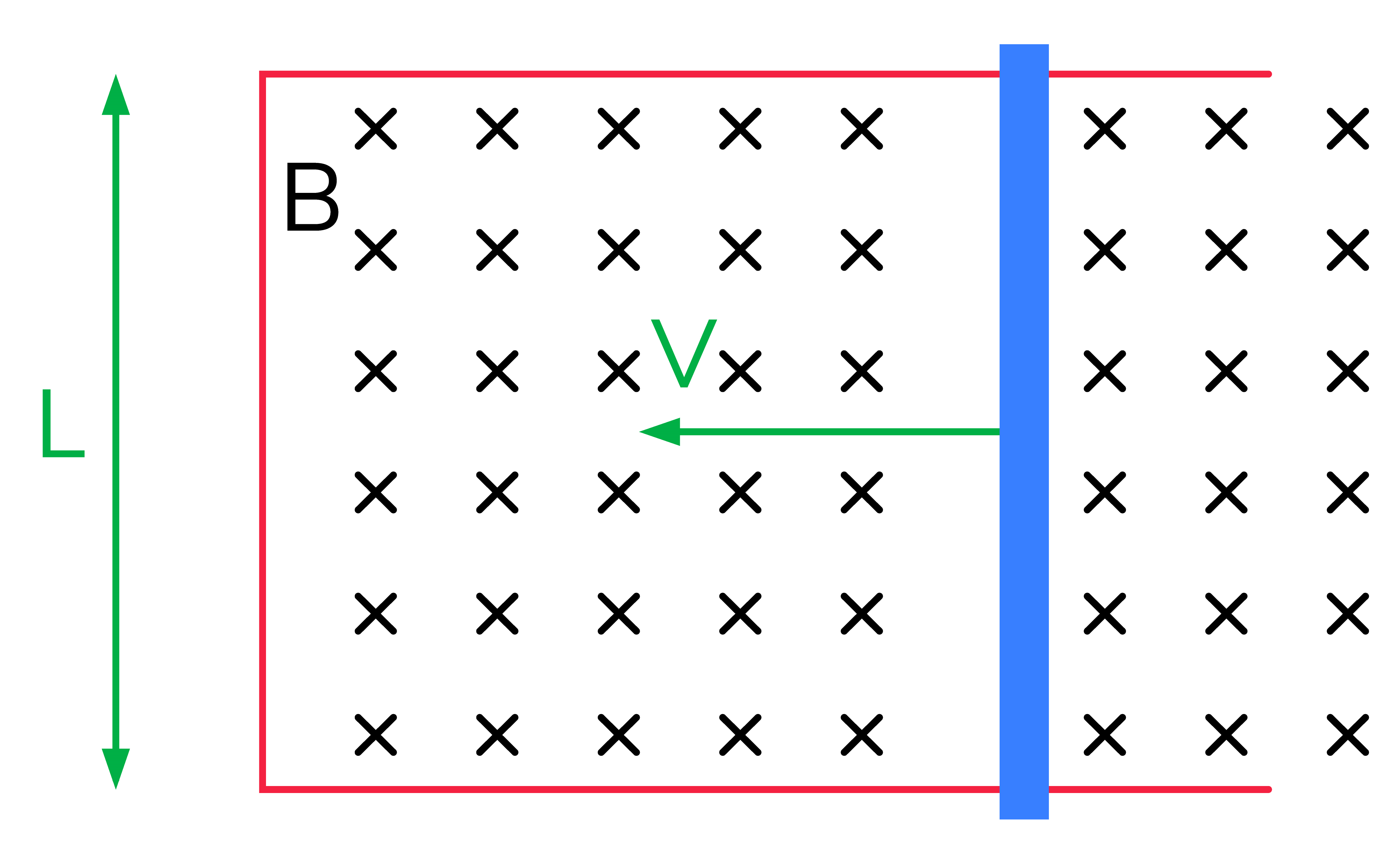
In the diagram below, the blue rod has a resistance of and it is moving with a speed of . The magnetic field is constant at . The length of the rod is 10 centimeters.
a) Find the induced emf and current in the circuit.
b) What force magnitude is required on the blue rod to maintain the constant speed of the bar?
c) How much power is dissipated in the blue bar?
Part a) - induced emf