Wize High School Grade 12 Physics Textbook > Circular Motion
Static Equilibrium
0:00 / 0:00
Static Equilibrium
A system is in a static equilibrium if it has both translational and rotational equilibrium (It does not move and it does not rotate!)
- Newton’s Second Law says that if a body is at rest, or moving at a constant velocity, the sum of all forces on it must be zero. This is known as translational equilibrium:
- Similarly, if an object is at rest and has no angular motion (is not rotating), the sum of all of the torques acting on it must be zero. This known as rotational equilibrium:
Exam Tip
For problems at equilibrium, you have to identify all forces acting on the object and then first set the net force to be zero and then find the net torque for the system and put it equal to zero as well. Using these equations you can solve for the unknowns of the problem.
0:00 / 0:00
Example: Ladder at Equilibrium
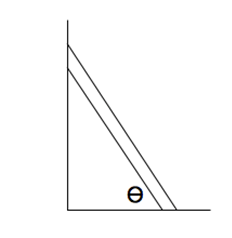
A 3.0 m ladder of mass 12 kg rests against a frictionless wall. The coefficient of friction between the ladder and the floor is 0.60. What is the smallest angle that the ladder can make with the ground if the ladder is to remain at rest?
Solution:
First we start with identifying forces and the location at which they are applied on the ladder in FBD:

We choose the maximum of the static friction because we are looking for the smallest angle.
The ladder is stationary, thus we have static equilibrium.
For torques, we choose the center of rotation to be at the bottom of the ladder, thus the torques produced by N and friction force are zero.
where as usual I chose clockwise torques to be negative and counter-clockwise torques to be positive.
Putting sum of all torques equal to zero we get:
where in the last step I used a trigonometric identity thatis equal to .
From the above equation, we can solve for :
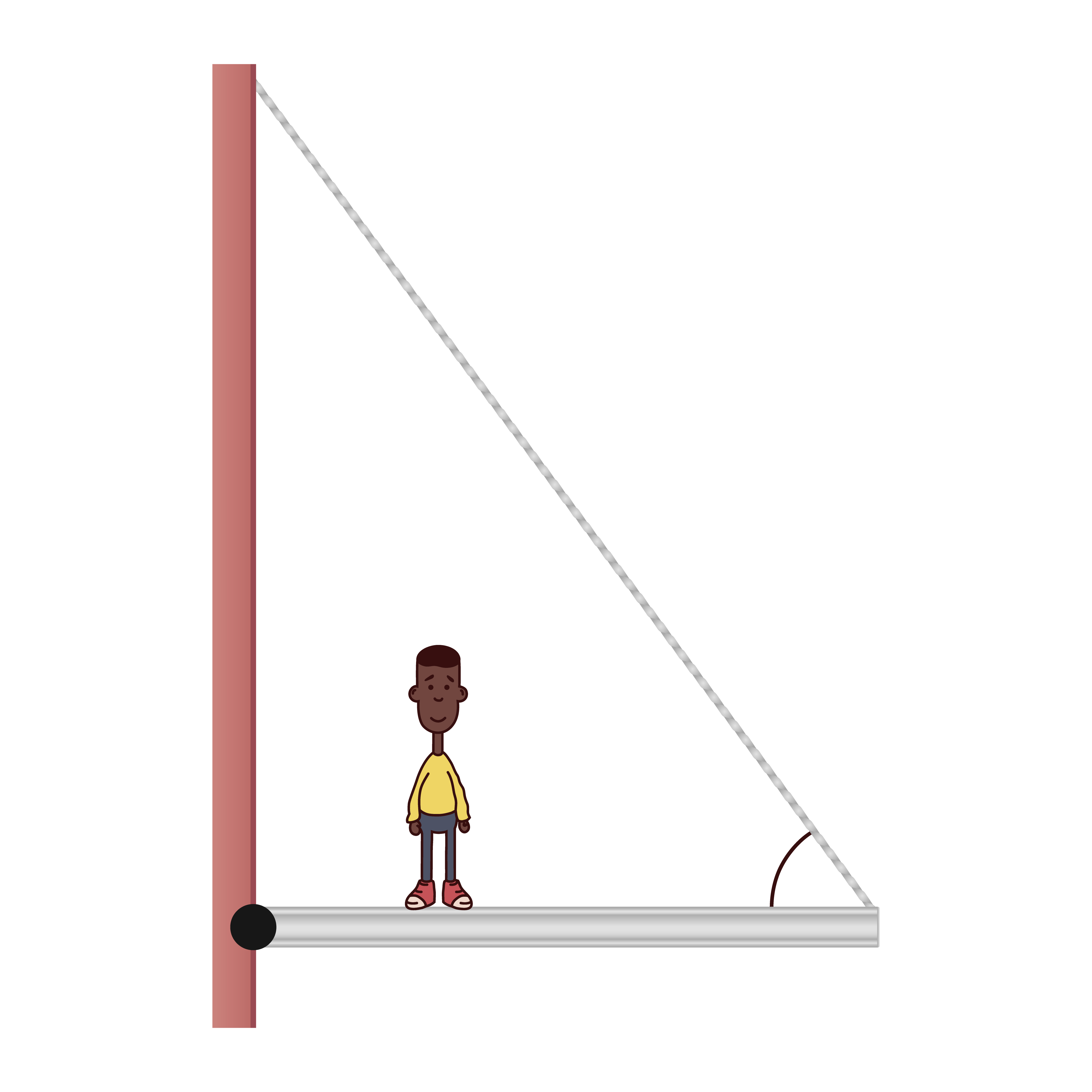
A horizontal beam with a length of 8 meters and weight of 200 N is attached to a wall by a pin connection. Its far end is attached to the cable that makes angle of 53 degrees with the beam. A person of weight 600 N stands 2 meters away from the wall. What is the tension of the cable (T) and the magnitude of the force that wall applies on the beam (R), respectively? (Assume the force from the wall has both horizontal and vertical components.