Wize University Physics Textbook (Master) > Modern Physics
Wave-Particle Duality
Popular Courses
MCAT
General Course
Grade 12 Physics
Ontario High School
High School Physics
US High School
Grade 12 Physics
Canada High School
PHYS*1300
University of Guelph
Physics 30
Alberta High School
PHYS 205
Concordia University
ENGG 212
University of Calgary
PHY132H1
University of Toronto
PHY132H1
University of Toronto
PHYS 102B
University of Victoria
PHYS 111
University of Victoria
PHYS-1300
University of Windsor
PHY 1121
University of Ottawa
PHY 1124
University of Ottawa
PHYS 121
University of Waterloo
PHYSICS 1102A/B
Western University
PHYS 206
Concordia University
PHYS 227
University of Calgary
SC/PHYS 2020 3.00
York University
Photons (Light as a Particle)
Light can be thought of as a wave or as a particle. What it behaves like depends on the nature of the experiment!
- In the double-slit experiment, and interference in general, we observe light as a wave.
- In interactions with other particles (e.g. photoelectric effect, Compton effect), light also behaves like a particle.
Light "particles" are called photons. They are actually packets of energy.
Photon energy:
The energy of a photon is given by:
where is Planck's constant and has the value:
This tells us that energy is quantized - and we are entering the field of quantum mechanics!
Wize Concept
The smallest amount of energy corresponds to a single photon, and we cannot have fractions of , only integer multiples of it.
Exam Tip
Switch between wavelength and frequency using to get two versions of the energy equation:
Photon momentum:
The photon doesn't have mass, so we can't use , instead we define the momentum of a photon as:
de Broglie Wavelength (Particles as Waves)
If light can behave like a particle, then particles can also behave like waves!
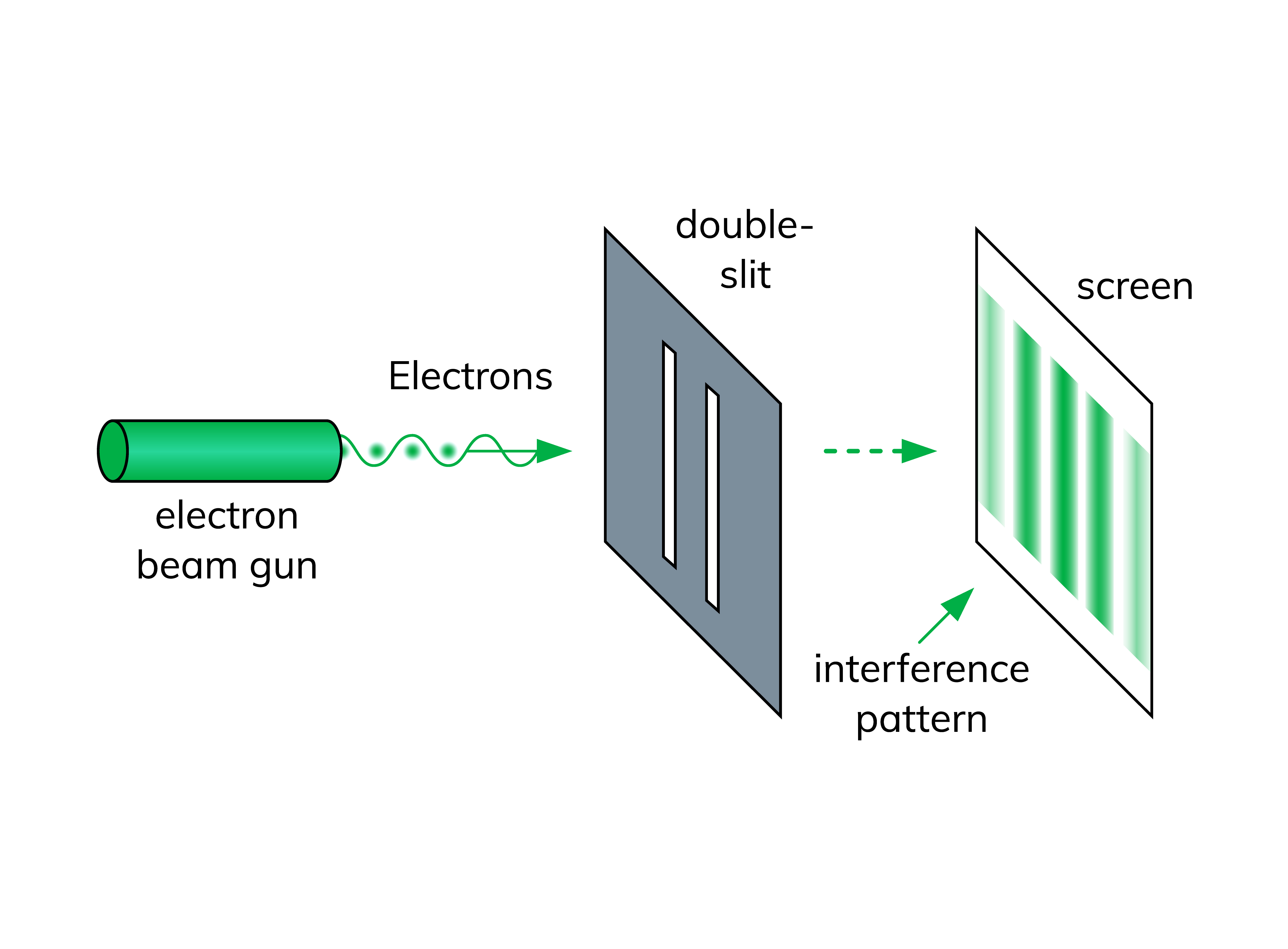
If we design an experiment that highlights the wave nature of things (e.g. interference, diffraction), but do it with particles instead of waves (e.g. with electrons instead of light), then those particles are forced to exhibit their wave-like properties.
Assuming that massive particles can behave like waves, we can equate the momentum of a particle with the momentum of a wave and solve for the wavelength. What we get is the de Broglie wavelength of a massive particle:
- is the de Broglie wavelength of the particle
- is the mass of the particle
- is the speed of the particle
- is Planck's constant
Exam Tip
As the mass or the velocity of the particle increases, the de Broglie wavelength decreases.
Wize Concept
- We can only detect wavelike properties of matter when the wavelength is comparable to the size of the particle.
- We don't observe the objects around as as waves because their very large mass means their wavelength is undetectably small.
Example: De Broglie Wavelength
a) What is the de Broglie wavelength of an electron moving at m/s ?
b) What is the de Broglie wavelength of a baseball of mass g traveling at km/hr ?
c) At what speed does a g golf ball need to move in order to achieve a de Broglie wavelength of nm?
Part a)
The de Broglie wavelength is:
(m)
(nm)
NOTE: The atomic diameter is in the range of m. Therefore this wavelength of an electron can generate measurable diffraction patterns, e.g. when passed through crystals. In other words, this wavelength is significant in the atomic world.
Part b)
The de Broglie wavelength is:
(m)
NOTE: This wavelength is too short to be significant, even in the microscopic world!
Part c)
The speed is given by:
(m/s)
Practice: Light vs. Particle
a) What is the kinetic energy of alpha particle whose wavelength is the same as a photon?
b) For the same problem, if the energy of the photon doubles, by what factor does the corresponding kinetic energy of the alpha change?
c) Using the results from part a) and b), predict the kinetic energy of the alpha if it has the same wavelength as that of a photon.