Wize University Physics Textbook (Master) > Modern Physics
The Compton Effect
Popular Courses
MCAT
General Course
Grade 12 Physics
Ontario High School
High School Physics
US High School
Grade 12 Physics
Canada High School
PHYS*1300
University of Guelph
Physics 30
Alberta High School
ENGG 212
University of Calgary
PHY132H1
University of Toronto
PHY132H1
University of Toronto
PHYS 111
University of Victoria
PHYS-1300
University of Windsor
PHY 1121
University of Ottawa
PHY 1124
University of Ottawa
PHYS 121
University of Waterloo
PHYSICS 1102A/B
Western University
PHYS 227
University of Calgary
SC/PHYS 2020 3.00
York University
PHYSICS 1AA3
McMaster University
PHY 9B
University of California - Davis
PHY 131
Arizona State University - Tempe
0:00 / 0:00
The Compton Effect
To observe the Compton effect, photons are shined onto a gas (e.g. gas of electrons) and they are observed to scatter at different angles with different wavelengths.
Wize Concept
This happens because when a photon hits a particle, it transfers some of its momentum to it, so it ends up having less momentum and therefore a longer wavelength. This is similar to an elastic collision between hard objects: momentum and energy are both conserved.
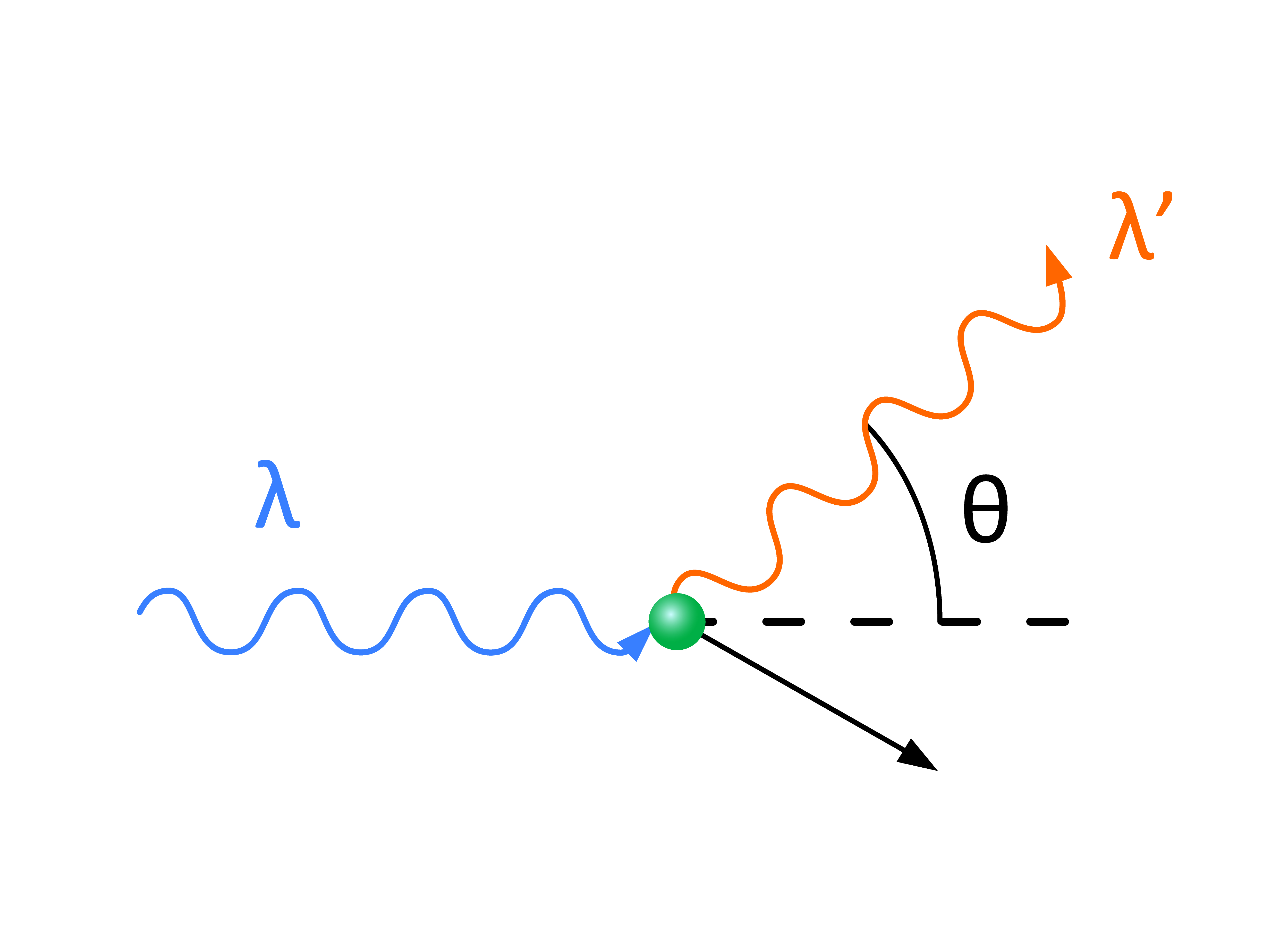
The difference in wavelengths for the incident and scattered photons is given by:
- is the difference between the scattered wavelength () and the incident wavelength ()
- is the angle of the scattered photon measured relative to the original direction of motion
- is Plank's constant
- is the mass of the electron
- is the speed of light
Wize Concept
The maximum change in wavelength happens when the angle is .
Watch Out!
The particle doesn't have to be an electron! So use the mass of the particle you're given (e.g. a proton) in the formula above.
Exam Tip
To find information about the electron, use conservation of momentum and/or conservation of energy.
- Use for the momentum of the photon, and for the particle.
- Use for the energy of the photon, and for the particle.
0:00 / 0:00
Example: Maximum
A m photon strikes an electron at rest.
a) If the angle of the scattered photon is , find the wavelength of the scattered photon.
b) Find the maximum change in wavelength.
Part a)
Isolate the to get:
(m)
Part b)
The maximum happens when is a maximum. Since , the maximum is and it corresponds to , i.e the angle is (the photon turns straight back).
The equation becomes:
(m)
Practice: Compton Effect
Light with a wavelength of m is shined towards a gas of electrons, and the scattered light is observed at angle of with respect to the direction of the incident light. (Use and )
a) What is the wavelength of the scattered light at this angle?
b) What is the momentum of the scattered photon?
c) What is the energy of the scattered photon?
d) What is speed of the scattered electron?
e) What is momentum of the scattered electron (magnitude only)?
f) What is the direction of the scattered electron (the angle below the original photon's direction of motion)?