Wize University Physics Textbook (Master) > Modern Physics
Photoelectric Effect
Popular Courses
MCAT
General Course
Grade 12 Physics
Ontario High School
High School Physics
US High School
Grade 12 Physics
Canada High School
PHYS*1300
University of Guelph
Physics 30
Alberta High School
PHYS 205
Concordia University
ENGG 212
University of Calgary
PHY132H1
University of Toronto
PHY132H1
University of Toronto
PHYS 111
University of Victoria
PHYS-1300
University of Windsor
PHY 1121
University of Ottawa
PHY 1124
University of Ottawa
PHYS 121
University of Waterloo
PHYSICS 1102A/B
Western University
PHYS 206
Concordia University
PHYS 227
University of Calgary
SC/PHYS 2020 3.00
York University
PHYSICS 1AA3
McMaster University
0:00 / 0:00
The Photoelectric Effect
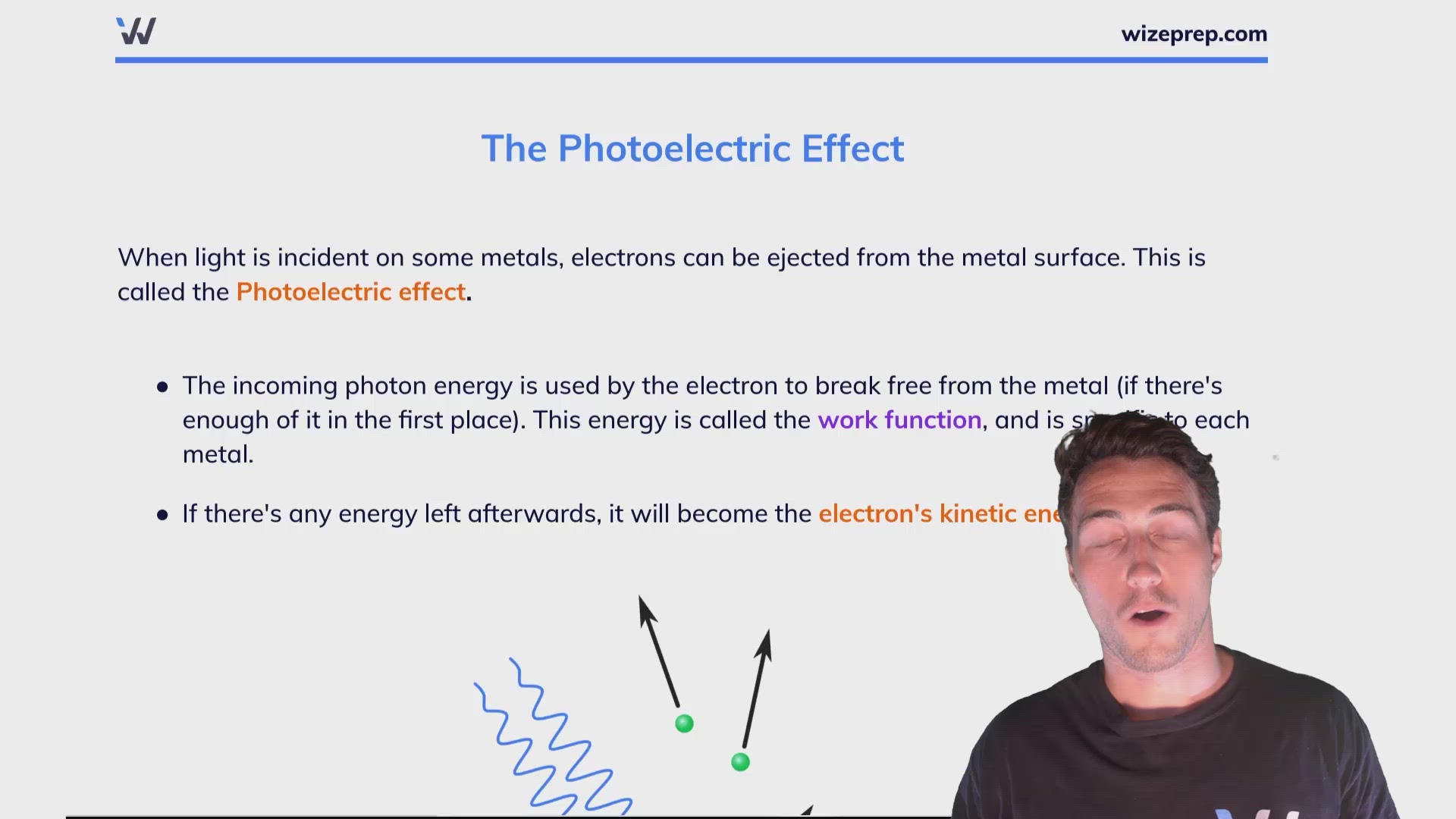
When light is incident on some metals, electrons can be ejected from the metal surface. This is called the Photoelectric effect.
- The incoming photon energy is used by the electron to break free from the metal (if there's enough of it in the first place). This energy is called the work function, and is specific to each metal.
- If there's any energy left afterwards, it will become the electron's kinetic energy.

Using conservation of energy we get:
- is Planck's constant
- is the frequency of the incoming photon
- is the work function of the metal
- is the mass of the electron
- is the speed of the ejected electron
The work function is the amount of energy that holds an electron to the metal surface, i.e. the minimum photon energy that will cause electrons to be ejected. The corresponding photon frequency is called the threshold frequency and is given by:
If the frequency of the photons is below the threshold frequency, no electrons will be ejected. This happens no matter how many photons we have (i.e. the intensity of the light doesn't matter).
Wize Concept
- Increasing the intensity (more photons) only causes more electrons to be ejected, but doesn't increase their energy.
- Increasing the frequency (more available energy) will increase the kinetic energy of the electrons, but not the number of electrons.
The experiment highlights the particle nature of light:
Electrons are "knocked out" by one-on-one, photon-electron collisions
The ejection is "instantaneous": the energy of light is highly localized in space, i.e. it's a particle of light (photon)
The photons transfer momentum to the electrons, which is similar to a hard particle collision (similar to the Compton effect)
Exam Tip
We can re-write the equation at the top as:
which can be graphed as a line:
Exam Tip
If the ejected electrons are then stopped by a potential difference, all their kinetic energy will be converted to electric potential energy (where is the charge of the electron and is the stopping voltage). Then the equation at the top becomes:
0:00 / 0:00
Example: Electron Speed
A certain metal has a work function of eV. If light of wavelength nm is incident on the metal, what is the maximum possible speed of the ejected electrons?
Using conservation of energy we can set up the photoelectric effect equation as:
Rearrange to get speed:
(m/s)

Mark Yourself Question
- Grab a piece of paper and try this problem yourself.
- When you're done, check the "I have answered this question" box below.
- View the solution and report whether you got it right or wrong.
Practice: Two Metals
A beam of photons with frequency Hz and total energy J hit two metals:
Gold ( J ) and Sodium ( J )
a) Which metal(s) will emit electrons?
b) For the metal(s) in part a), calculate the kinetic energy of each ejected electron.
c) For the metal(s) in part a), find how many electrons are ejected.
d) Given that the frequency of light is kept constant, if the total energy of the beam increases, how will the Photoelectric Effect of each metal be affected?