Wize University Physics Textbook (Master) > Modern Physics
Basics of Special Relativity
Popular Courses
Grade 12 Physics
Ontario High School
Grade 12 Physics
Canada High School
PHYS*1300
University of Guelph
Physics 30
Alberta High School
Physics 12
British Columbia High School
ENGG 212
University of Calgary
PHY132H1
University of Toronto
PHY132H1
University of Toronto
PHYS 111
University of Victoria
PHYS-1300
University of Windsor
PHY 1121
University of Ottawa
PHY 1124
University of Ottawa
PHYS 121
University of Waterloo
PHYSICS 1102A/B
Western University
PHYS 227
University of Calgary
PHYS 206
Concordia University
SC/PHYS 2020 3.00
York University
PHYSICS 1AA3
McMaster University
PHYS 120
Simon Fraser University
PHY 9B
University of California - Davis
Lorenz Transformations

Wize Concept
Basis of Special Relativity:
- The laws of physics are the same in all inertial reference frames.
- The speed of light is constant (in vacuum) in all inertial reference frames, and is approximately equal to
Inertial reference frames are systems of coordinates that move with a constant speed relative to each other, but do not accelerate with respect to each other.
In special relativity, every event is represented in the -dimensional spacetime as , where , and are the spatial coordinates and show the point at which this event happens, and is the time at which it happens. All coordinates are measured from an arbitrary "origin" at which they're all zero.
Consider an event shown by in frame .
The coordinates describe the same event in another frame , which is moving along the axis with a constant speed relative to .
The Lorentz Transformations between these two reference frames are:
where Gamma is defined to be:
Wize Concept
- Gamma is also called the dilation factor, and since always, we have .
- When the speed is very small, is close to .
- As the speed approaches the speed of light, approaches infinity.
Exam Tip
If the other reference frame is moving along the or axis instead, then that particular coordinate will be transformed, and the other two will stay the same.
Wize Concept
The Inverse Lorentz Transformations from to can be found by switching , , , and in the equations above.
0:00 / 0:00
Time Dilation and Length Contraction

Time Dilation
The time between two events in not the same in inertial reference frames that are moving with respect to each other.
Clocks run slower in a moving frame compared to a stationary frame. That is why the time they measure between two events is longer than the time between the same two events where the clocks are stationary:
where is the time interval between the two events in the rest frame, and is called the proper time.
- Since , the time interval in the moving frame is greater than the proper time (time dilation).
Length Contraction
Length is also relative. The length of a moving object seen from an inertial reference frame at rest is:
where is the length of the object at rest, and is called the proper length.
- Since , the length in the moving frame is smaller than the proper length (length contraction).
Exam Tip
Length contraction can only happen along the direction of motion.
0:00 / 0:00
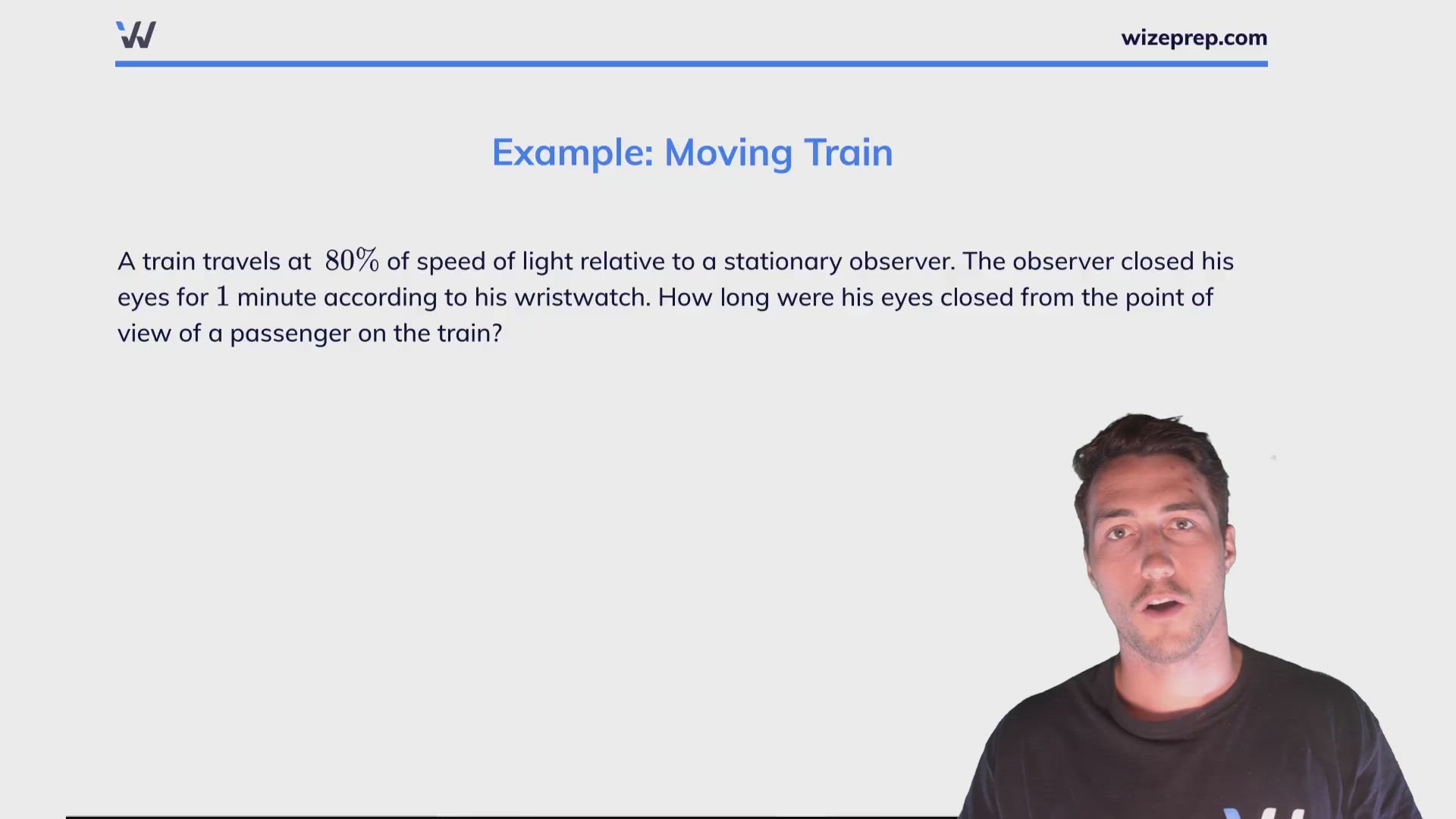
Example: Moving Train
A train travels at of speed of light relative to a stationary observer. The observer closed his eyes for minute according to his wristwatch. How long were his eyes closed from the point of view of a passenger on the train?
We have
Using the time dilation formula we get:
(min)
(s)
Practice: Car in a Garage
A car has length of m at rest. At what speed should the car move to fit in a garage of length m measured by a person that's stationary with respect to the garage? Answer in terms of .
0:00 / 0:00
Relativistic Velocity Transformations
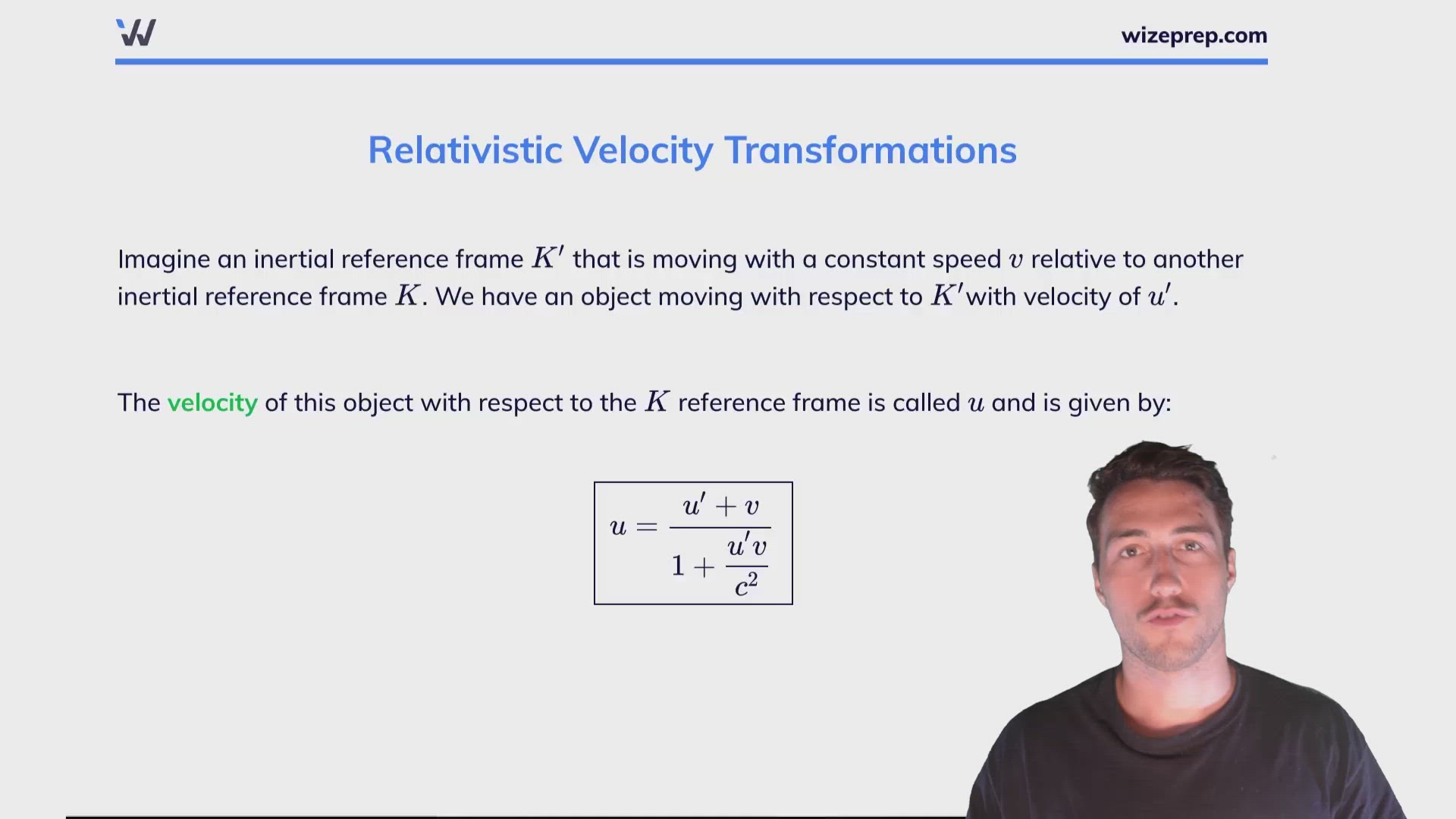
Imagine an inertial reference frame that is moving with a constant speed relative to another inertial reference frame . We have an object moving with respect to with velocity of .
The velocity of this object with respect to the reference frame is called and is given by:
The reverse of this transformation can be found by switching and in the equation above, and is given by:
Relativistic Momentum and Energy
Relativistic Momentum is given by:
with as before.
Relativistic Energy is given by:
If the object is at rest, then and we have the rest mass energy:
The relativistic kinetic energy could be found using:
Watch Out!
These only apply to massive particles. For massless particles such as photons we still have and .
Practice: Relativistic Velocity, Momentum and Energy
A spaceship is moving away from Earth at a speed of relative to Earth when the spaceship captain shoots a bullet of mass g with a speed of relative to the spaceship, in the direction along the motion of the spaceship. Calculate:
a) The speed of the bullet relative to someone stationary on Earth.
b) The momentum of the bullet relative to someone stationary on Earth.
c) The rest mass energy of the bullet.
d) The kinetic energy of the bullet according to the captain.