Popular Courses
MCAT
General Course
Grade 12 Physics
Ontario High School
Grade 12 Physics
Canada High School
PHYS*1300
University of Guelph
Physics 30
Alberta High School
Physics 12
British Columbia High School
ENGG 212
University of Calgary
PHY132H1
University of Toronto
PHY132H1
University of Toronto
PHYS 111
University of Victoria
PHYS-1300
University of Windsor
PHY 1121
University of Ottawa
PHY 1124
University of Ottawa
PHYS 121
University of Waterloo
PHYSICS 1102A/B
Western University
PHYS 227
University of Calgary
SC/PHYS 2020 3.00
York University
PHYSICS 1AA3
McMaster University
PHY 9B
University of California - Davis
PHY 131
Arizona State University - Tempe
0:00 / 0:00
Radioactive Decays
Radioactive nuclei decay until they become stable. The decay happens with probability , also called the decay rate.
The activity is defined as the number of decay processes in a sample per second, given by:
- is the activity of the sample
- is the decay rate
- is the total number of radioactive particles that have not decayed yet
The unit for activity is Becquerel:
The number of radioactive nuclei in a sample decreases based of the following formula:
- is the initial number of radioactive particles in the sample
- is the lifetime, the time it takes for the number of radioactive particles drop by a factor of
Wize Concept
The lifetime and the decay rate are inverses of each other.
Exam Tip
The final and initial quantities and may represent any of the following: number of atoms, mass, activity etc.
0:00 / 0:00
Half-Life
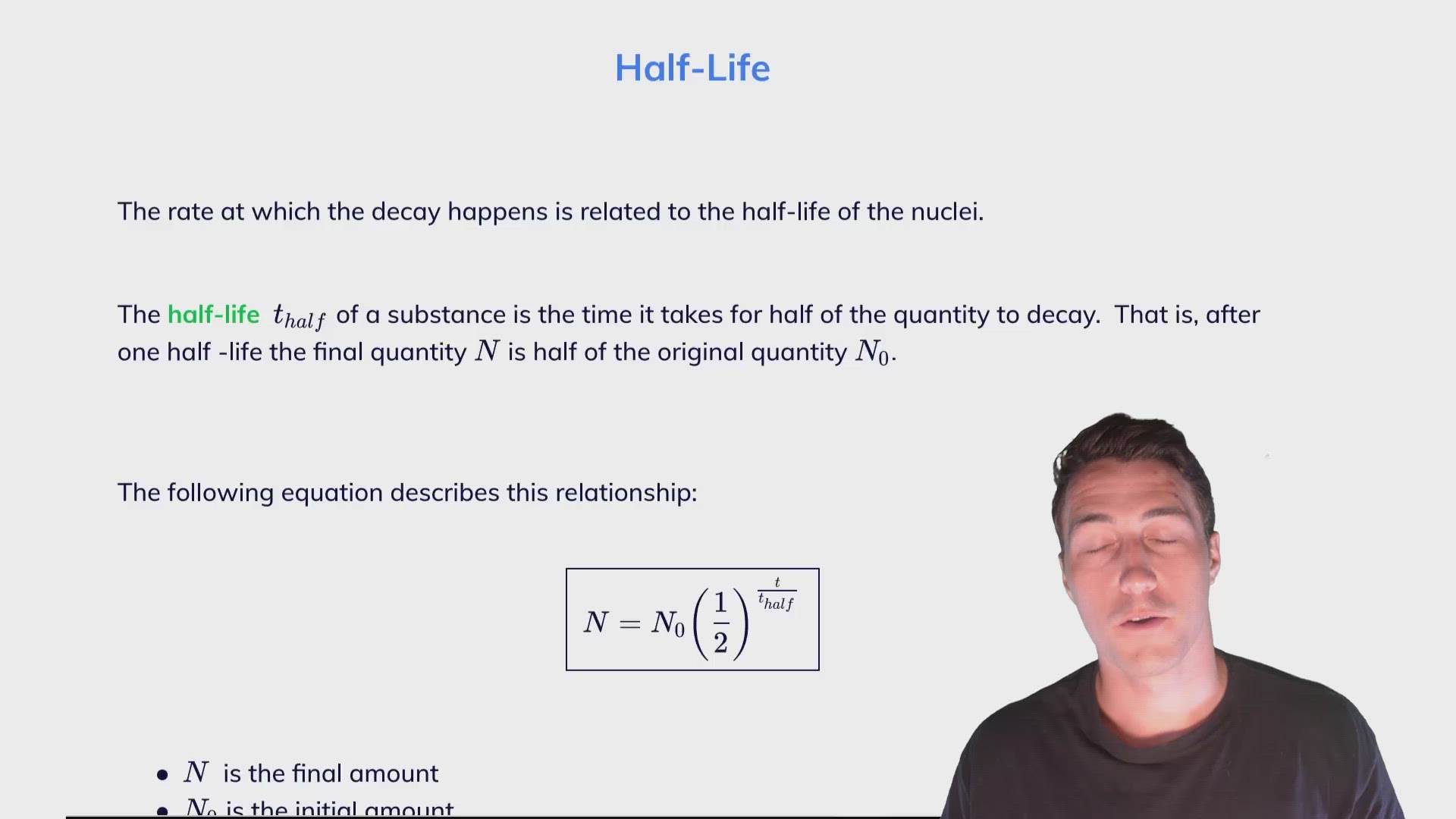
The rate at which the decay happens is related to the half-life of the nuclei.
The half-life of a substance is the time it takes for half of the quantity to decay. That is, after one half -life the final quantity is half of the original quantity .
The following equation describes this relationship:
- is the final amount
- is the initial amount
- is the half-life
The half-life is related to the decay rate and the lifetime by the following:
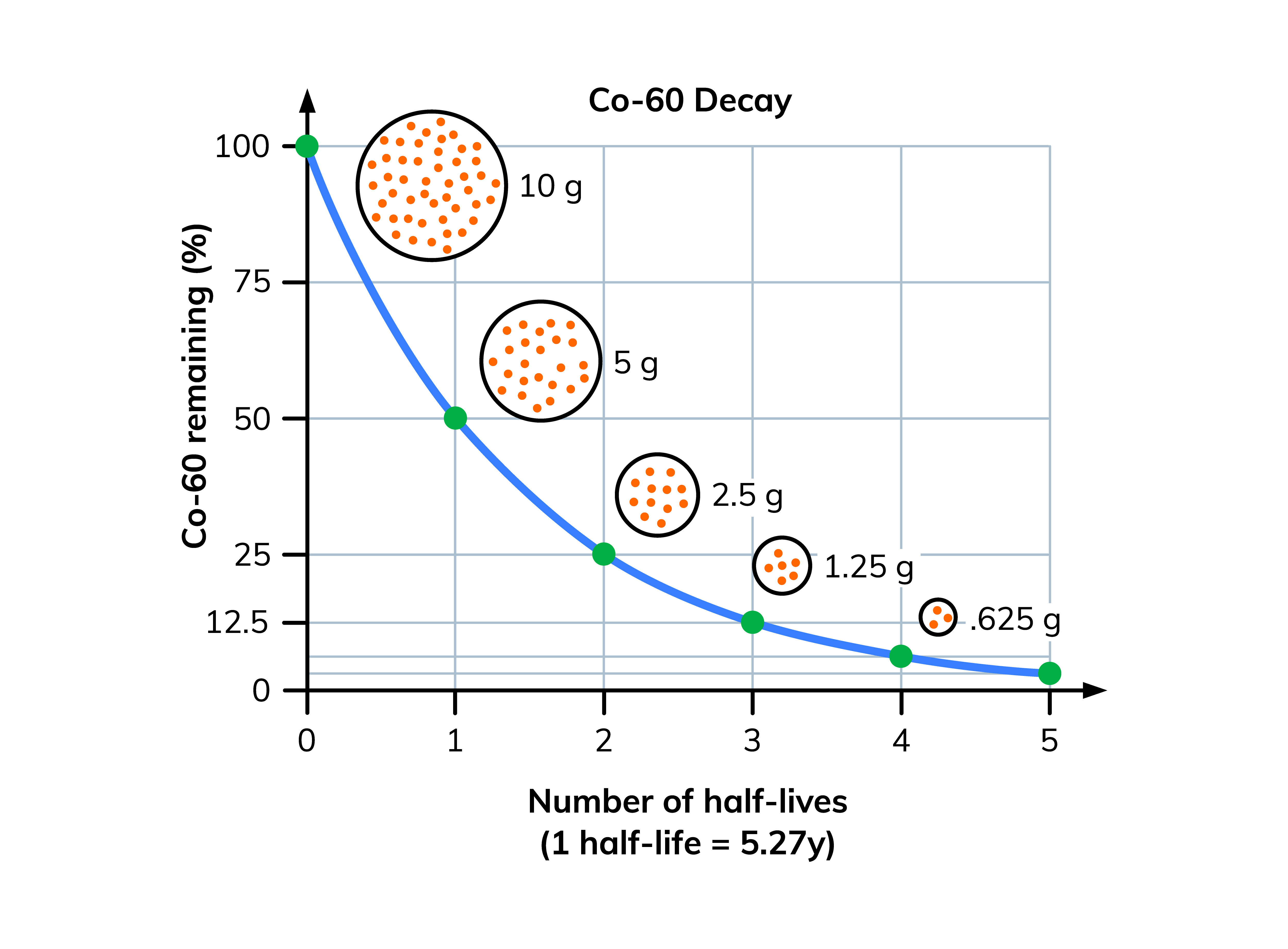
Example: Cobalt-60 is a radioactive isotope that emits gamma rays and is used to treat cancer. It has a half-life of 5.27 years. The cobalt-60 used for the cancer treatment must be replaced regularly to continue to be effective.
Wize Concept
The longer the half-life, the more stable the element is.
0:00 / 0:00
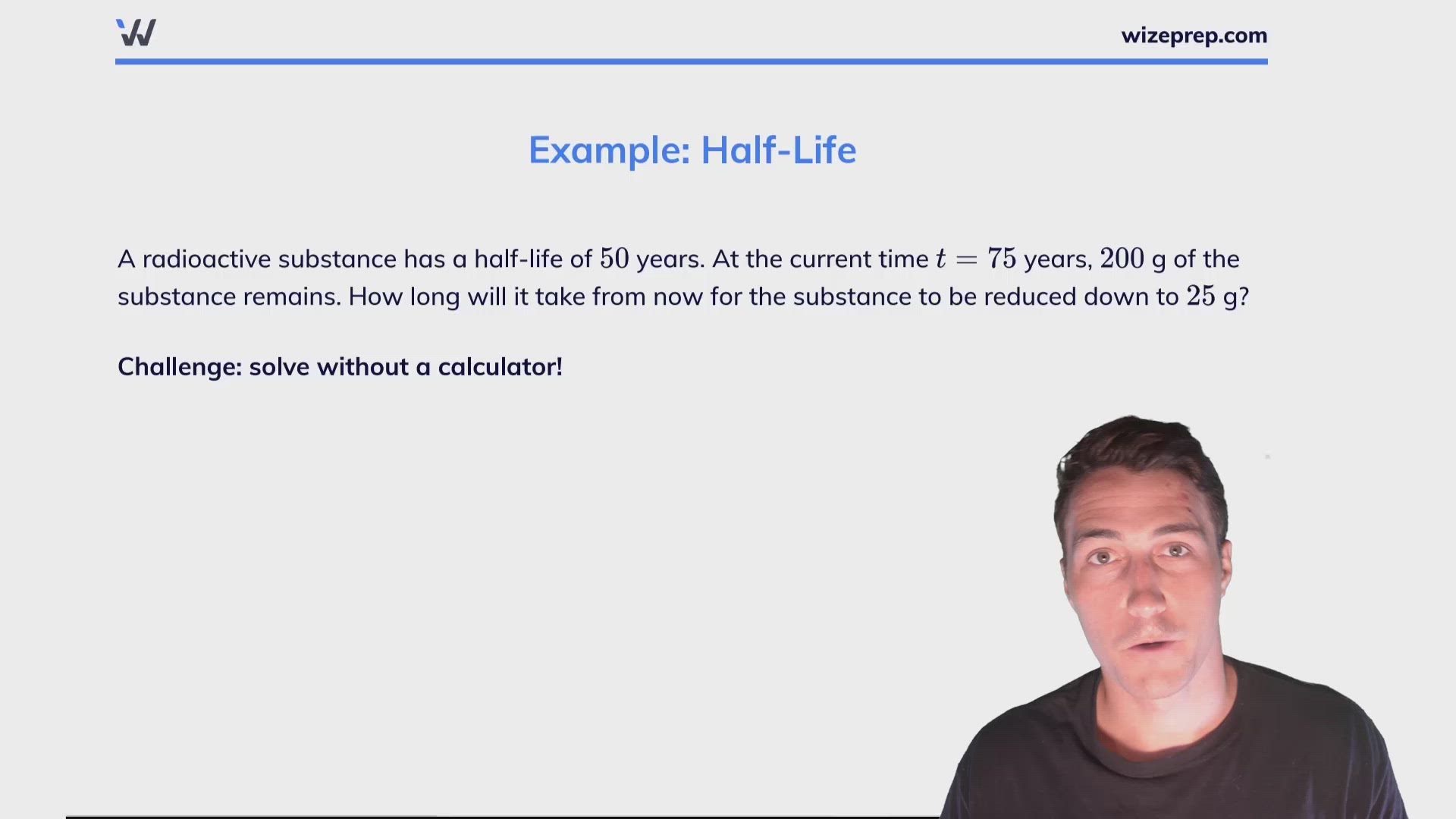
Example: Half-Life
A radioactive substance has a half-life of years. At the current time years, g of the substance remains. How long will it take from now for the substance to be reduced down to g?
Challenge: solve without a calculator!
We know that , and when the amount left is .
Let's put these into our formula to solve for the initial value:
NOTE: There's no need to compute this value. We'll just put it in our equation, which becomes:
Solve for time by using the final value :
Write both sides using the same base of :
Equate exponents to get:
Multiply everything by to eliminate the fractions:
Finally, the time from now () to then () is the difference:
(yrs)
Practice: Half-Life
A radioactive element has an unknown half-life. The original sample weighs g. Two years later, the sample weighs g. What is the half-life of the element?