Popular Courses
COMM 217
Concordia University
ACCT 2301
The University of Texas at Dallas
Intro to Financial Accounting
General Course
COMM 293
University of British Columbia
Intro to Financial Accounting
University Study Guides
MGCR 211
McGill University
Intro to Financial Accounting
University Study Guides
ACCT 217
University of Calgary
AP/ADMS 2500 3.00
York University
ACCTG 211
University of Alberta
COMMERCE 1AA3
McMaster University
BU127
Wilfrid Laurier University
ACCT 2301
Houston
ACCT 2301
Houston
RSM219H1
University of Toronto
COMM 1101
Dalhousie University
AFM 101
University of Waterloo
BUS 251
Simon Fraser University
SB/ACTG 2010 3.00
York University
AFA 100
Toronto Metropolitan University
0:00 / 0:00
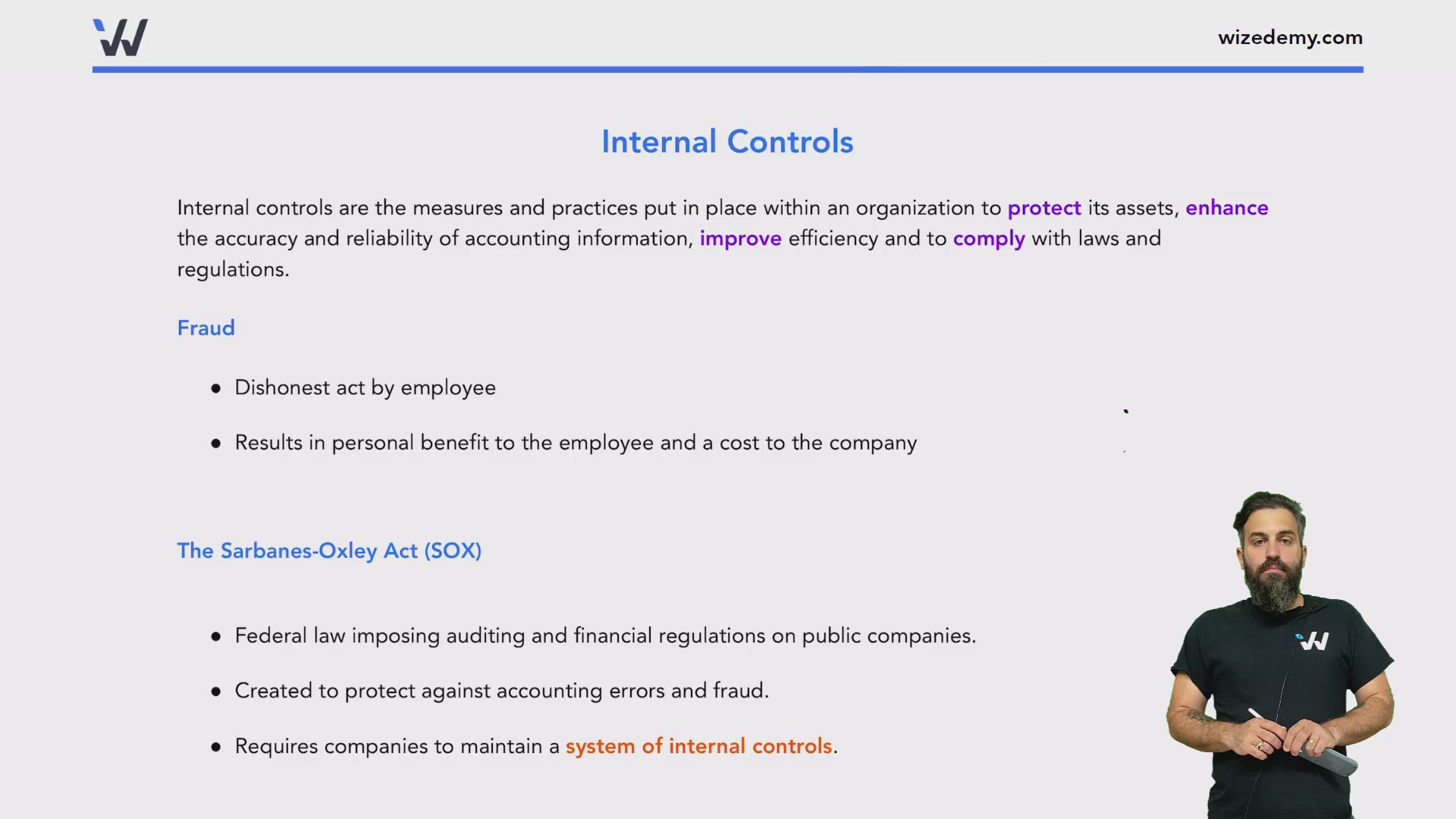
Internal Controls
Internal controls are the measures and practices put in place within an organization to protect its assets, enhance the accuracy and reliability of accounting information, improve efficiency and to comply with laws and regulations.
Fraud
- Dishonest act by employee
- Results in personal benefit to the employee and a cost to the company
The Sarbanes-Oxley Act (SOX)
- Federal law imposing auditing and financial regulations on public companies.
- Created to protect against accounting errors and fraud.
- Requires companies to maintain a system of internal controls.
Five Components of Internal Controls
- Control environment: This refers to the attitude of the company towards internal controls.
- Risk assessment: Management should identify and evaluate the areas that are at risk of error or manipulation and impose preventative controls.
- Control activities: Policies and procedures used to address specific risks.
- Information and communication: Important information must be communicated to all relevant parties, both internal and external.
- Monitoring: Internal controls should be monitored periodically to maintain effectiveness.
Control Activities
These are the guidelines, rules and regulations imposed by management to decrease dishonest activities and errors.
Physical Controls
- Physically protect assets from theft and damage.
- Examples
- Locks
- Alarms
- Fencing
- Computer passwords
- Biometric identification
- Frequent bank deposits
- Use of cash registers and safes for cash on hand
Assignment of Responsibilities
- Assignment of task to one person
- Allows responsible individual to be held accountable
- Examples
- Assign only one person responsible for cash register.
- Assign only one person responsible for bank deposits.
Separation of Duties
- Separate related responsibilities
- Ensures same employee is not responsible for verifying themselves
- Examples
- Separate task of receiving cash and counting it
- Separate task of preparing bank deposit and physically bring the deposit to the bank
Independent Verification
- Verification of one individual's work by another.
- Can be internal or external.
- Examples
- Manager double checking cash register count
- Having two employees count large cash collections
Documentation
- Evidence that events took place
- Creates an audit trail
- Examples
- Cash register tape
- Use of cheques
- Signatures on bank deposits