Wize University Introduction to Financial Accounting Textbook > Receivables
Collecting Notes Receivable
Popular Courses
COMM 217
Concordia University
ACCT 2301
The University of Texas at Dallas
Intro to Financial Accounting
General Course
COMM 293
University of British Columbia
Intro to Financial Accounting
University Study Guides
MGCR 211
McGill University
ACCT*1220
University of Guelph
Intro to Financial Accounting
University Study Guides
ACCT 217
University of Calgary
AP/ADMS 2500 3.00
York University
COMMERCE 1AA3
McMaster University
ACCTG 211
University of Alberta
ACC 100
Toronto Metropolitan University
COMM 111
Queen's University
ADM 1340
University of Ottawa
BU127
Wilfrid Laurier University
ACCT 2301
Houston
ACCT 2301
Houston
COMM 1101
Dalhousie University
AFM 101
University of Waterloo
0:00 / 0:00
Collecting Notes Receivable
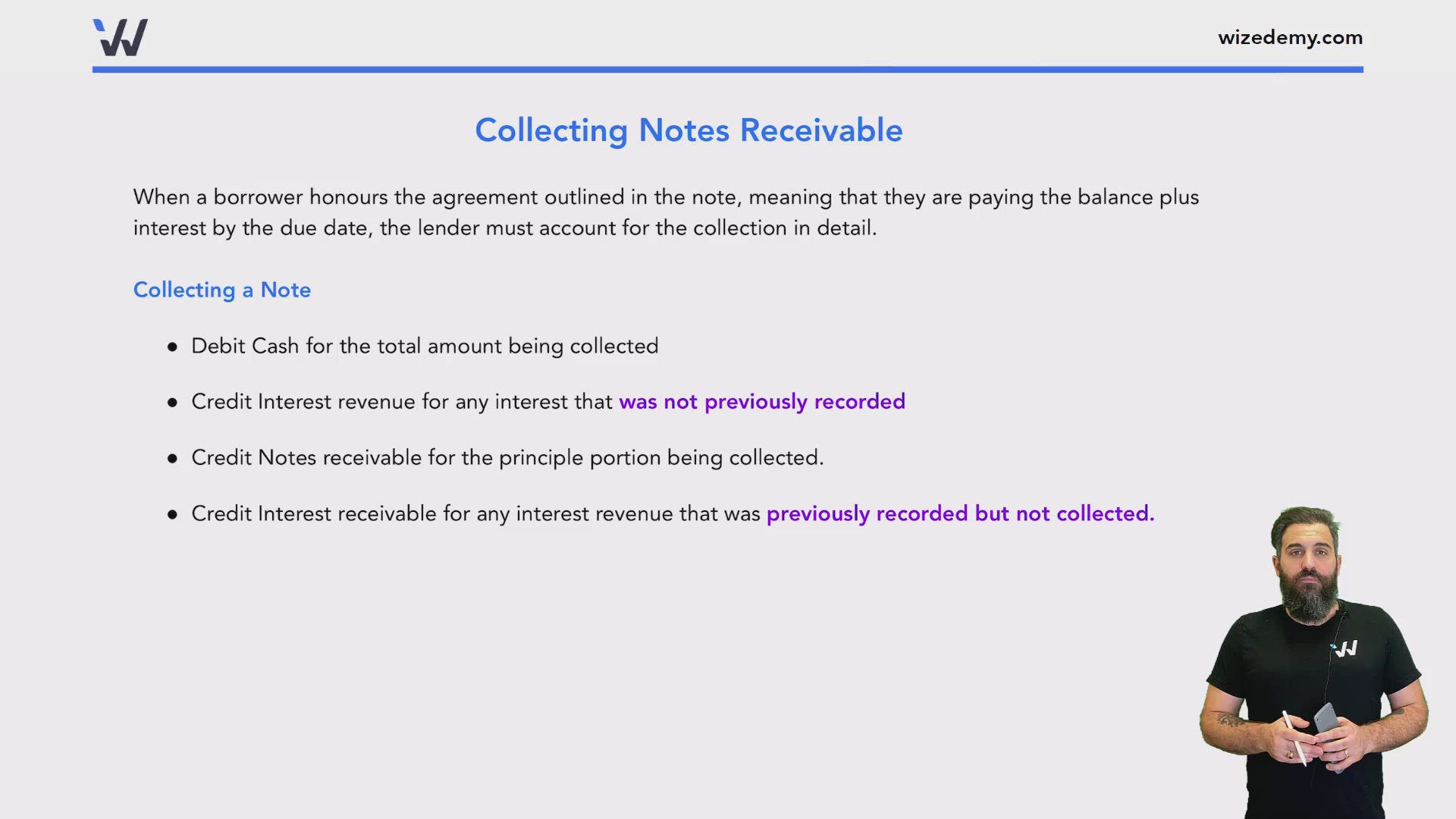
When a borrower honours the agreement outlined in the note, meaning that they are paying the balance plus interest by the due date, the lender must account for the collection in detail.
Collecting a Note
- Debit Cash for the total amount being collected
- Credit Interest revenue for any interest that was not previously recorded
- Credit Notes receivable for the principle portion being collected.
- Credit Interest receivable for any interest revenue that was previously recorded but not collected.


0:00 / 0:00
Example: Collecting Notes Receivable
Prepare the journal entry to record the transaction on July 1st, the company's fiscal year ends June 30th:
April 1: Your company has just received a letter from a customer with an open account balance of $40,000. The customer is requesting a 3-month extension to the credit terms as of today. The note carries a 6% interest rate.
July 1 : You receive a full payment including all interest.
Practice: Collecting Notes Receivable
Prepare the journal entries to record the transactions on September 1st. The company's fiscal year ends April 30th.
Feb 1: Sold an old machine for $50,000, accepting a 7-month note for the balance. The note carries an interest rate of 8%.
Mar 1: Accepted a 4-month note from a customer whose credit terms expired on that date. The customers balance was $10,000 and the note carries an interest rate of 12%.
Jul 1: Note received from the customer on March 11th expired and no payment had been received yet.
Sep 1: Received a payment in full for the note on the sale of the old machine.
Round your answer to 2 decimal places.
Transactions:
| Account | Debit | Credit |
|---|---|---|