Create a free account to get started

Unlock full course notes by signing up

  • Video lessons taught by top educators
  • Practice questions with guided solutions
  • Written review notes for reference
  • Expert answers anytime from course tutors

Price-Earnings Ratio

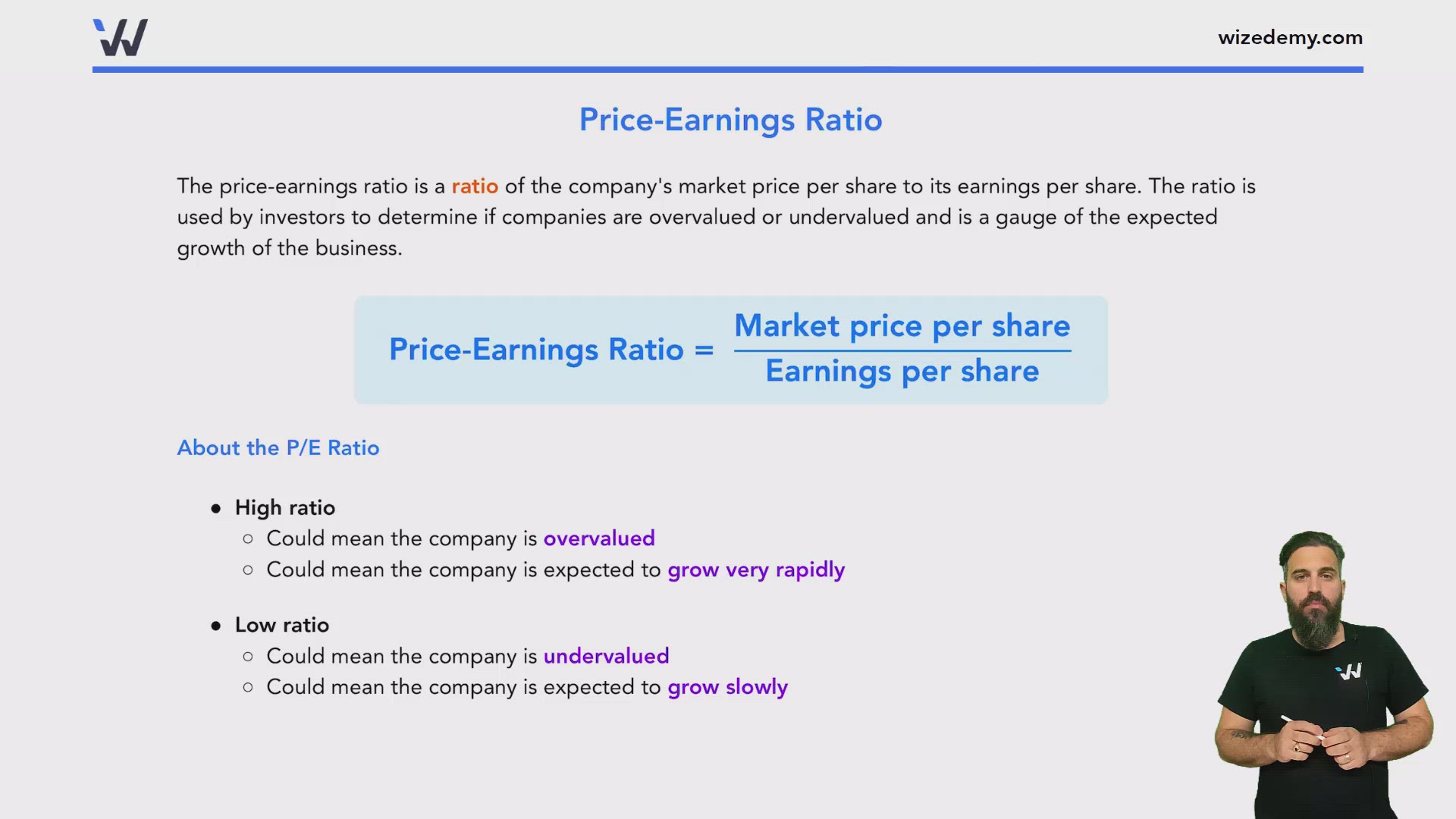
The price-earnings ratio is a ratio of the company's market price per share to its earnings per share. The ratio is used by investors to determine if companies are overvalued or undervalued and is a gauge of the expected growth of the business.


Image illustrating Price-Earnings Ratio


About the P/E Ratio

  • High ratio
  • Could mean the company is overvalued
  • Could mean the company is expected to grow very rapidly
  • Low ratio
  • Could mean the company is undervalued
  • Could mean the company is expected to grow slowly
Create a free account to get started

Unlock full course notes by signing up

  • Video lessons taught by top educators
  • Practice questions with guided solutions
  • Written review notes for reference
  • Expert answers anytime from course tutors

Example: Price-Earnings Ratio

In 2019, Apple Inc. reported EPS of $11.97 and paid $3.08 in dividends. The current market price of the stock is $364.11.


What is the company's price-earnings ratio?

Practice: Price-Earnings Ratio

Compute the price-earnings ratio for the year 2020. Do not round your work, round your final answer to 4 decimal places and enter you answer in decimal form.


Additional information:

  • On May 31, 2020 the market price per common share was $98.58.
  • The average number of outstanding common shares is 1,558.8 million shares
  • The company pays annual dividends of $0.955 per common share.


Illustration for practice question: Practice: Price-Earnings Ratio


Your answers

Create a free account to get started

Unlock full course notes by signing up

  • Video lessons taught by top educators
  • Practice questions with guided solutions
  • Written review notes for reference
  • Expert answers anytime from course tutors