Popular Courses
ACCT 2301
The University of Texas at Dallas
Intro to Financial Accounting
General Course
COMM 293
University of British Columbia
Intro to Financial Accounting
University Study Guides
Intro to Financial Accounting
University Study Guides
ACCTG 211
University of Alberta
ACCT 2301
Houston
ACCT 2301
Houston
AFM 101
University of Waterloo
BUSINESS 3321K
Western University
ACCT-1510
University of Windsor
ADMN 1221H
Trent University
ACC 110
Toronto Metropolitan University
ACC 1100
University of Manitoba
ACCT 1201
Northeastern University
SB/ACTG 2011 3.00
York University
ACC 221
Miami University - Ohio
ACTG 1P01
Brock University
ACCT 2101
University of Georgia
ACCT 207
University of Delaware
0:00 / 0:00
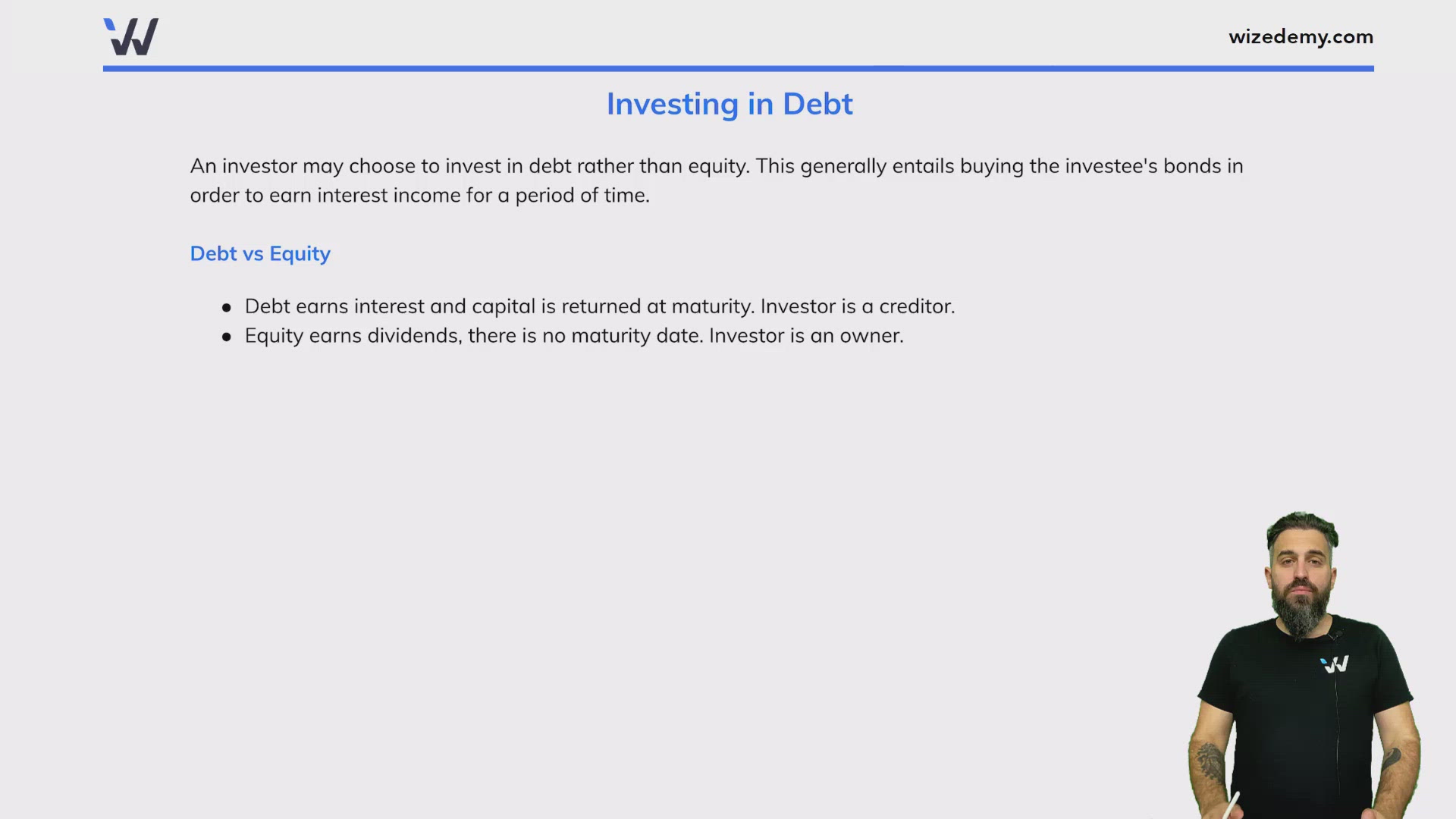
Investing in Debt
An investor may choose to invest in debt rather than equity. This generally entails buying the investee's bonds in order to earn interest income for a period of time.
Debt vs Equity
- Debt earns interest and capital is returned at maturity. Investor is a creditor.
- Equity earns dividends, there is no maturity date. Investor is an owner.
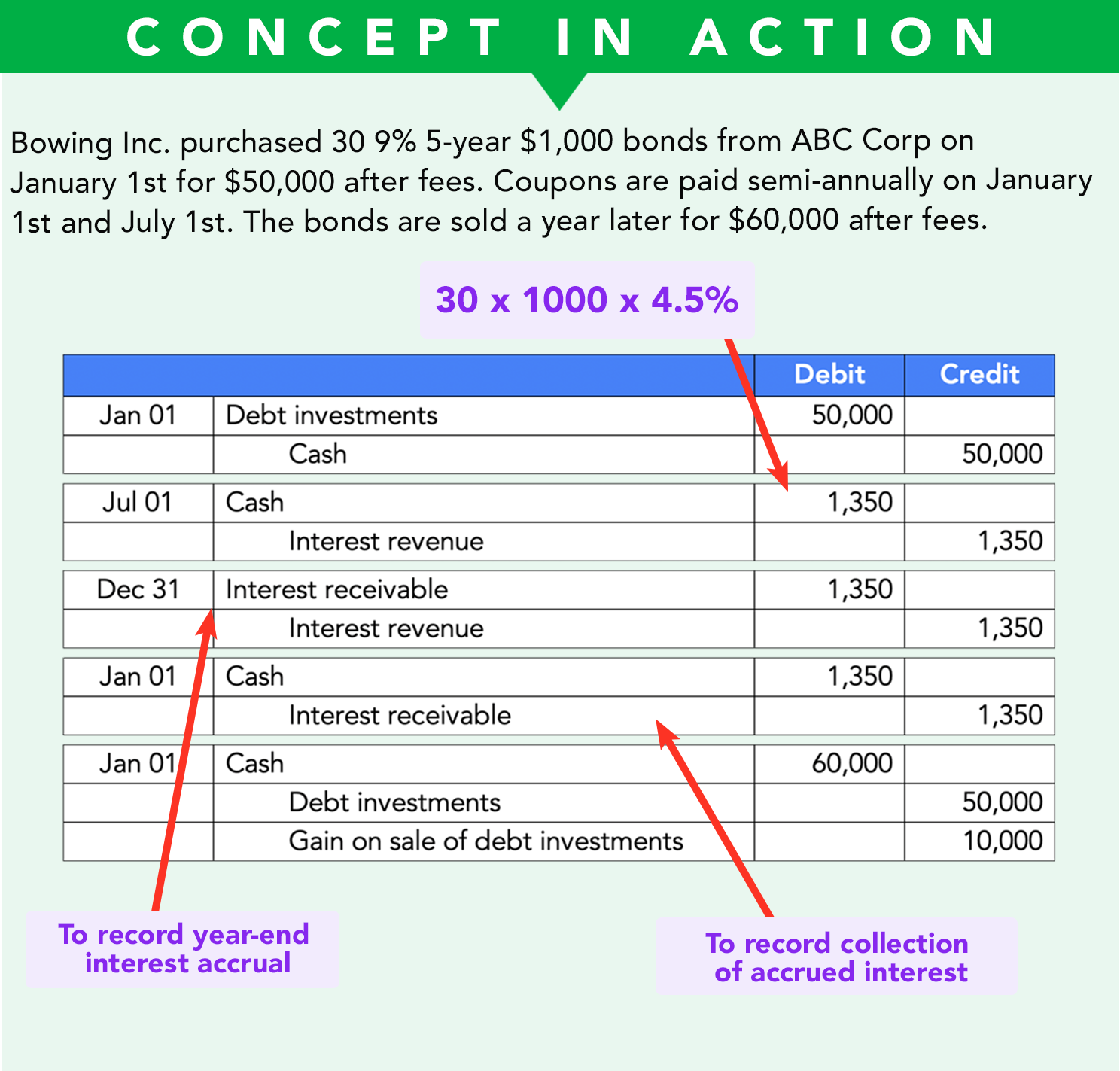
Recording Purchase of Bonds
- Asset is titled Debt Investments
- Recorded at total cost including all additional costs like brokerage fees and commissions
Recording Interest Revenue
- Record cash received on payment dates
- Interest is recorded as Interest revenue
- Record Interest receivable on accrual dates
Recording Sale of Bonds
- Record proceeds received after expenses like brokerage fees and commissions
- Record gain or loss on sale
- Difference between purchase cost and proceeds from sale
0:00 / 0:00
Example: Investing in Debt
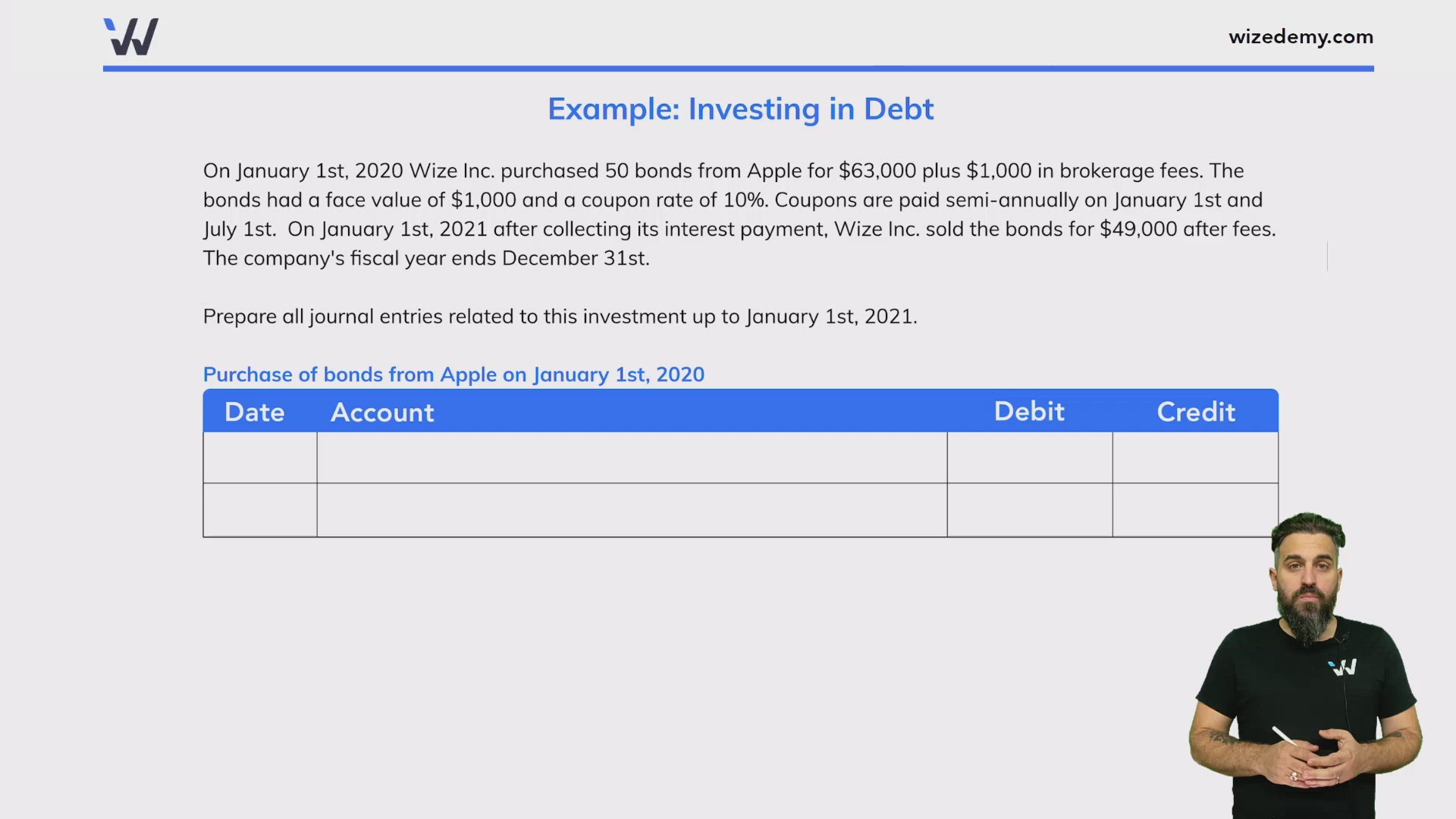
On January 1st, 2020 Wize Inc. purchased 50 bonds from Apple for $63,000 plus $1,000 in brokerage fees. The bonds had a face value of $1,000 and a coupon rate of 10%. Coupons are paid semi-annually on January 1st and July 1st. On January 1st, 2021 after collecting its interest payment, Wize Inc. sold the bonds for $49,000 after fees. The company's fiscal year ends December 31st.
Prepare all journal entries related to this investment up to January 1st, 2021.
Purchase of bonds from Apple on January 1st, 2020

Collection of coupon payment on July 1st, 2020

Accrual of interest on December 31st, 2020

Collection of coupon payment on January 1st, 2021

Sale of bonds on January 1st, 2021

0:00 / 0:00
Example: Investing in Debt
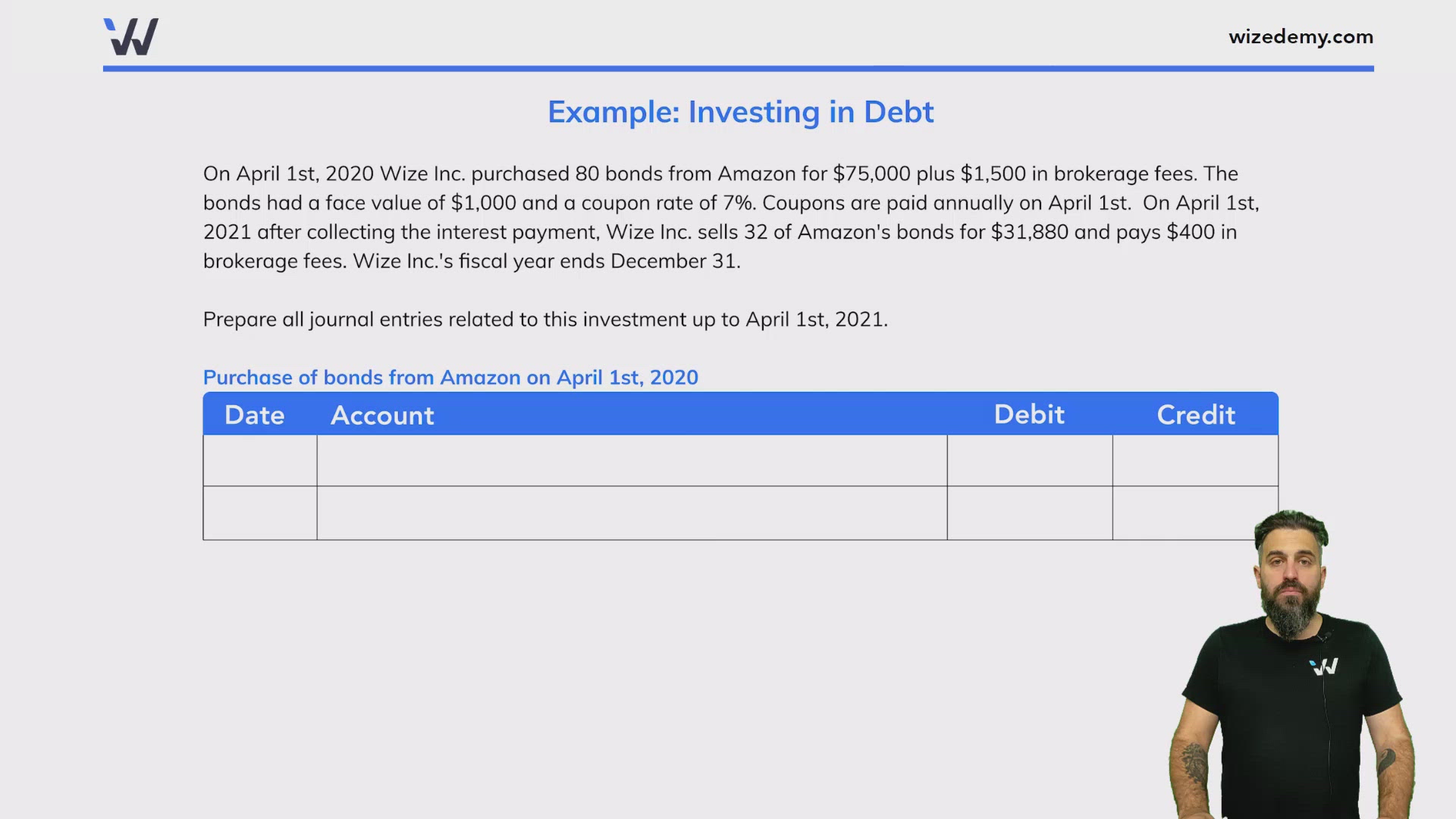
On April 1st, 2020 Wize Inc. purchased 80 bonds from Amazon for $75,000 plus $1,500 in brokerage fees. The bonds had a face value of $1,000 and a coupon rate of 7%. Coupons are paid annually on April 1st. On April 1st, 2021 after collecting the interest payment, Wize Inc. sells 32 of Amazon's bonds for $31,880 and pays $400 in brokerage fees. Wize Inc.'s fiscal year ends December 31.
Prepare all journal entries related to this investment up to April 1st, 2021.
Purchase of bonds from Amazon on April 1st, 2020
Accrual of interest on December 31st, 2020
Collection of coupon payment on April 1st, 2021

Sale of bonds on April 1st, 2021
Practice: Investing in Debt
On October 1st, 2021 your company purchases 100 5% bonds from Tesla Inc. The bonds have a face value of $1,000 each and coupons are paid semi-annually. The cost of the bonds was $108,000 including $1,000 in brokerage fees. Your company's fiscal year ends December 31st and on the date of the first coupon payment, you sell the bonds for $115,000.
Record the purchase of the bonds on October 1st, 2021.
Transactions:
| Account | Debit | Credit |
|---|---|---|
Practice: Investing in Debt
On June 1st, 2022 your company purchases 120 8% bonds from Amazon Inc. The bonds have a face value of $1,000 each and coupons are paid semi-annually. The cost of the bonds was $117,000 plus $2,000 in brokerage fees. Your company's fiscal year ends September 30th and on the date of the first coupon payment, you sell 40 bonds for $964 each and paid $500 in brokerage fees.
Record the purchase of the bonds on June 1st, 2022.
Transactions:
| Account | Debit | Credit |
|---|---|---|