Wize University Introduction to Financial Accounting Textbook > Shareholders' Equity
Issuing Par-Value Shares
Popular Courses
ACCT 2301
The University of Texas at Dallas
Intro to Financial Accounting
General Course
COMM 293
University of British Columbia
Intro to Financial Accounting
University Study Guides
ACCT*1220
University of Guelph
Intro to Financial Accounting
University Study Guides
AP/ADMS 2500 3.00
York University
ADM 1340
University of Ottawa
BU127
Wilfrid Laurier University
ACCT 2301
Houston
ACCT 2301
Houston
AFM 101
University of Waterloo
BUS 251
Simon Fraser University
AFA 100
Toronto Metropolitan University
BUSINESS 3321K
Western University
COM 315
University of Victoria
ACCT-1510
University of Windsor
ADMN 1221H
Trent University
ACC 110
Toronto Metropolitan University
ACC 1100
University of Manitoba

0:00 / 0:00
Issuing Par Value Shares
The par-value, or book value, of a stock is the minimum value assigned to the stock by the issuing company. It plays no role in the market value of the stock and is simply used for accounting purposes.
Contributed Surplus
- Amount received by a company above the par value of its stock.
- Also called Additional paid-in capital
- Recorded on the balance sheet in the Shareholders' Equity section
Issuing Par-Value Shares
- Common shares account is increased by the par-value of the issued shares.
- Amount paid above par-value is added to additional paid-in capital.

0:00 / 0:00
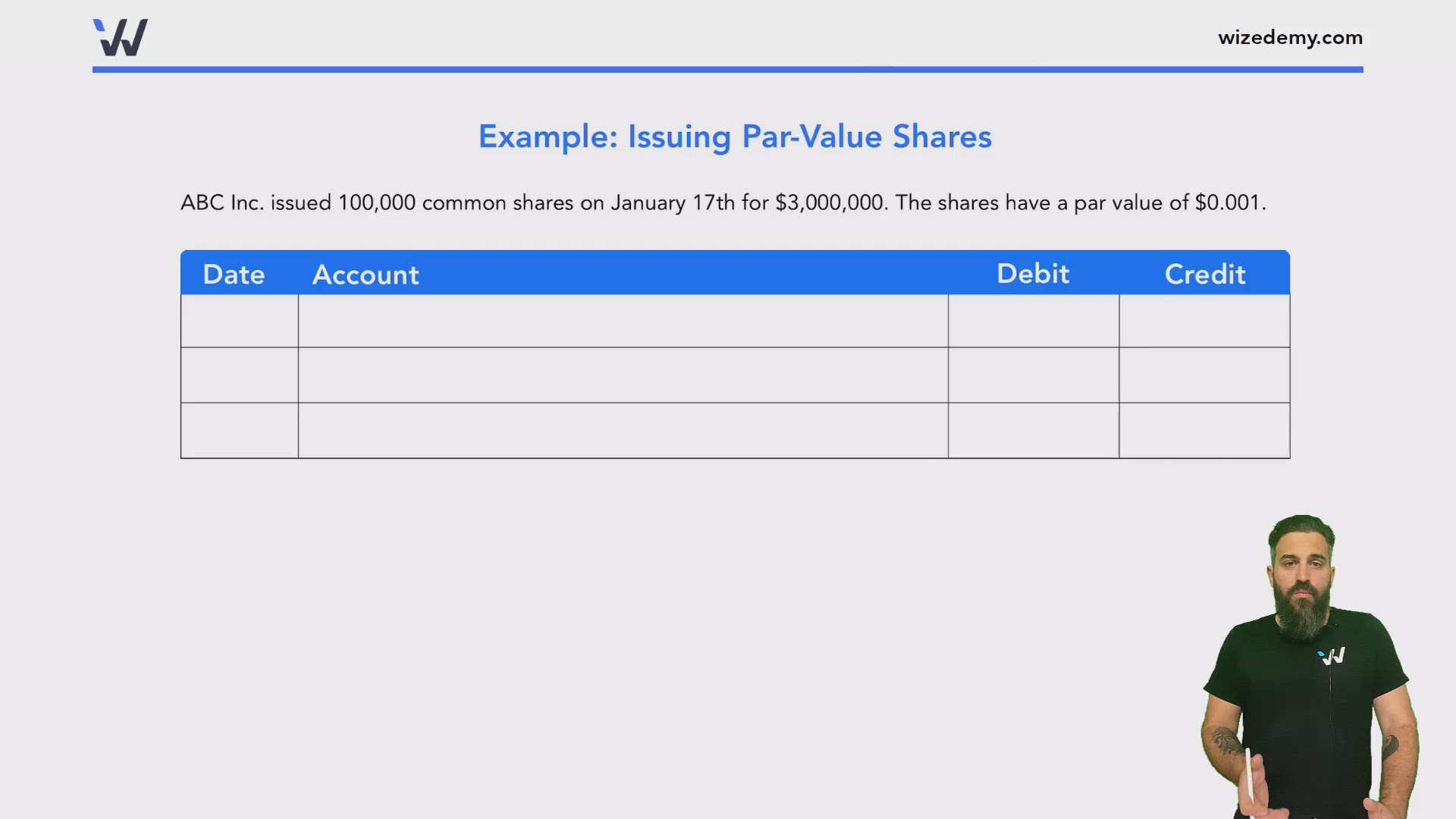
Example: Issuing Par-Value Shares
ABC Inc. issued 100,000 common shares on January 17th for $3,000,000. The shares have a par value of $0.001.

Practice: Issuing Par-Value Shares
Prepare the journal entries to record the following transaction:
Issued 200,000 common shares with a $5 par-value, the total cash received for the shares is $1,800,000
Transactions:
| Account | Debit | Credit |
|---|---|---|