Wize University Introduction to Financial Accounting Textbook > Transaction Analysis
Accounting Characteristic, Assumptions and Principles
Popular Courses
COMM 217
Concordia University
ACCT 2301
The University of Texas at Dallas
Intro to Financial Accounting
General Course
COMM 293
University of British Columbia
Intro to Financial Accounting
University Study Guides
MGCR 211
McGill University
ACCT*1220
University of Guelph
Intro to Financial Accounting
University Study Guides
ACCT 217
University of Calgary
AP/ADMS 2500 3.00
York University
ACCTG 211
University of Alberta
COMMERCE 1AA3
McMaster University
ACC 100
Toronto Metropolitan University
COMM 111
Queen's University
ADM 1340
University of Ottawa
BU127
Wilfrid Laurier University
ACCT 2301
Houston
ACCT 2301
Houston
RSM219H1
University of Toronto
COMM 1101
Dalhousie University

0:00 / 0:00
Qualitative Characteristics of Accounting Information
In order to fulfill the primary goal of providing useful and accurate information, certain characteristics must always be present in financial accounting reports.
Relevance
- Can influence or impact a decision
- Can confirm previous predictions
- Can predict future results
Faithful Representation
- Accurately reflect the condition of the business
- Information should be:
- Complete
- Neutral (free of any bias)
- Free of any material error
Comparability
- Comparable to other companies
- Comparable to same company at another point in time
- Achieved by using consistent accounting methods
Verifiability
- Information can be verified by an independent accountant
- Information can be reproduced by a third-party who has access to the same facts and assumptions
Timeliness
- Accounting information should be made available to users in time to be used in decision-making
Understandability
- Quality of information is understandable by someone with reasonable knowledge of business and economic activities.

0:00 / 0:00
Accounting Assumptions
The accounting assumptions are a set of basic concepts that are assumed to have been respected in preparing the financial reports and transaction analyses of a business.
Separate-Entity Assumption
- Transactions and activities conducted by a business are separate to those conducted by its owners.
Unit-of-Measurement Assumption
- Accounting information should be reported in the domestic currency of the business. Example: Canadian companies should report earnings in Canadian dollars.
Continuity (Going Concern) Assumption
- Businesses are assumed to continue operating for the foreseeable future.
- Business should continue operating long enough to meet all of its commitments, obligations and objectives.
Periodicity Assumption
- Accounting information can be separated into artificial periods of time. Example: months, quarters, years
0:00 / 0:00
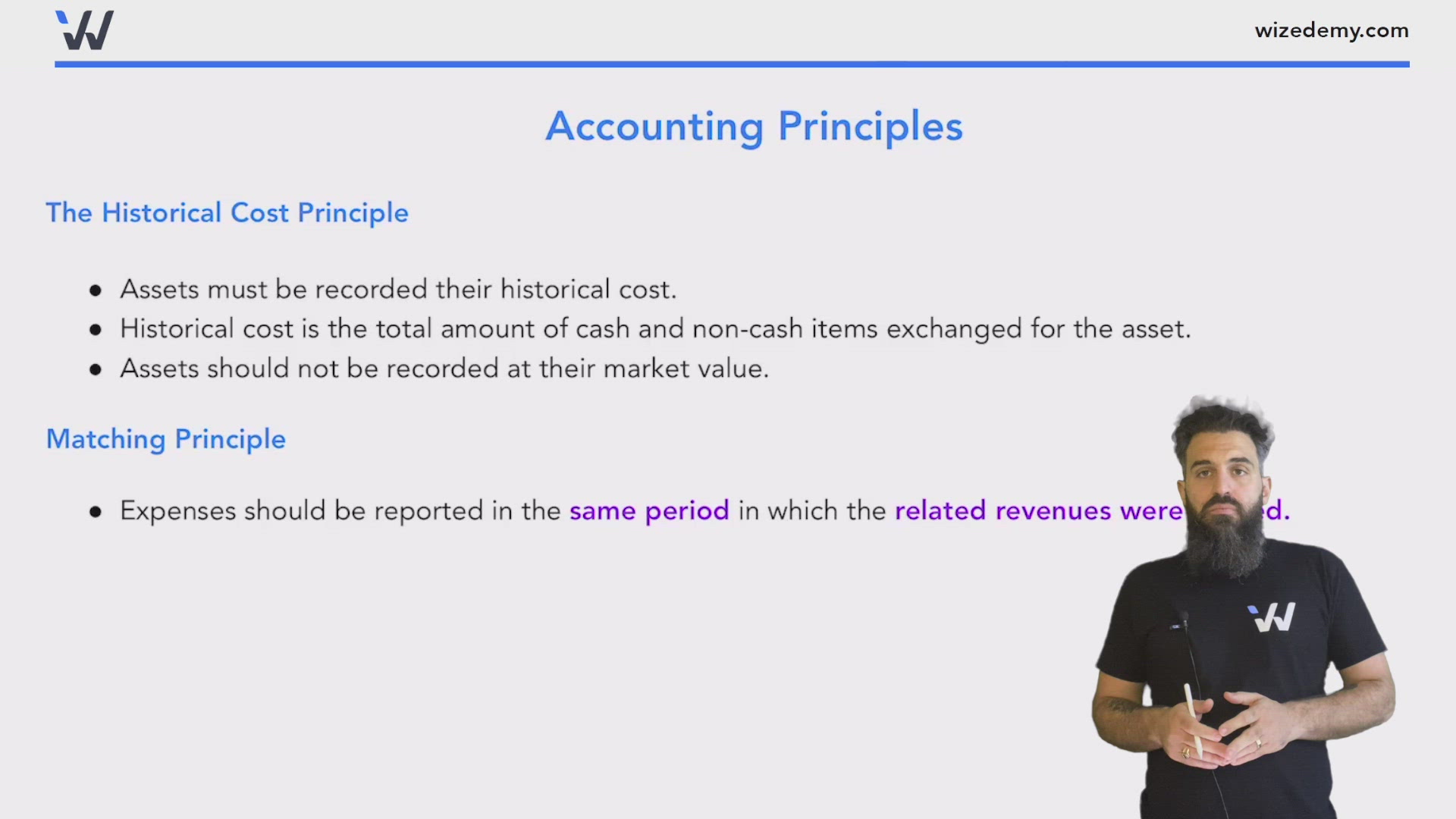
Accounting Principles
The Historical Cost Principle
- Assets must be recorded their historical cost.
- Historical cost is the total amount of cash and non-cash items exchanged for the asset.
- Assets should not be recorded at their market value.
Matching Principle
- Expenses should be reported in the same period in which the related revenues were earned.
Practice: Accounting Characteristics
Indicate the characteristic of useful accounting information that corresponds to each definition.
Using the same accounting information year after year