Popular Courses
COMM 217
Concordia University
ACCT 2301
The University of Texas at Dallas
Intro to Financial Accounting
General Course
COMM 293
University of British Columbia
Intro to Financial Accounting
University Study Guides
MGCR 211
McGill University
ACCT*1220
University of Guelph
Intro to Financial Accounting
University Study Guides
ACCT 217
University of Calgary
AP/ADMS 2500 3.00
York University
ACCTG 211
University of Alberta
COMMERCE 1AA3
McMaster University
ACC 100
Toronto Metropolitan University
COMM 111
Queen's University
ADM 1340
University of Ottawa
BU127
Wilfrid Laurier University
ACCT 2301
Houston
ACCT 2301
Houston
RSM219H1
University of Toronto
COMM 1101
Dalhousie University
0:00 / 0:00
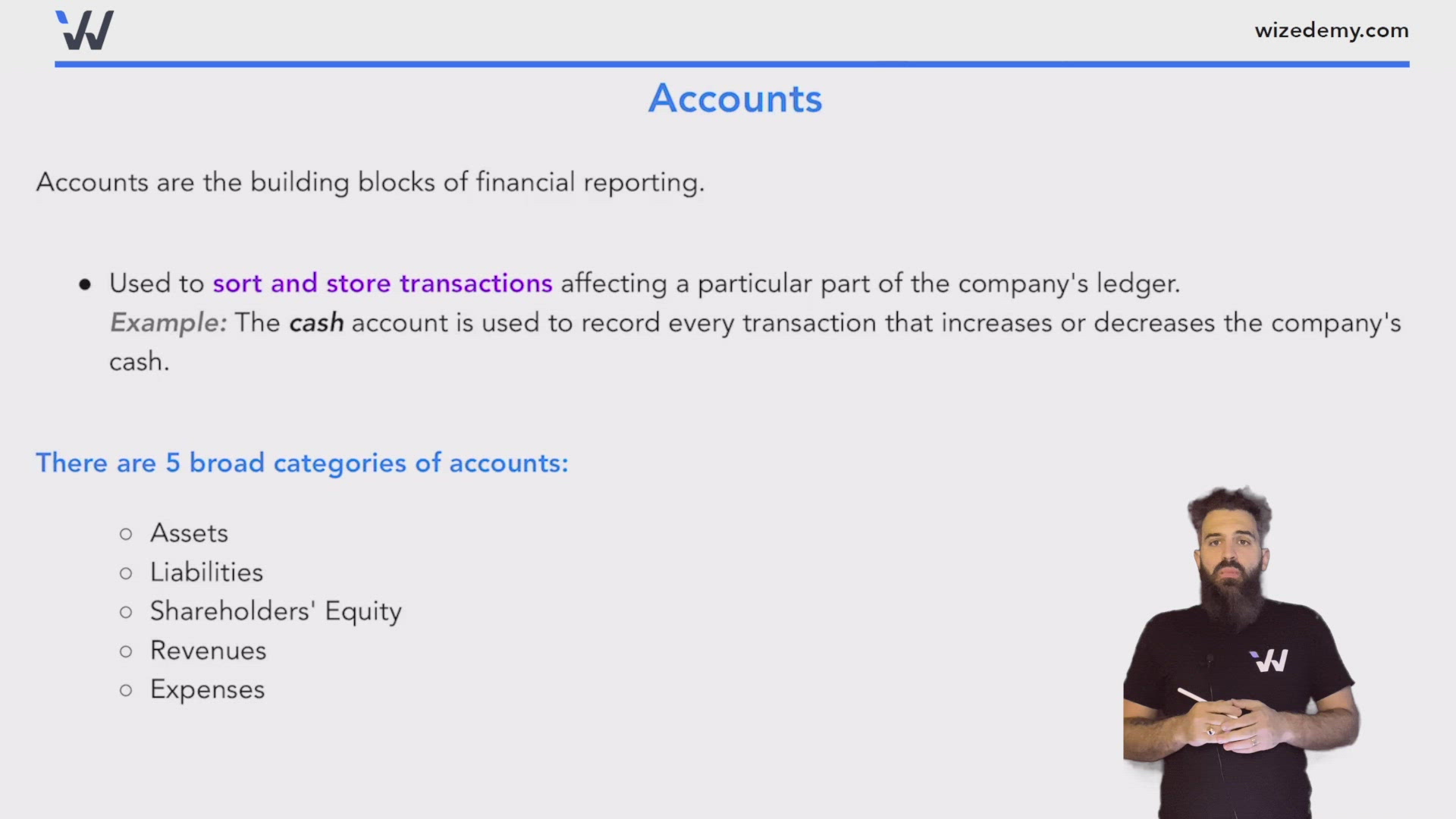
Accounts
Accounts are the building blocks of financial reporting. They are Used to sort and store transactions affecting a particular part of the company's ledger.
Example: The cash account is used to record every transaction that increases or decreases the company's cash.
There are 5 broad categories of accounts:
- Assets
- Liabilities
- Shareholders' Equity
- Revenues
- Expenses
0:00 / 0:00
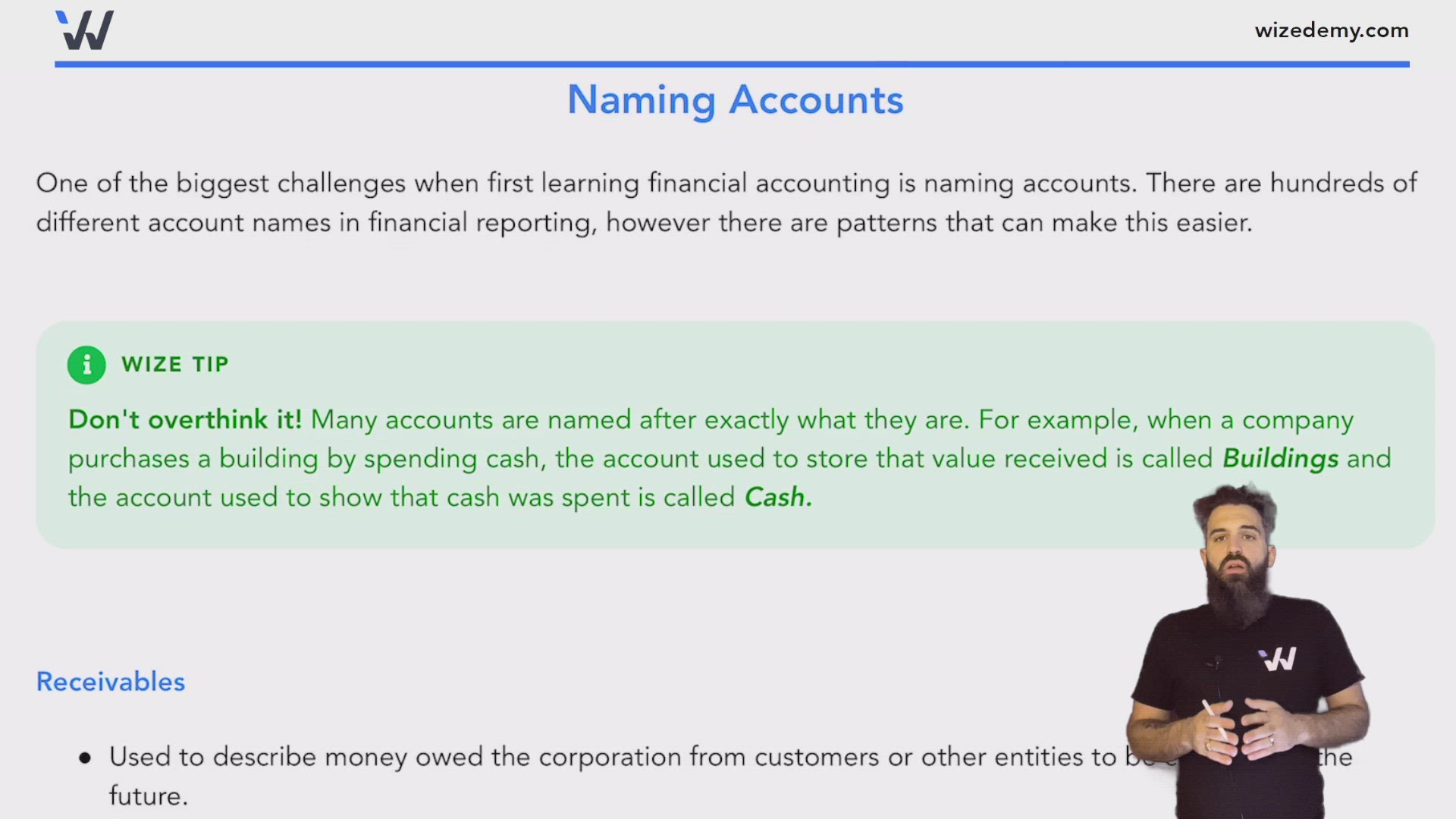
Naming Accounts
One of the biggest challenges when first learning financial accounting is naming accounts. There are hundreds of different account names in financial reporting, however there are patterns that can make this easier.
Wize Tip
Don't overthink it! Many accounts are named after exactly what they are. For example, when a company purchases a building by spending cash, the account used to store that value received is called Buildings and the account used to show that cash was spent is called Cash.
Receivables
- Used to describe money owed the corporation from customers or other entities to be collected in the future.
- Attach a descriptor before the word Receivable to create an account that best fits the transaction. Example:
- Money owed from a customer is called Accounts Receivable
- Money owed for interest is called Interest Receivable
- Money owed from a borrower is called Loan Receivable or Notes Receivable
- A note is a contractual agreement ("promise to pay") between a lender and a borrower that outlines the amount of the loan, the due date and the interest rate.
Payables
- Used to describe money the corporation owes to other entities to be paid in the future.
- Attach a descriptor before the word Payable to create an account that best fits the transaction. Example:
- Money owed to suppliers for goods and services is called Accounts Payable
- Money owed to employees for wages or salaries is called Salaries and Wages Payable
- Money owed for income taxes is called Income Tax Payable
- Money owed to a lender is called Loan Payable or Notes Payable
- Money owed for rent is called Rent Payable
Revenues
- Used to describe income earned by the company for goods and services provided.
- Attach a descriptor before the word Revenue to create an account that best describes it. Example:
- Income earned from a sale to a customer is called Sales Revenue
- Income earned from providing a service to a customer is called Service Revenue
- Income earned from proving rental space to a tenant is called Rent Revenue
- Income earned from interest is called Interest Revenue
Watch Out!
The account Unearned Revenue is not a revenue, it is a liability!
Expenses
- Used to describe goods and services used by the company.
- Attach a descriptor before the word Expense to create an account that best describes it. Example:
- Cost of utilities used (electricity, water, telephone) the account is called Utilities Expense
- Cost of interest accumulated on debt is called Interest Expense
- Cost of salaries and wages to employees is called Salaries and Wages Expense
- Cost of depreciation of assets is called Depreciation Expense
Practice: Naming Accounts
Select the correct account title for each situation
Money owed to you by a customer for goods and services you provided