Wize University Introduction to Financial Accounting Textbook > Introduction to Financial Accounting
Forms of Business Organization
Popular Courses
COMM 217
Concordia University
ACCT 2301
The University of Texas at Dallas
Intro to Financial Accounting
General Course
COMM 293
University of British Columbia
Intro to Financial Accounting
University Study Guides
MGCR 211
McGill University
ACCT*1220
University of Guelph
Intro to Financial Accounting
University Study Guides
ACCT 217
University of Calgary
AP/ADMS 2500 3.00
York University
COMMERCE 1AA3
McMaster University
ACCTG 211
University of Alberta
ACC 100
Toronto Metropolitan University
COMM 111
Queen's University
ADM 1340
University of Ottawa
BU127
Wilfrid Laurier University
ACCT 2301
Houston
ACCT 2301
Houston
RSM219H1
University of Toronto
COMM 1101
Dalhousie University
0:00 / 0:00
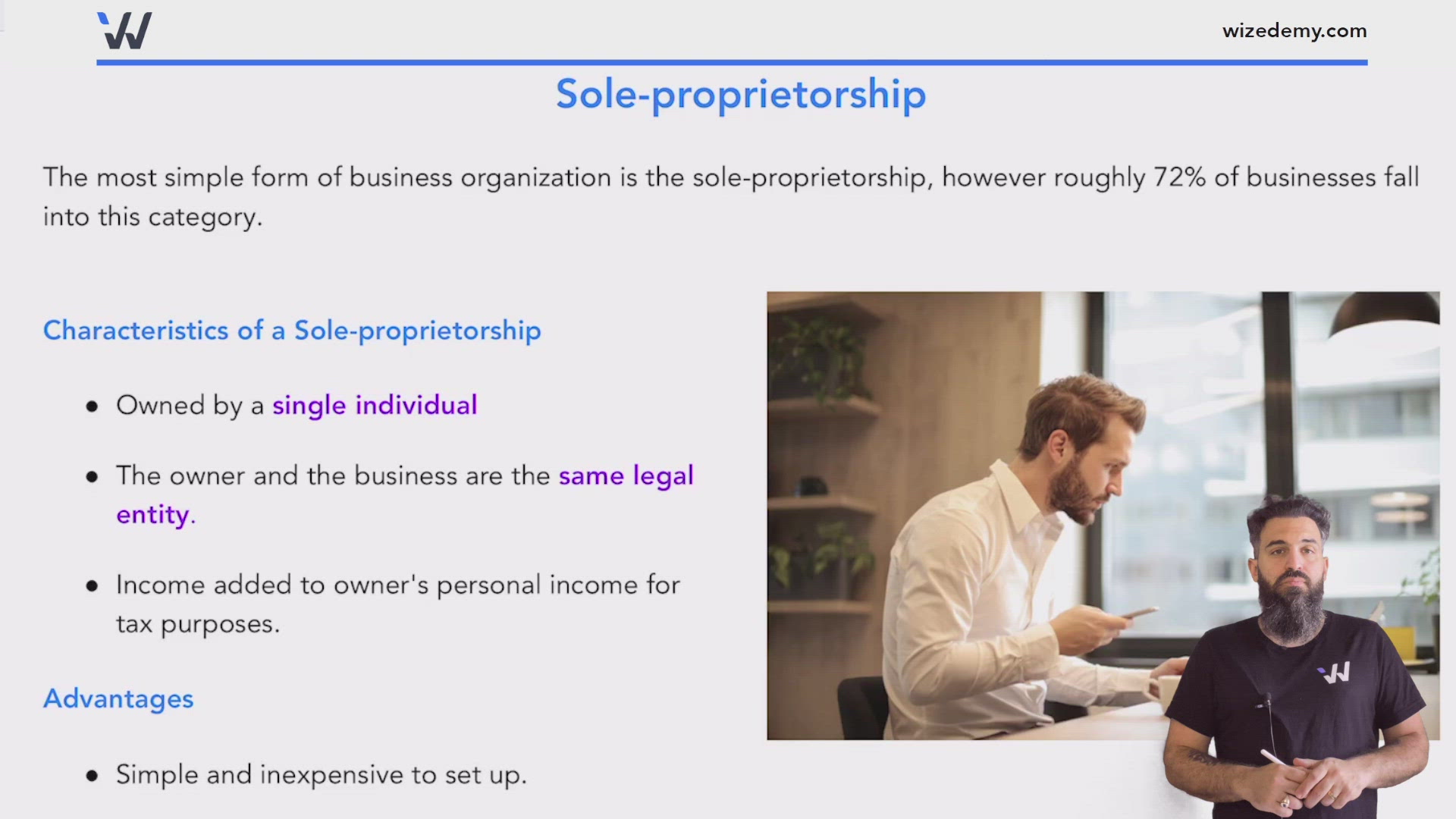
Sole-proprietorship
The most simple form of business organization is the sole-proprietorship, however, roughly 72% of businesses fall into this category.

Characteristics of a Sole-proprietorship
- Owned by a single individual
- The owner and the business are the same legal entity.
- Income added to owner's personal income for tax purposes.
Advantages
- Simple and inexpensive to set up.
- Owner receives all profits earned by the business.
- Easily dissolvable
Disadvantages
- Owner is personally responsible (liable) for the business's debts (unlimited liability).
- Difficult to raise capital.
0:00 / 0:00
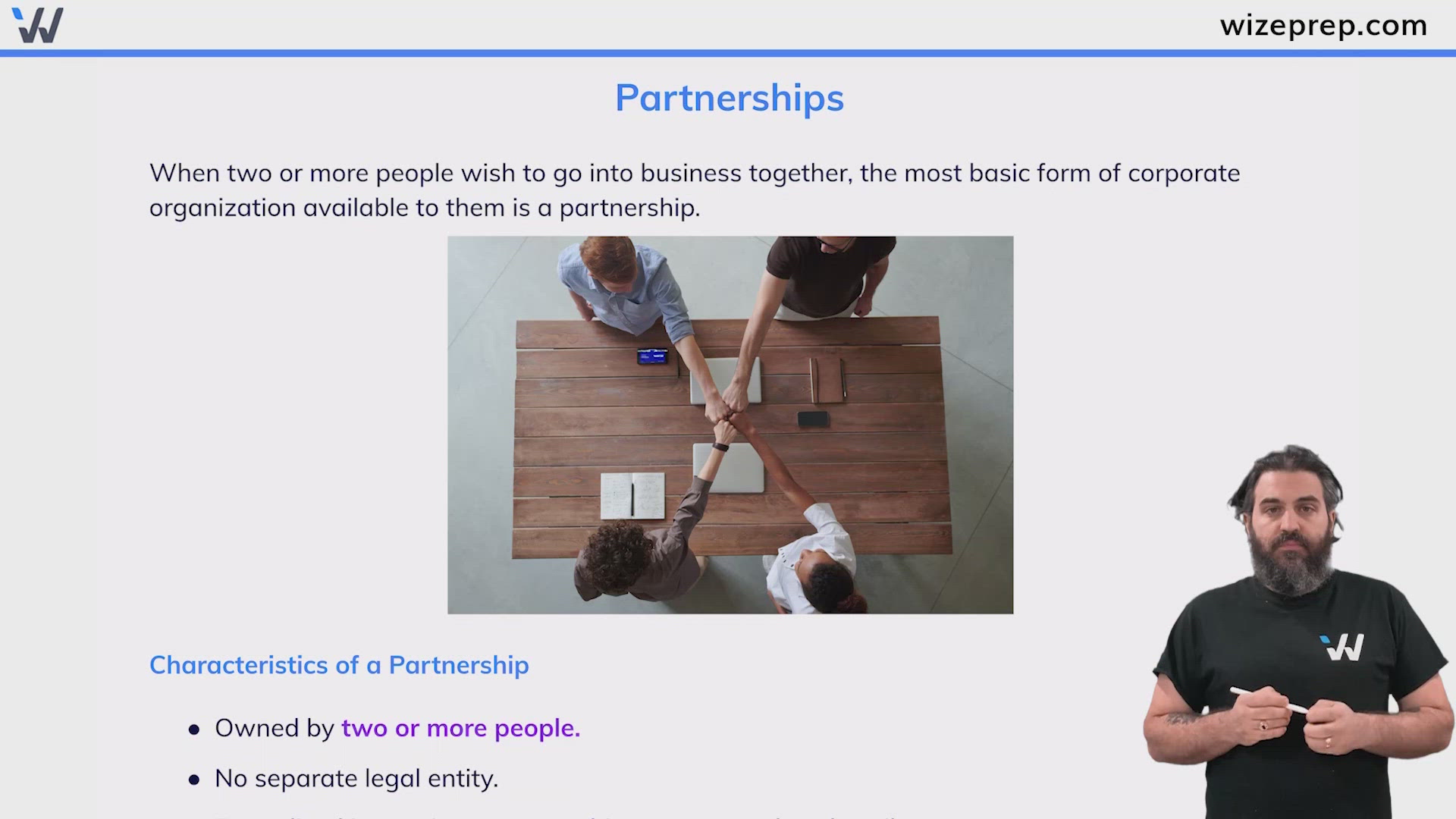
Partnerships
When two or more people wish to go into business together, the most basic form of corporate organization available to them is a partnership.

Characteristics of a Partnership
- Owned by two or more people.
- No separate legal entity.
- Formalized in a written partnership agreement that describes:
- Each partner's contribution
- How profits are shared
- How to resolve disputes
Advantages
- Easy to form.
- More capital available.
Disadvantages
- Owners are personally responsible for obligations (unlimited liability)
- Except for limited/silent partners (limited liability)
- Potential for conflicts
- Profit-sharing can be complicated.
- Difficult to dissolve or to transfer ownership.
0:00 / 0:00
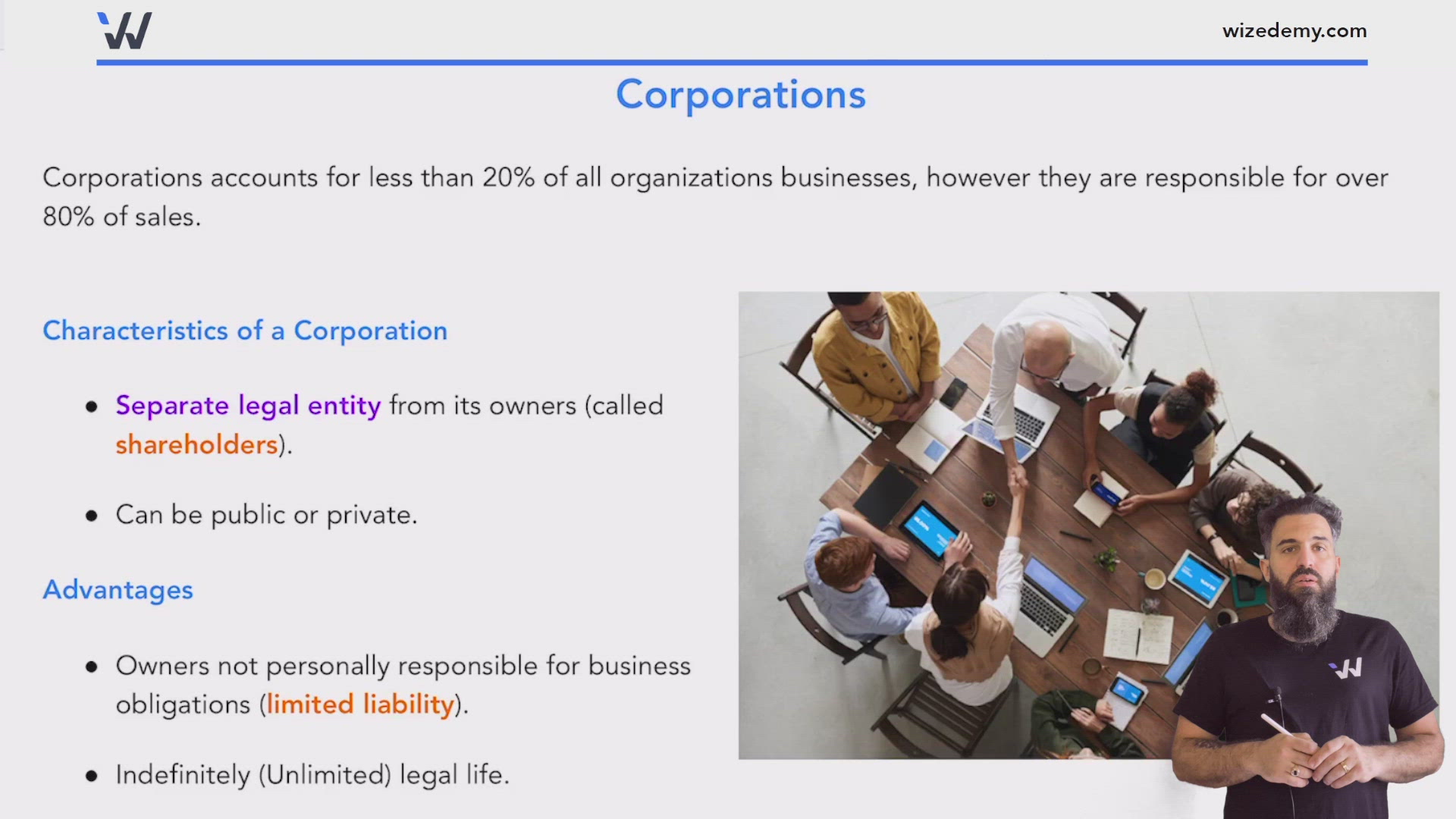
Corporations
Corporations account for less than 20% of all organizations' businesses, however, they are responsible for over 80% of sales.

Characteristics of a Corporation
- A separate legal entity from its owners (called shareholders)
- Can be public or private
Advantages
- Owners are not personally responsible for business obligations (limited liability)
- Indefinitely (Unlimited) legal life
- Ownership is easily transferrable
- Easier to raise capital
Disadvantages
- More costly and more complex to set up than sole-proprietorships and partnerships.
- Double taxation
- Corporation's income is taxed at the corporate level
- Owners are taxed on dividends at the personal level
Practice: Forms of Business Organization
Answer the following multiple choice questions.
In what way is a corporation more advantageous than a partnership or sole-proprietorship?