Wize University Introduction to Financial Accounting Textbook > Transaction Analysis
Journalizing Revenues
Popular Courses
COMM 217
Concordia University
ACCT 2301
The University of Texas at Dallas
Intro to Financial Accounting
General Course
COMM 293
University of British Columbia
Intro to Financial Accounting
University Study Guides
MGCR 211
McGill University
ACCT*1220
University of Guelph
Intro to Financial Accounting
University Study Guides
ACCT 217
University of Calgary
AP/ADMS 2500 3.00
York University
ACCTG 211
University of Alberta
COMMERCE 1AA3
McMaster University
ACC 100
Toronto Metropolitan University
COMM 111
Queen's University
ADM 1340
University of Ottawa
BU127
Wilfrid Laurier University
ACCT 2301
Houston
ACCT 2301
Houston
RSM219H1
University of Toronto
COMM 1101
Dalhousie University

0:00 / 0:00
Journalizing Revenues
Revenues are the fees earned by a business for goods and services provided, as well as other non-operating activities such as selling old assets, settling liabilities, and earnings interest.
Revenue Accounts
- Operating revenues: Revenues earned from the company's primary operations Examples
- Sales revenue: Used for recording fees earned from selling merchandise as part of the company's primary operations.
- Service revenue: Used for recording fees earned from providing services.
- Non-operating revenues: Revenues earned from secondary or non-operating activities Examples
- Rent revenue: Used for recording fees earned from tenants for rented space.
- Interest revenue: Used for recording interest earned on bank deposits or from loans given out.
- Gains: Used to record profits earned from non-operating activities such as selling long-term assets and settling liabilities.
Recording General Revenues
- Should be recorded when the revenue is earned, not when it is collected.
- When revenue is earned, the revenue account increases (credit).
- Debit account depends on situation.
- Receivable: If cash will be collected in the future
- Cash: If cash is collected at the time of revenue
- Unearned revenue: If cash was collected in the past

Recording Sales of Merchandise Inventory
Two journal entries are required:
- First entry is to record revenue and payment.
- Second entry is to record 'Cost of goods sold' and to decrease inventory asset account

0:00 / 0:00
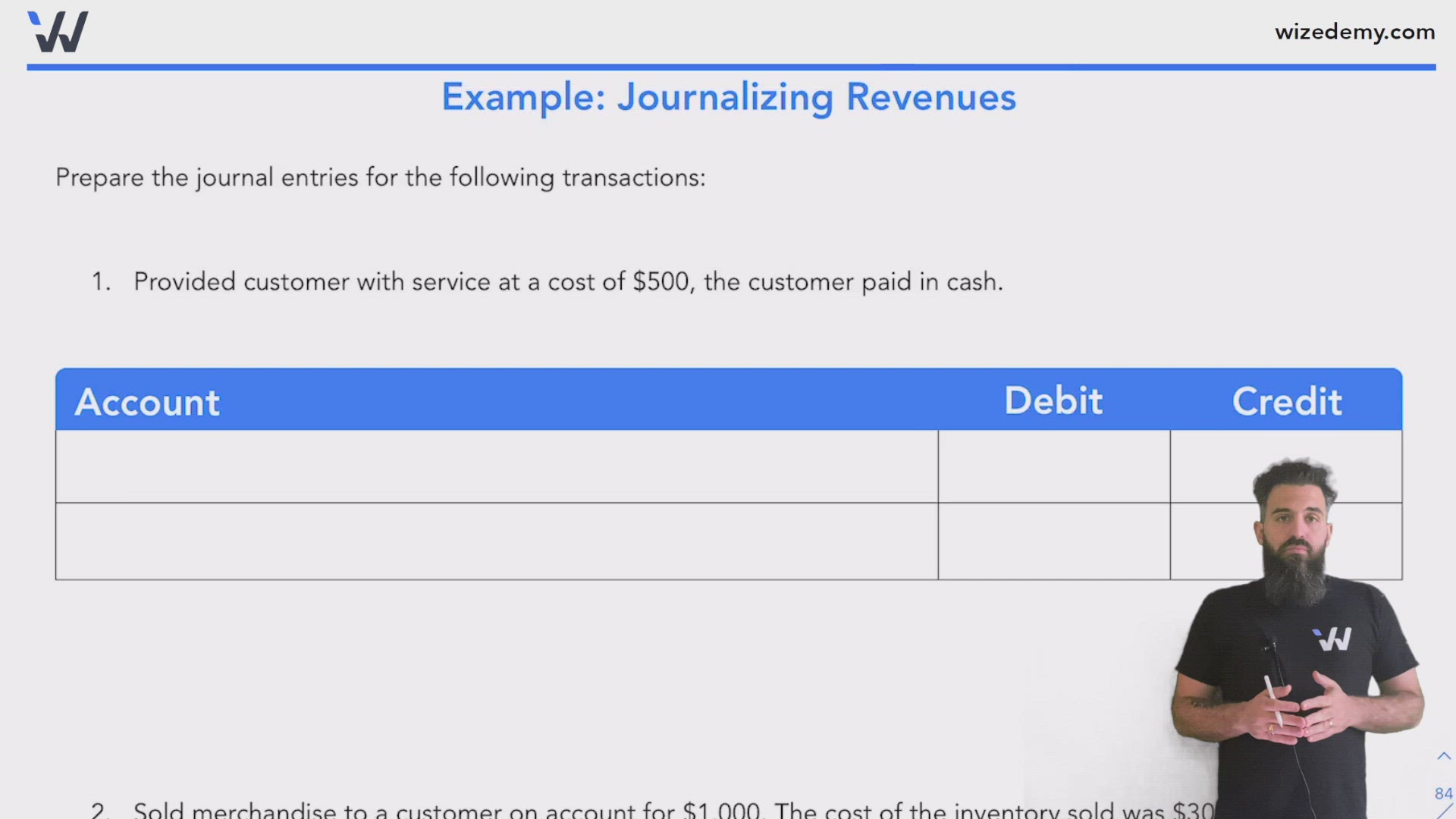
Example: Journalizing Revenues
Prepare the journal entries for the following transactions:
- Provided customer with service at a cost of $500, the customer paid in cash.

- Sold merchandise to a customer on account for $1,000. The cost of the inventory sold was $300.

- Delivered goods to a client's warehouse. The merchandise had a cost of $4,000 and was sold for $9,000. The customer had paid for the inventory when the order was placed 2 weeks prior.

- Earned $100 of interest on bank account balance, the interest was automatically deposit to the company's account.

- Received an order from a customer 200 units of inventory, the selling price is $30 per unit.

Practice: Journalizing Revenues
Prepare the journal entries for the following transactions
Rented the corporate office's boardroom to an unrelated business for the day at a cost of $1,000, the rent was received the same day.
Transactions:
| Account | Debit | Credit |
|---|---|---|
Practice: Journalizing Revenues
Prepare the journal entries to record the following transactions
Entered into a service agreement with a customer to provide 5-months of service at a price of $2,000 per month.
Transactions:
| Account | Debit | Credit |
|---|---|---|