Wize University Managerial Accounting Textbook > Activity Based Costing
Activity-Based Costing
Popular Courses
COMM 305
Concordia University
Managerial Accounting
University Study Guides
Managerial Accounting
University Study Guides
ACC 406
Toronto Metropolitan University
ACCTG 322
University of Alberta
ACCT*2230
University of Guelph
ADM 2341
University of Ottawa
RSM222H1
University of Toronto
COMMERCE 2AB3
McMaster University
SB/ACTG 2020 3.00
York University
COMM 1102
Dalhousie University
ACC 312
The University of Texas at Austin
ACC 242
Arizona State University - Tempe
ACC 202
Michigan State University
ACIS 2116
Virginia Tech
ACG 2071
University of Central Florida
BUS1 21
San José State University
BUS-A 306
Indiana University - Bloomington
ACCT 2102
Temple University
ACCTG-202
San Diego State University

0:00 / 0:00
Activity-Based Costing
Activity-based costing (ABC) is a method of assigning overhead cost to products by groups of activities (cost pools) rather than using a single overhead rate like in job-order costing. This method is especially important for companies that make different products.
In ABC, each cost pool or department has an expected overhead cost and an expected activity (the cost driver) and the first step in solving a question is to determine the overhead rate for each department.
For Example:

If Product A requires 2 assemblies and 1 inspection, we would assign overhead based on the rates we found:
Overhead = (2 x $5) + (1 x $25) = $35
Advantages and Limitations of ABC
Advantages
Since ABC uses multiple cost pools instead of just one, it is more accurate in estimate product costs.
Leads to more control of overhead costs because spending can be traced back to each department.
Leads to better management decisions
Limitations
ABC is more expensive to use than traditional costing methods
Some arbitrary allocation will always exist, it is impossible to have a cost driver to account for every dollar of overhead spent
Who should use ABC?
Companies that have product lines that differ greatly from each other
Companies whose overhead costs make up a large portion of total manufacturing costs
Companies whose manufacturing process has recently changed significantly
0:00 / 0:00
Example: Traditional Costing
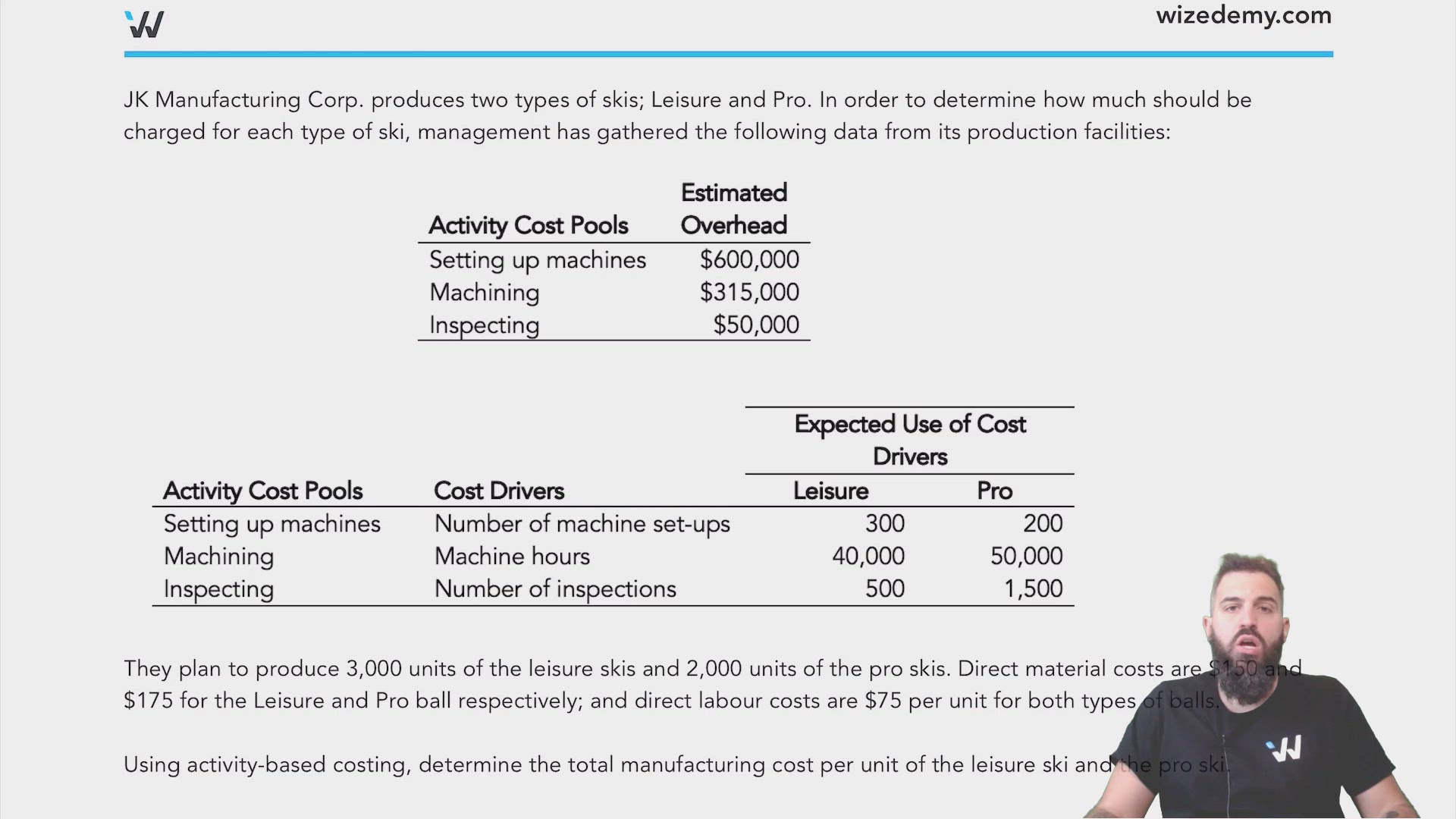
JK Manufacturing Corp. produces two types of skis; Leisure and Pro. In order to determine how much should be charged for each type of ski, management has gathered the following data from its production facilities:

They plan to produce 3,000 units of the leisure skis and 2,000 units of the pro skis. Direct material costs are $150 and $175 for the Leisure and Pro ball respectively; and direct labour costs are $75 per unit for both types of balls.
Using activity-based costing, determine the total manufacturing cost per unit of the leisure ski and the pro ski.
Practice: Activity Based Costing
A company incurs $1,200,000 of overhead each year in three departments, Processing, Packaging, and Testing. The company performs 800 processing transactions, 200,000 packaging transactions, and 2,000 tests per year in producing 400,000 drums of oil and 600,000 drums of sludge. The following data are available:
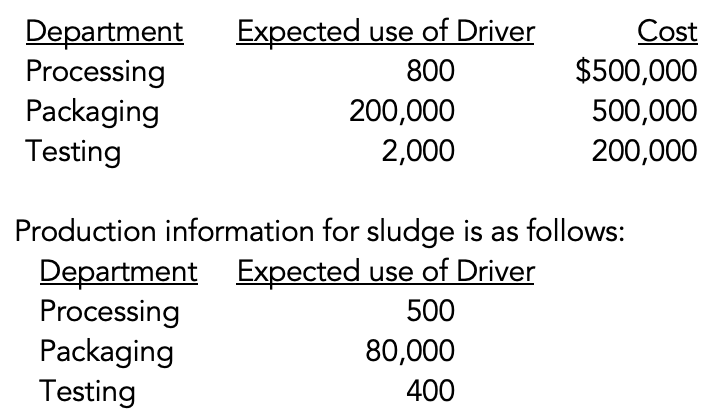
Using activity-based costing, determine the overhead allocated to sludge.