Wize University Managerial Accounting Textbook > Pricing
Transfer Pricing
Popular Courses
COMM 305
Concordia University
Managerial Accounting
University Study Guides
Managerial Accounting
University Study Guides
COMMERCE 2AB3
McMaster University
SB/ACTG 2020 3.00
York University
ACC 312
The University of Texas at Austin
ACIS 2116
Virginia Tech
ACG 2071
University of Central Florida
BUS1 21
San José State University
BUS-A 306
Indiana University - Bloomington
ACCT 2102
Temple University
ACCTG-202
San Diego State University
MGMT 20100
Purdue University
ACG 2071
University of Florida
ACCT 210
University of Arizona
ACCY 202
University of Illinois at Urbana - Champaign
BCOR 2303
University of Colorado Boulder
ACCT 2082
University of Cincinnati
ACCT 2102
Georgia Institute of Technology
33:010:275
Rutgers University - New Brunswick (Busch)
0:00 / 0:00
Transfer Pricing
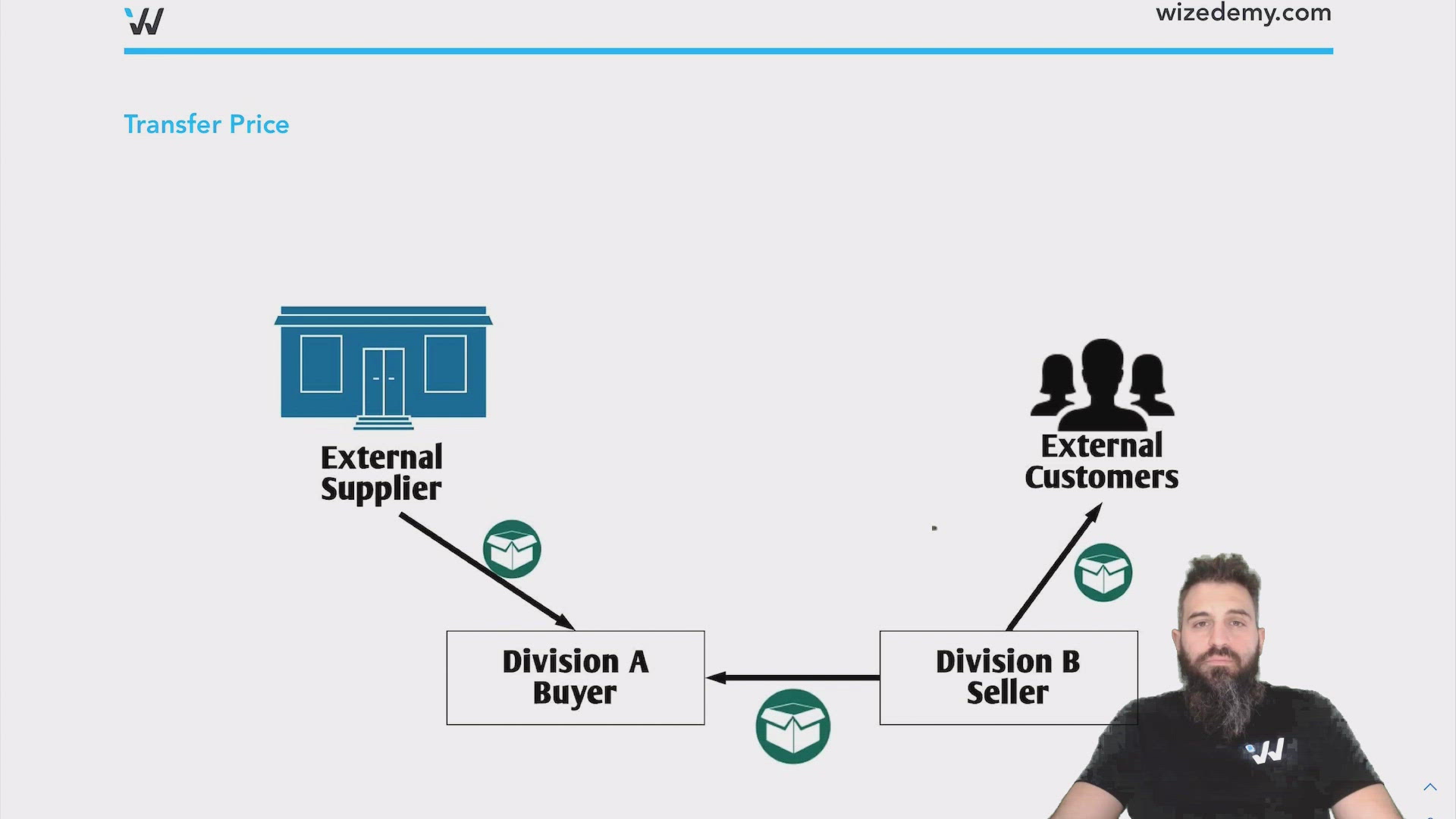
A transfer price is the price goods and services are sold for when being sold internally, meaning from one division in a company to another division in the same company.

The Seller
In every transfer pricing scenario there is the selling division (transferor). Management of the selling division must decide how much to sell their products for internally. The seller has a minimum transfer price which represents the least amount they are willing to accept to sell internally.
Minimum Transfer Price
The minimum transfer price is the least amount needed for the seller to not be any worse off from selling internally.
When there is no excess capacity (available units) this means selling internally for the same price that they would sell to external customers.
When there is excess capacity the goods should be transferred for no less than the variable costs to produce them.


The Buyer
The buying division (transferee) must decide the most they are willing to pay to buy internally, this is called the maximum transfer price. The maximum transfer price is the lowest market price that they could buy the products for from an external supplier.
0:00 / 0:00
Example: Transfer Pricing
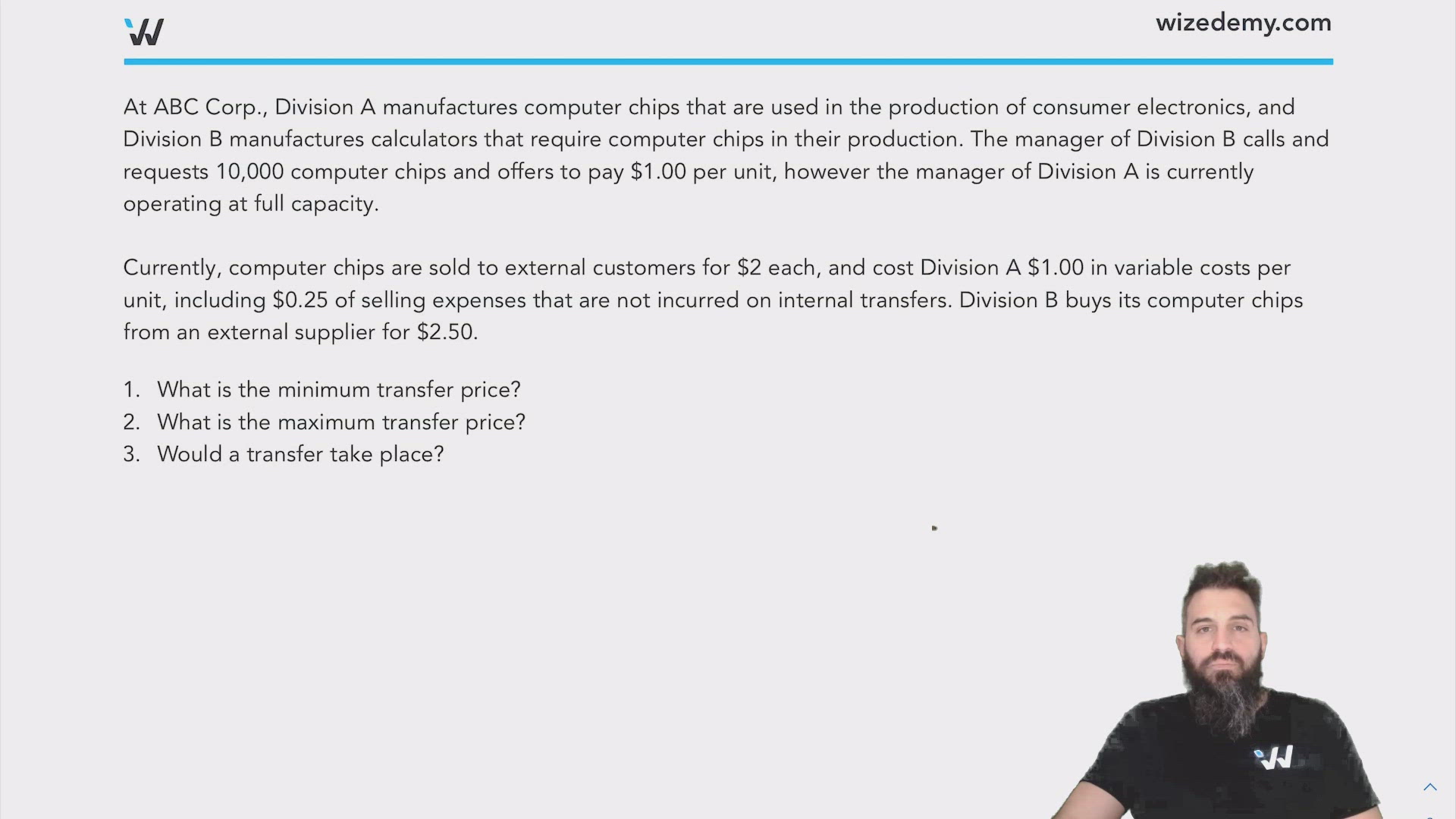
At ABC Corp., Division A manufactures computer chips that are used in the production of consumer electronics, and Division B manufactures calculators that require computer chips in their production. The manager of Division B calls and requests 10,000 computer chips and offers to pay $1.00 per unit, however the manager of Division A is currently operating at full capacity.
Currently, computer chips are sold to external customers for $2 each, and cost Division A $1.00 in variable costs per unit, including $0.25 of selling expenses that are not incurred on internal transfers. Division B buys its computer chips from an external supplier for $2.50.
- What is the minimum transfer price?
- What is the maximum transfer price?
- Would a transfer take place?
0:00 / 0:00
Example: Transfer Pricing
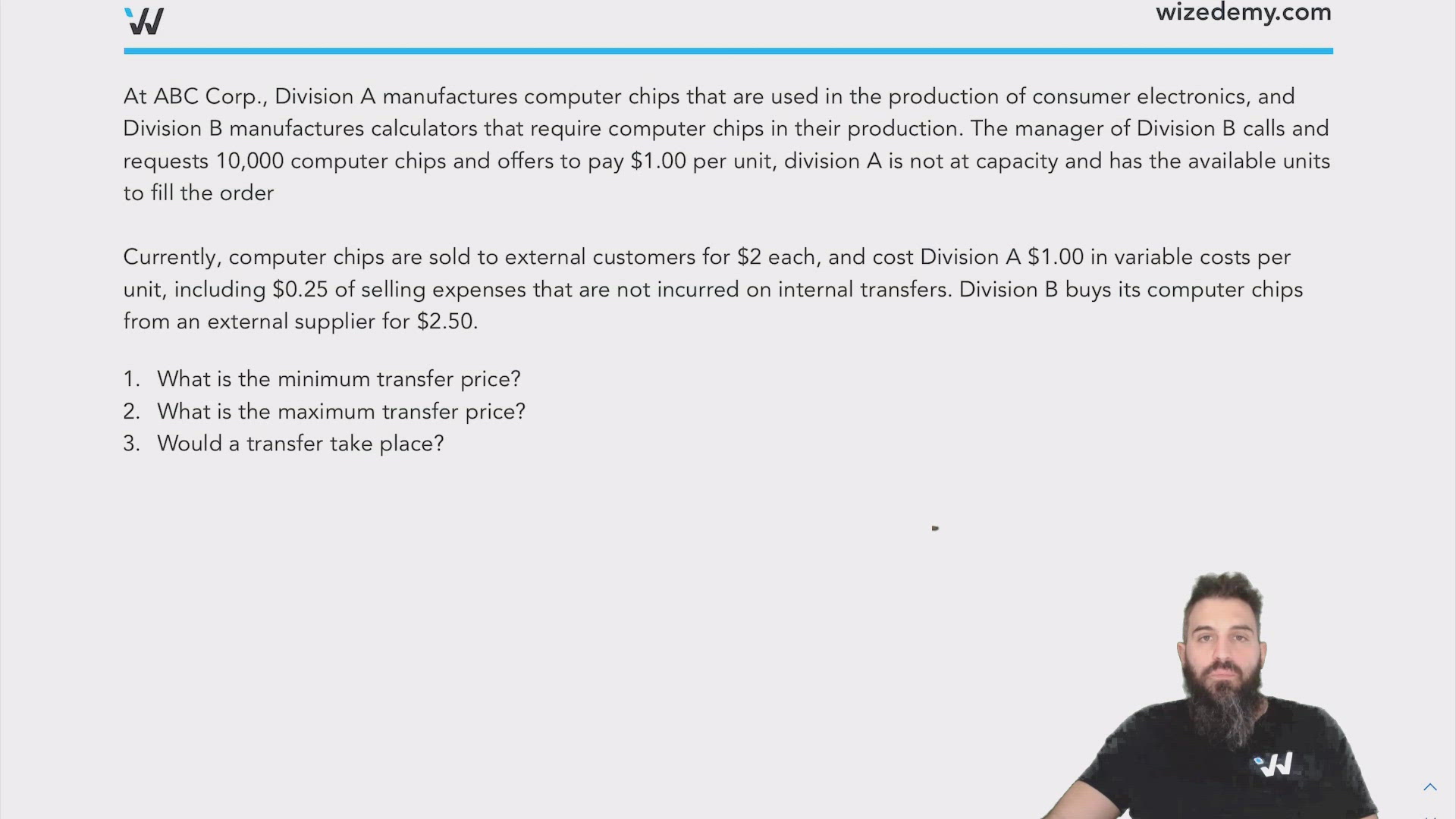
At ABC Corp., Division A manufactures computer chips that are used in the production of consumer electronics, and Division B manufactures calculators that require computer chips in their production. The manager of Division B calls and requests 10,000 computer chips and offers to pay $1.00 per unit, division A is not at capacity and has the available units to fill the order
Currently, computer chips are sold to external customers for $2 each, and cost Division A $1.00 in variable costs per unit, including $0.25 of selling expenses that are not incurred on internal transfers. Division B buys its computer chips from an external supplier for $2.50.
- What is the minimum transfer price?
- What is the maximum transfer price?
- Would a transfer take place?

0:00 / 0:00
Example: Transfer Pricing
At ABC Corp., Division A manufactures computer chips that are used in the production of consumer electronics, and Division B manufactures calculators that require computer chips in their production. The manager of Division B calls and requests 10,000 computer chips and offers to pay $1.00 per unit, division A is not at capacity and has the available units to fill the order
At ABC Corp., Division A manufactures computer chips that are used in the production of consumer electronics, and Division B manufactures calculators that require computer chips in their production. The manager of Division B calls and requests 10,000 computer chips and offers to pay $1.00 per unit, division A has 6,000 units of excess capacity.
Currently, computer chips are sold to external customers for $2 each, and cost Division A $1.00 in variable costs per unit, including $0.25 of selling expenses that are not incurred on internal transfers. Division B buys its computer chips from an external supplier for $2.50.
- What is the minimum transfer price?
- What is the maximum transfer price?
- Would a transfer take place?
Practice: Transfer Pricing
ABC Corp. operates severals divisions within its operations. Division A produces and sells small metal gears that are used in the production of various products; Division B manufactures vacuum cleaners that require metals gears to be produced. Division A has the capacity to produce one million metal gears and is currently operating at 90%, it incurs $0.90 per unit to manufacture the gears, $0.40 of which is fixed overhead, and it incurs an additional $0.30 in variable selling expenses only on units sold externally, Division A sells its standard product on the market for $3 per unit.
Division B has requested that Division A transfer to it 90,000 units of a special type of gear in order for them to produce a new autonomous vacuum cleaner and has offered to pay Division A $2.50 per unit. The gear is twice the size of Division A's standard product and will therefore cost Division A twice as much in variable manufacturing costs to produce and each unit of the special gear will take up twice as much capacity as a standard unit. Should Division A reject the transfer, an external supplier has been found that can produce the special gear for $4 per unit.
What is the minimum transfer price?