Wize University Managerial Accounting Textbook > Cost-Volume-Profit Analysis
The Contribution Margin
Popular Courses
COMM 305
Concordia University
Managerial Accounting
University Study Guides
Managerial Accounting
University Study Guides
COMM 112
Queen's University
ACC 406
Toronto Metropolitan University
ACCTG 322
University of Alberta
ACCT*2230
University of Guelph
ADM 2341
University of Ottawa
COMMERCE 2AB3
McMaster University
SB/ACTG 2020 3.00
York University
COMM 1102
Dalhousie University
ACC 312
The University of Texas at Austin
ACC 242
Arizona State University - Tempe
ACC 202
Michigan State University
ACIS 2116
Virginia Tech
ACG 2071
University of Central Florida
BUS1 21
San José State University
BUS-A 306
Indiana University - Bloomington
ACCT 2102
Temple University
ACCTG-202
San Diego State University
0:00 / 0:00
Contribution Margin
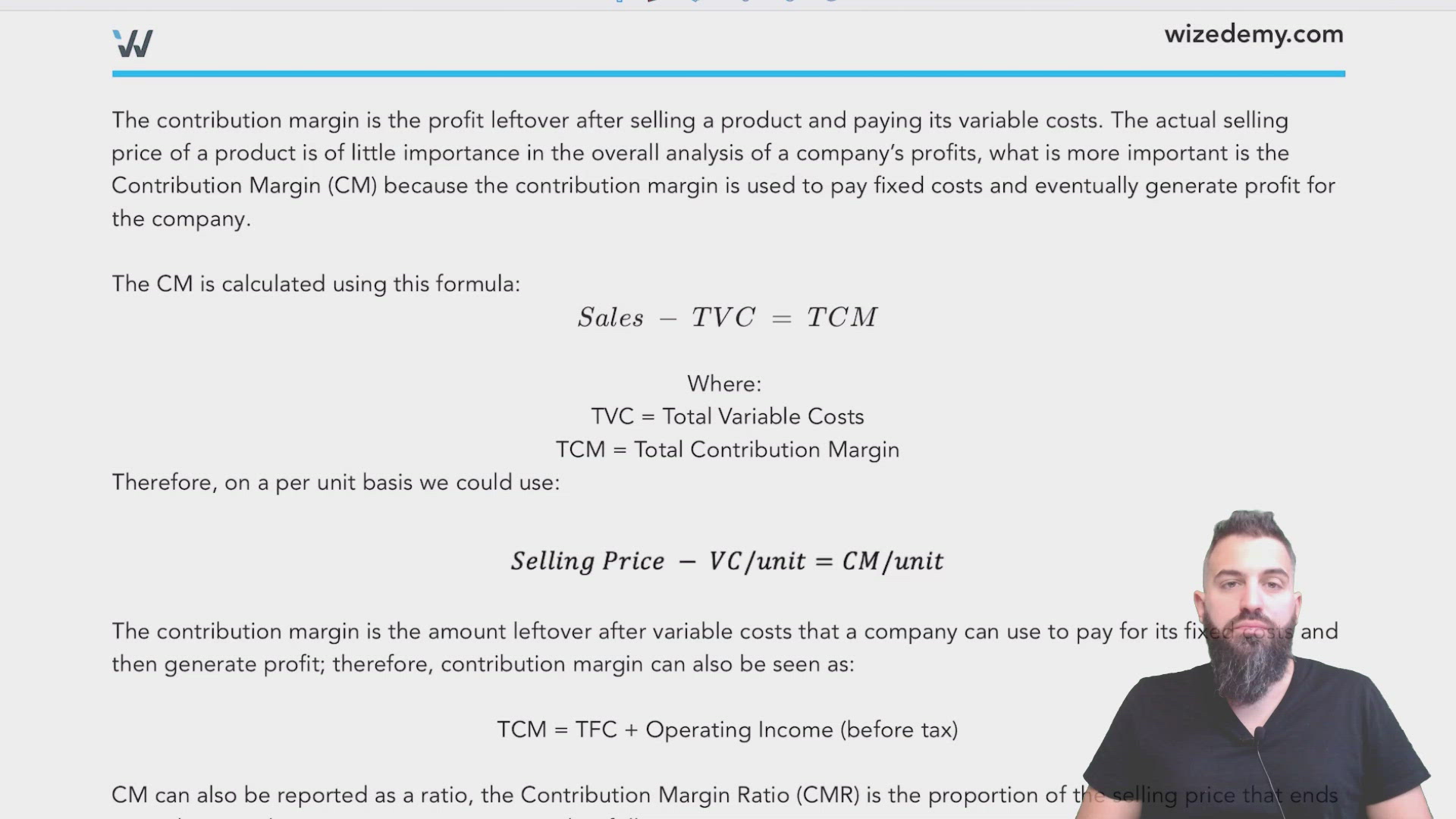
The contribution margin is the profit leftover after selling a product and paying its variable costs. The actual selling price of a product is of little importance in the overall analysis of a company’s profits, what is more important is the Contribution Margin (CM) because the contribution margin is used to pay fixed costs and eventually generate profit for the company.
The CM is calculated using this formula:

Therefore, on a per unit basis we could use:

The contribution margin is the amount leftover after variable costs that a company can use to pay for its fixed costs and then generate profit; therefore, contribution margin can also be seen as:
CM can also be reported as a ratio, the Contribution Margin Ratio (CMR) is the proportion of the selling price that ends up in the contribution margin, it is computed as follows:

0:00 / 0:00
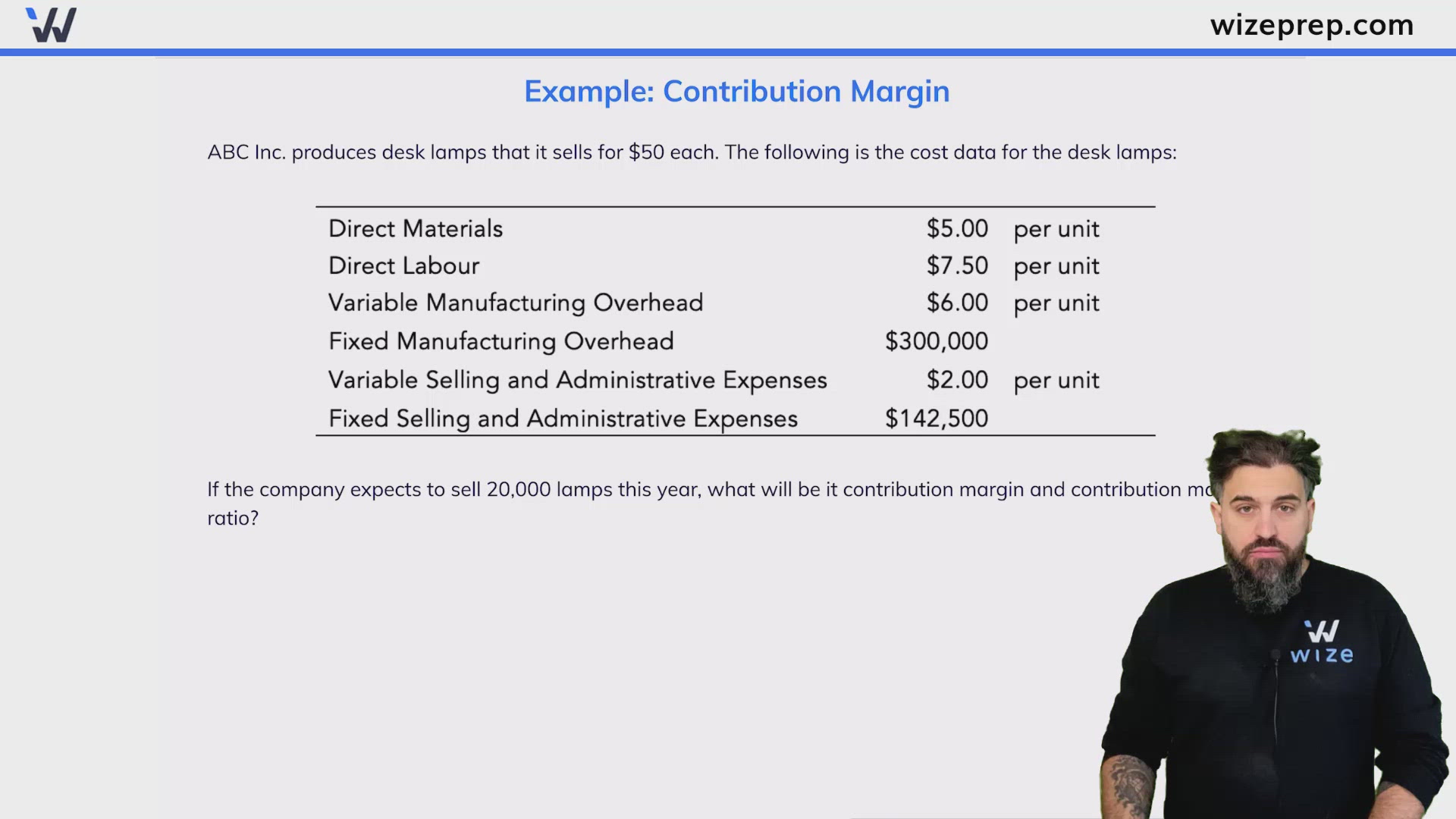
Example: Contribution Margin
ABC Inc. produces desk lamps that it sells for $50 each. The following is the cost data for the desk lamps:
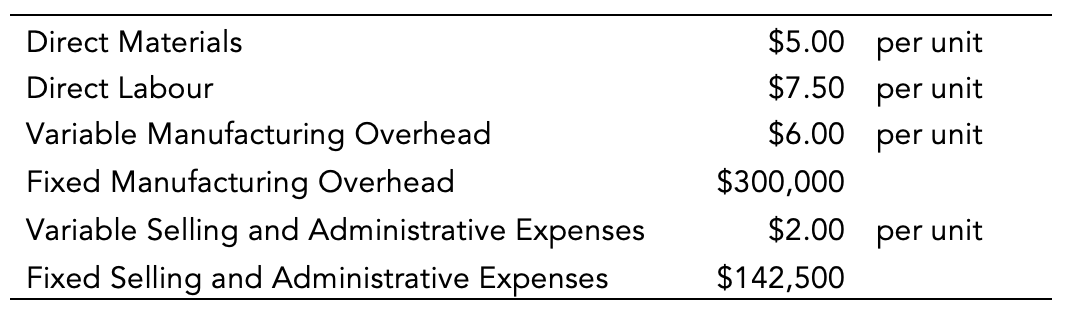
If the company expects to sell 20,000 lamps this year, what will be it contribution margin and contribution margin ratio?
Practice: Contribution Margin
ABC Inc produces skateboards and sells them for $60 each. Each skateboard costs $5 in direct materials, $7 in direct labor, and $3 in variable manufacturing overhead. The fixed manufacturing overhead costs a total of $20,000 per month and the company pays a 5% sales commission on each unit sold. There are no other costs. It is estimated that the company will sell 5,000 units this month. Compute the following:
- Contribution margin per unit
- Total contribution margin
- Contribution margin ratio
Contribution margin per unit