Wize University Managerial Accounting Textbook > Pricing
Cost-Plus Pricing
Popular Courses
COMM 305
Concordia University
Managerial Accounting
University Study Guides
Managerial Accounting
University Study Guides
COMMERCE 2AB3
McMaster University
SB/ACTG 2020 3.00
York University
ACC 312
The University of Texas at Austin
ACIS 2116
Virginia Tech
ACG 2071
University of Central Florida
BUS1 21
San José State University
BUS-A 306
Indiana University - Bloomington
ACCT 2102
Temple University
ACCTG-202
San Diego State University
MGMT 20100
Purdue University
ACG 2071
University of Florida
ACCT 210
University of Arizona
ACCY 202
University of Illinois at Urbana - Champaign
BCOR 2303
University of Colorado Boulder
ACCT 2082
University of Cincinnati
ACCT 2102
Georgia Institute of Technology
33:010:275
Rutgers University - New Brunswick (Busch)
0:00 / 0:00
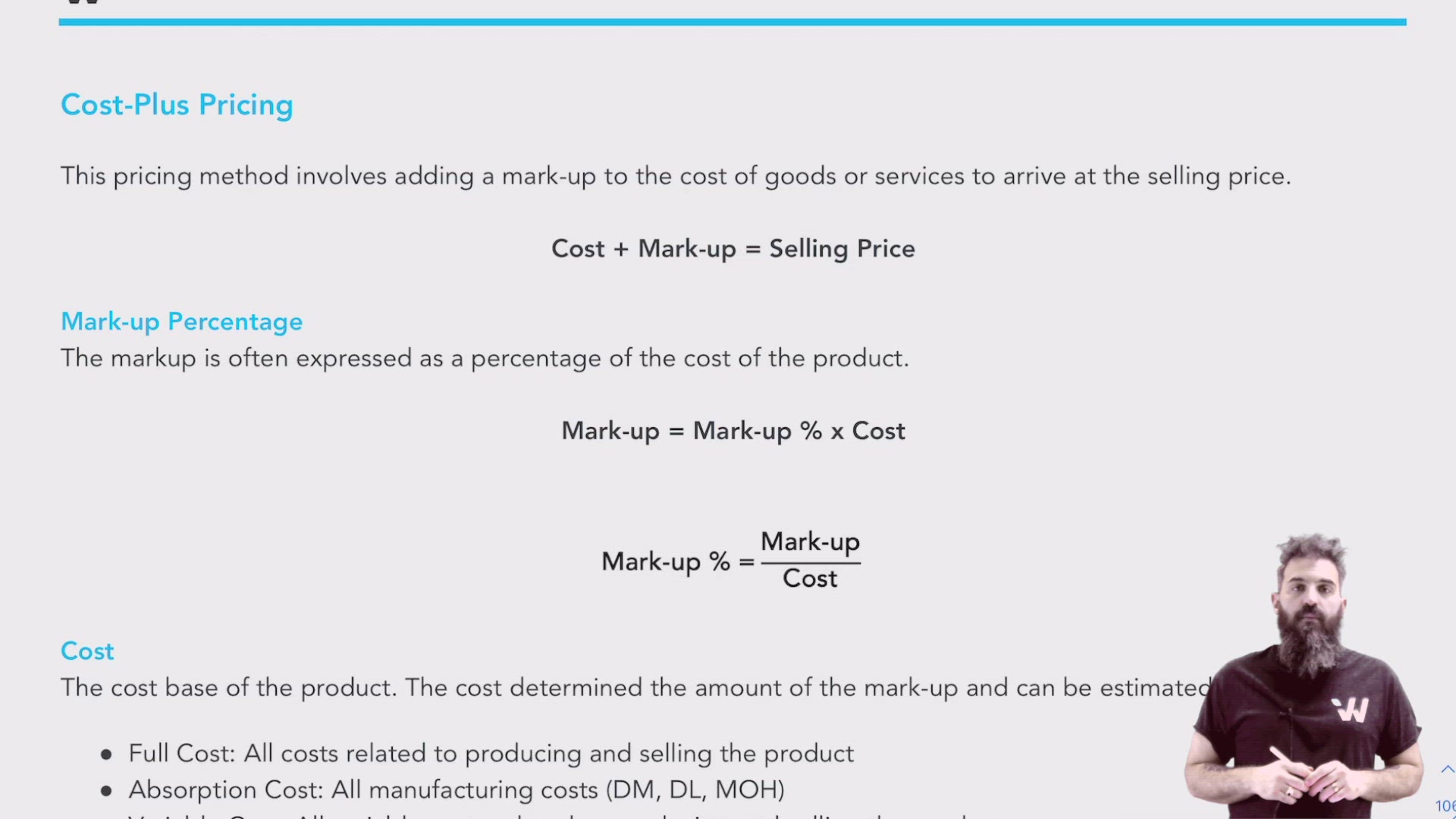
Cost-Plus Pricing
This pricing method involves adding a mark-up to the cost of goods or services to arrive at the selling price.

Mark-up Percentage
The markup is often expressed as a percentage of the cost of the product.

Cost
The cost base of the product. The cost determined the amount of the mark-up and can be estimated differently:
- Full Cost: All costs related to producing and selling the product
- Absorption Cost: All manufacturing costs (DM, DL, MOH)
- Variable Cost: All variable costs related to producing and selling the product.

0:00 / 0:00
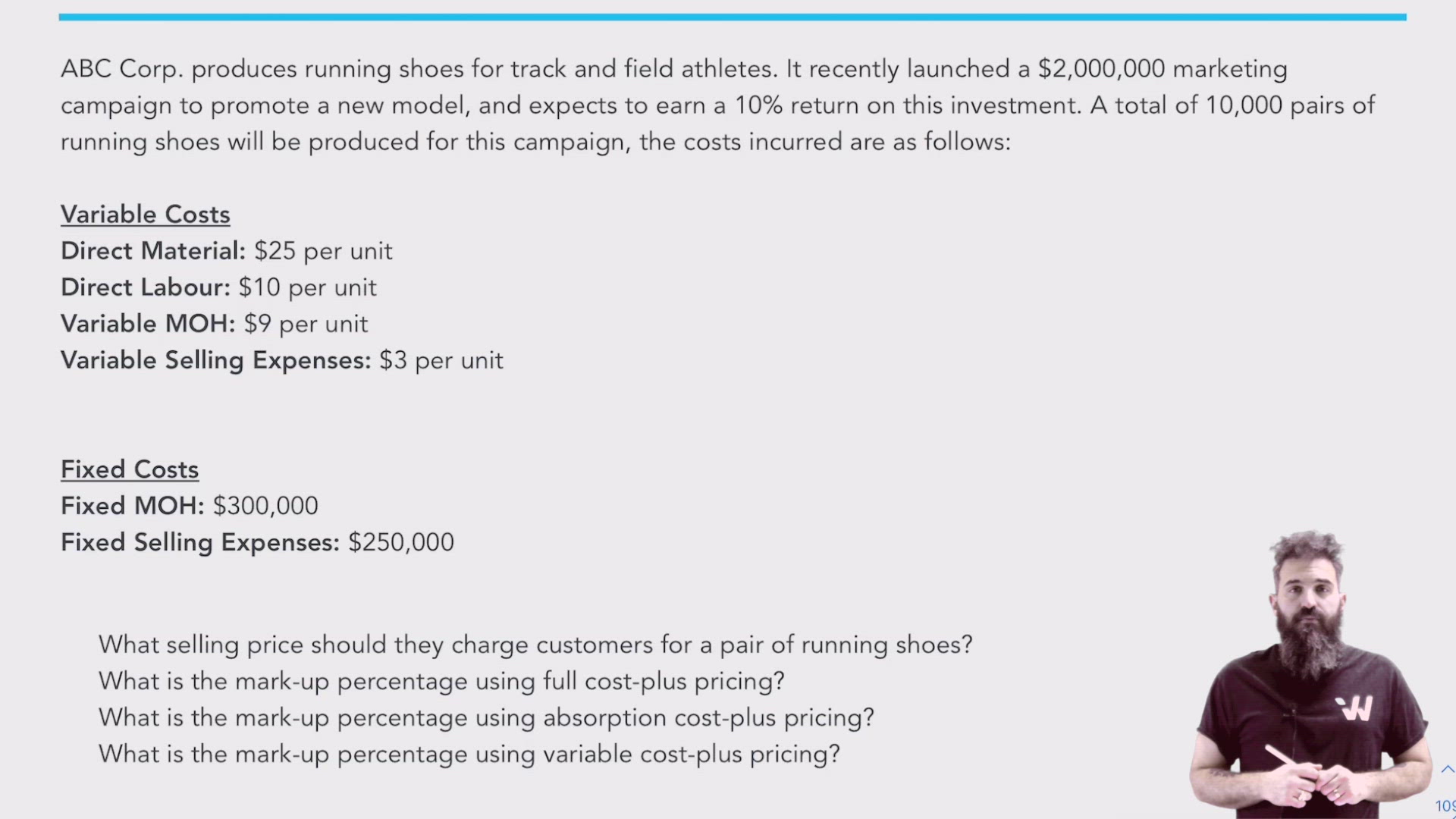
Example: Cost-Plus Pricing
ABC Corp. produces running shoes for track and field athletes. It recently launched a $2,000,000 marketing campaign to promote a new model, and expects to earn a 10% return on this investment. A total of 10,000 pairs of running shoes will be produced for this campaign, the costs incurred are as follows:
Variable Costs
Direct Material: $25 per unit
Direct Labour: $10 per unit
Variable MOH: $9 per unit
Variable Selling Expenses: $3 per unit
Fixed Costs
Fixed MOH: $300,000
Fixed Selling Expenses: $250,000
- What selling price should they charge customers for a pair of running shoes?
- What is the mark-up percentage using full cost-plus pricing?
- What is the mark-up percentage using absorption cost-plus pricing?
- What is the mark-up percentage using variable cost-plus pricing?
Practice: Cost-Plus Pricing
A manufacturer of home appliances plans to produce 50,000 toasters. Fixed costs are $300,000 for manufacturing overhead and $100,000 for selling and administrative costs; Variable costs are $10 per unit ($8 of variable manufacturing costs and $2 of variable selling and administrative costs). The manufacturer wishes to earn a 20% return on the total cost.
The company should charge $ per unit.
If the company uses variable cost-plus pricing, the mark-up should be %.