Wize University Chemistry Textbook > Early Atomic Theory to Quantum Theory
How Atomic Spectra Relates to Electronic Transitions + Other Applications of the Bohr Model
Popular Courses
General Chemistry
University Study Guides
CHEM 101
University of Alberta
CHEM 112
Queen's University
CHEM 121
University of British Columbia
DAT
General Course
Chemistry
General Course
General Chemistry
University Study Guides
CHEM 103
University of Alberta
CHEM 110
McGill University
CHEM 1E03
McMaster University
CHM135H1
University of Toronto
CHEM 120
University of Waterloo
CHEM 205
Concordia University
CHEM 121
Simon Fraser University
APSC 131
Queen's University
CHEM 1100
University of Manitoba
CHEM 1481
Texas A & M University
CEM 141
Michigan State University
CHY 113
Toronto Metropolitan University
CHMA10H3
University of Toronto
0:00 / 0:00
Atomic Line Spectra
Emission and Absorption
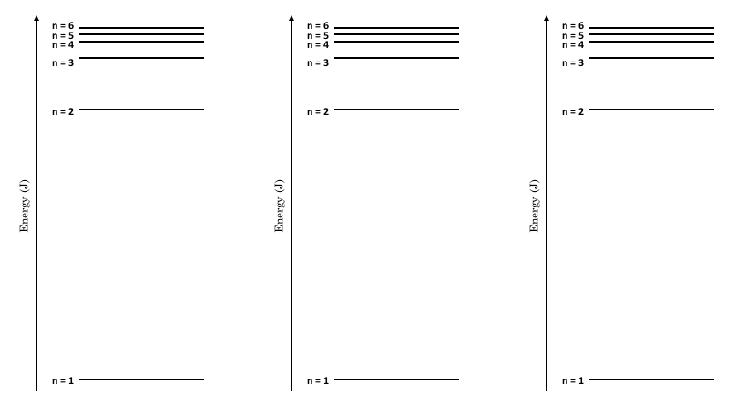
Note: n=1 is ground state, all other n levels are excited states
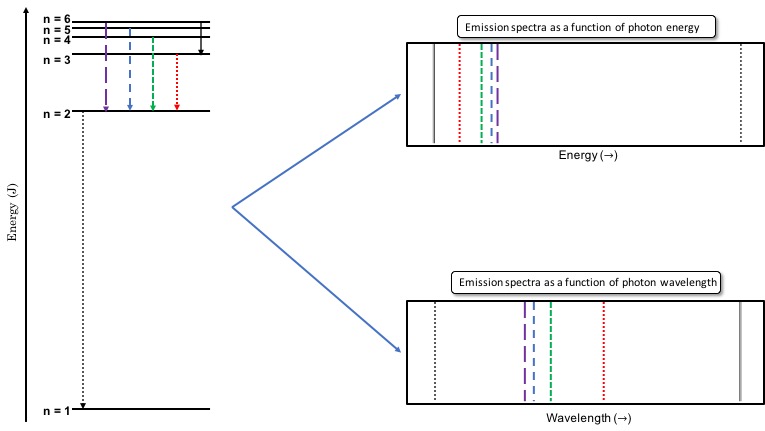
Emission Spectra

0:00 / 0:00
Relating Electronic Transitions to Emission Spectra
Bohr Model of the Hydrogen Atom


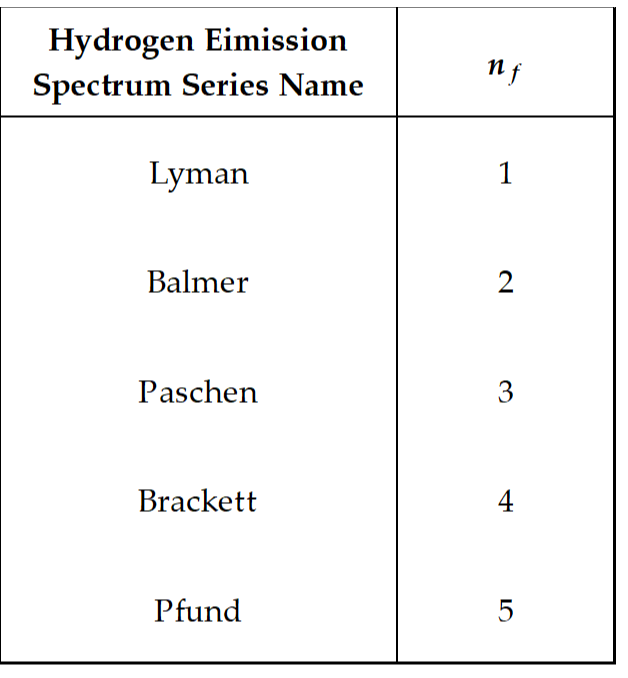
Hydrogen Emission Spectral Series:

0:00 / 0:00
Example: Removing an Electron
What wavelength of light corresponds to the 4th ionization energy of Beryllium?
Can start by solving for the energy difference for this transition:
The 4th I.E. of Be corresponds to , which is a transition from n = 1 to n = infinity for a one-electron species .
Therefore,
Now you can solve for the wavelength that the energy difference corresponds to:
λ=5.704x10⁻⁹ m
1nm=1x10⁻⁹m
Divide meters value by 1x10⁻⁹ to get nm
λ=5.704nm
Practice: Understanding Emissions
Which of the following transitions would emit the shortest wavelength photon?
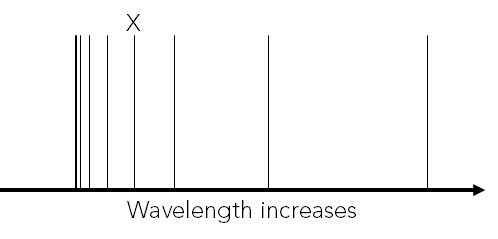
You shine light through a sample of gaseous atomized hydrogen and take an absorption spectrum as shown below. Only transitions to or from the ground state (n = 1) appear in the spectrum. Which of these energy-level transitions correspond to the line labelled X in the absorption spectrum?