Wize University Chemistry Textbook > Periodic Table Trends
Atomic Radius Trend
Popular Courses
MCAT
General Course
Grade 12 Chemistry
Ontario High School
Grade 12 Chemistry
Canada High School
CHEM 1301A/B
Western University
CHEM 201
University of Calgary
General Chemistry
University Study Guides
AP Chemistry Exam Prep Course
AP Exam Prep
CHEM 1A03
McMaster University
CHEM 101
University of Alberta
CHEM 112
Queen's University
CHEM 121
University of British Columbia
High School Chemistry
US High School
DAT
General Course
CHM 1311
University of Ottawa
Chemistry
General Course
General Chemistry
University Study Guides
CHEM 103
University of Alberta
CHEM 110
McGill University
CHEM 1E03
McMaster University
ENGG 204
University of Calgary

0:00 / 0:00
Atomic Radius
The atomic radius is the estimated radius of an atom (from the nucleus to the outermost valence electrons)
The Periodic Trend
- As we move to the right on the periodic table, the Zeff increases and this “pulls” the electrons closer to the nucleus which decreases the radii.
- As we move down a group in the periodic table, the number of electron shells increases which makes the atom radii larger.
- 🡻 group → 🡹 shells
- 🡹 shells → 🡹 shielding and 🡻 Zeff
- With a 🡻 Zeff →🡻 pull on outer electrons, leading to 🡹 atomic radii

Element with the largest atomic radii in the periodic table:
Fr
Element with the smallest atomic radii in the periodic table:
He
How do ions change this?
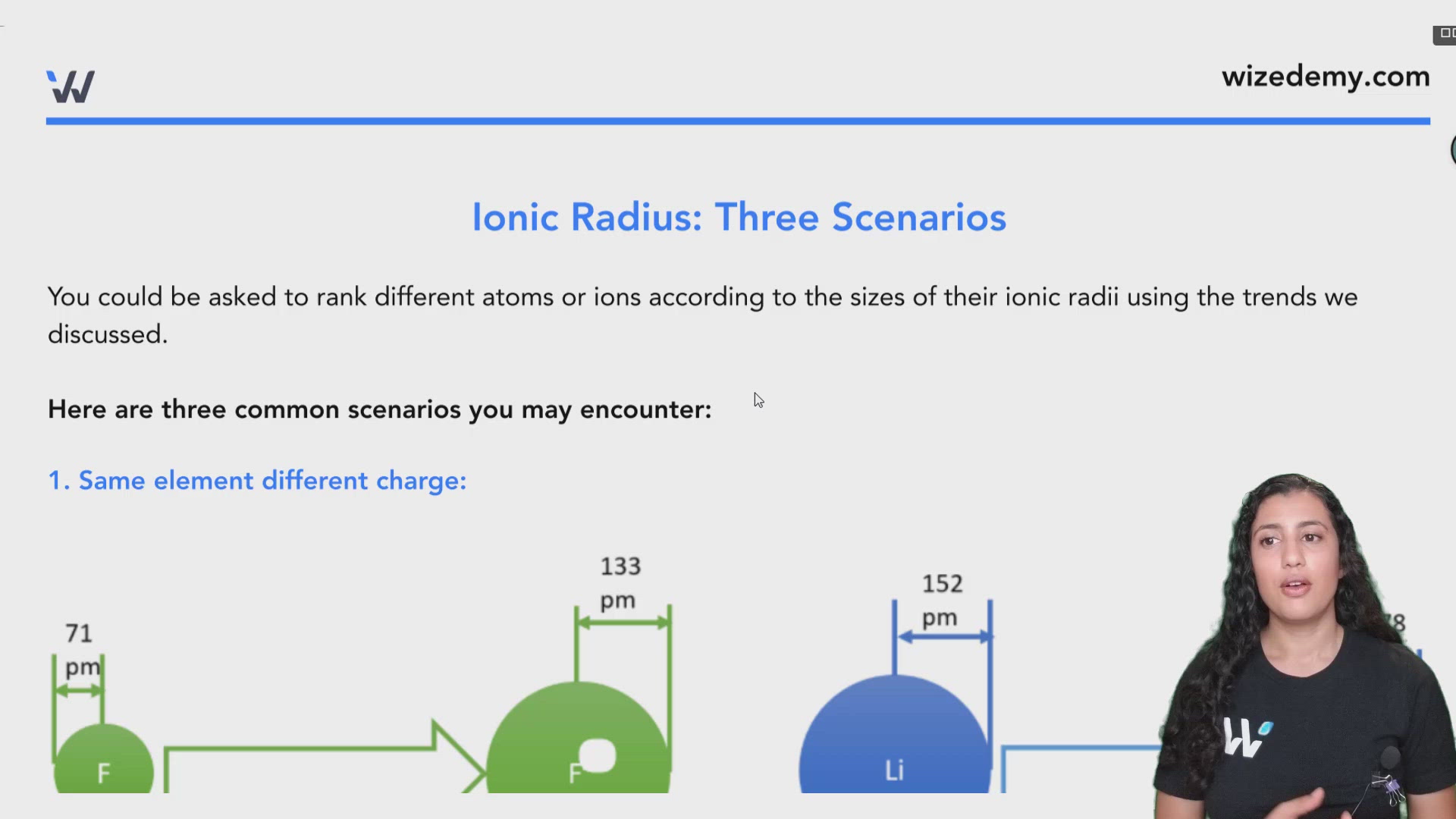
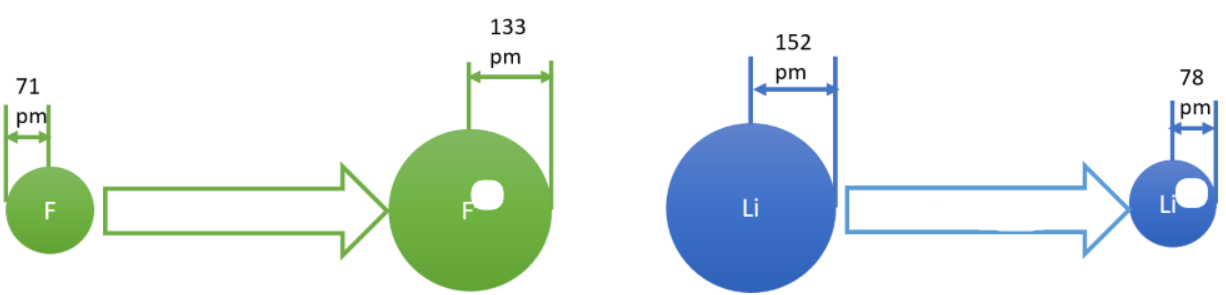
- Anions:Largerdue to increased electron-electron repulsion
- Cations:Smallerdue to decreased electron-electron repulsion
- How does this relate to Zeff?
- Anions (negatively charged ions) have additional electrons → after adding additional electrons, the "pull" that the nucleus has on each valence electron is less → the atomic radius of an anion > atomic radius of a neutral atom
- Cations (positively charged ions) have had electrons removed from the neutral element → with less electrons, the nucleus now has a stronger "pull" on the remaining valence electrons → the atomic radius of a cation < atomic radius of a neutral atom
In general:
X+ < X < X-
0:00 / 0:00
Ionic Radius: Three Scenarios
You could be asked to rank different atoms or ions according to the sizes of their ionic radii using the trends we discussed.
Here are three common scenarios you may encounter:
1. Same element different charge:
2. Different element same charge:
- Identical trend to atoms Example: Li < Na so Li+ < Na+
3. Different element different charge
- Can only be assessed for isoelectronic species (same # of electrons)
- Compare the proton to electron ratio.
- More protons than electrons, means stronger pull, smaller radius.
- Less protons than electrons, means weaker pull, larger radius. Example: Compare the radii for the following: O2- F- Ne Na+ Mg2+
- (smallest radius) Mg2+ < Na+ < Ne < F- < O2- (largest radius)


0:00 / 0:00
Example: Ranking Size of Atoms
Rank the following atoms in order of increasing atomic radius: Se, Cs, Br, Ga, F, As.

In order of increasing atomic radius means that we want to list the atom with the smallest atomic radius on the left and the atom with the largest atomic radius on the right.
F < Br < Se < As < Ga < Cs
0:00 / 0:00
Example: Ranking Size of Ions
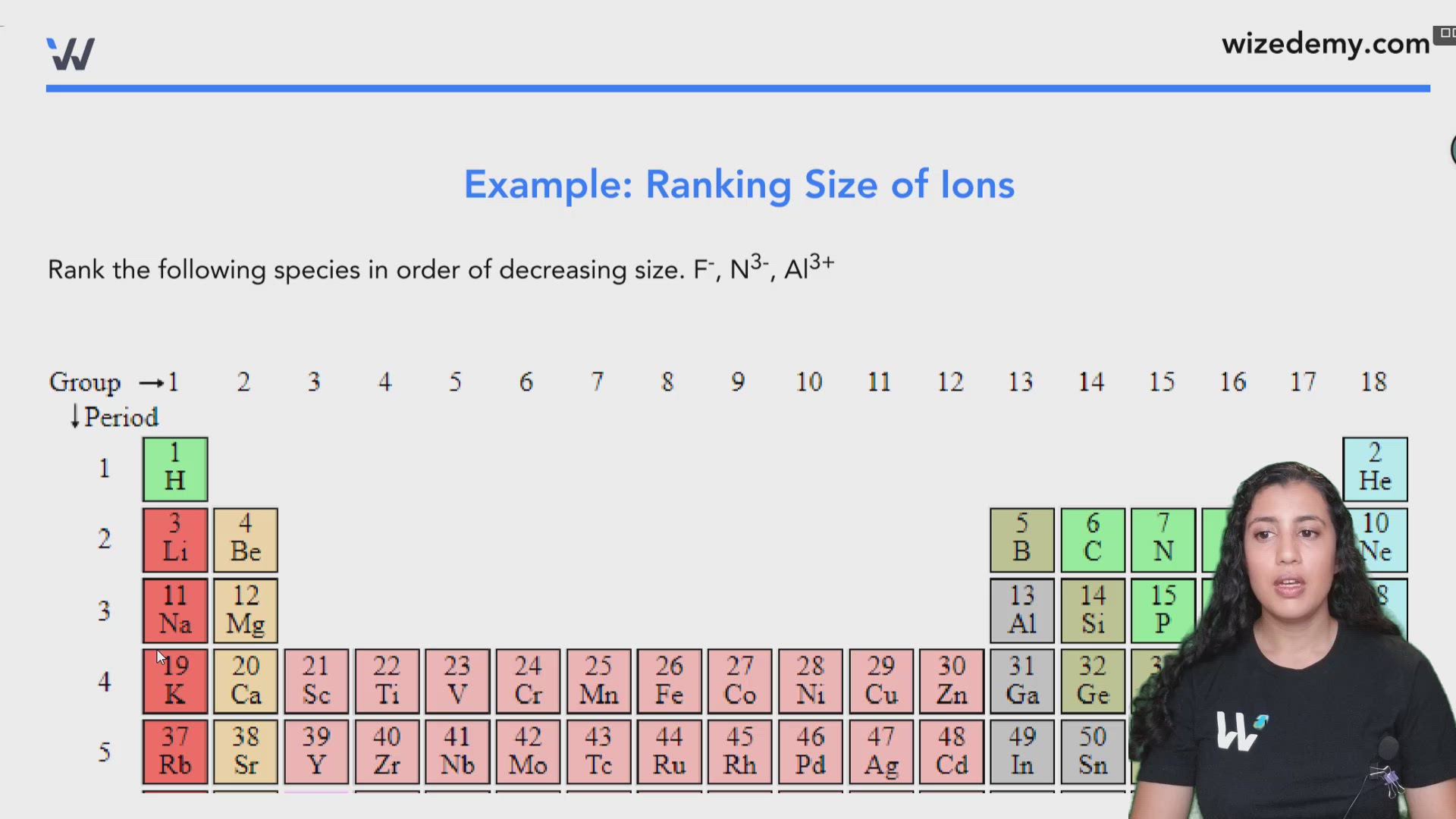
Rank the following species in order of decreasing size. F-, N3-, Al3+

Step 1: Determine the number of electrons for each of these
Al3+ = 10
F- = 10
N3-= 10
These ions are all isoelectronic with Ne
Wize Tip
When comparing atoms that are isoelectronic (i.e. they have the same number of electrons), remember more protons in the nucleus means a stronger the pull of electrons toward the + charged nucleus, so the smaller the atomic radius
Step 2: Determine the number of protons for the isoelectronic species and rank by number of protons. More protons --> smaller radius
Al3+ = 13
F- = 9
N3-= 7
N3- > F- > Al3+
Practice: Determining the Largest Atom
Select the atom below which has the largest atomic radius?
