Wize University Chemistry Textbook > Quantum Numbers and Electron Configurations
Ground State vs Excited State Electron Configurations
Popular Courses
MCAT
General Course
CHEM 201
University of Calgary
General Chemistry
University Study Guides
CHEM 121
University of British Columbia
DAT
General Course
Chemistry
General Course
General Chemistry
University Study Guides
CHM135H1
University of Toronto
CHEM 120
University of Waterloo
CHEM 121
Simon Fraser University
CHEM 1100
University of Manitoba
CHEM 1481
Texas A & M University
CEM 141
Michigan State University
CHMA10H3
University of Toronto
SC/CHEM 1100 4.00
York University
CHEM 1035
Virginia Tech
CHM 2045
University of Florida
CHEM 1001
Carleton University
CHEM 6A
University of California - San Diego
CHEM 111
University of British Columbia

0:00 / 0:00
Ground State Vs Excited State Electron Configurations
Generally, when we find electron(s) in a higher energy level than expected for ground state, the atom is in an excited state.
Watch Out!
Do not confuse excited state configurations with those of ions.
Excited states have the same number of electrons as the ground state atom, whereas an ionic configuration will have a different a number of electrons than the atom it came from.

Wize Tip
For excited states, the Aufbau Principle and Hund's Rule can be disobeyed, but the Pauli Exclusion Principle must ALWAYS be followed.


0:00 / 0:00
Example: Excited State Electronic Configurations
Determine the electronic configuration for a chlorine atom that has one electron excited from the 3p orbital to the 4s orbital.

ground state Cl: [Ne] 3s2 3p5
excited state Cl: [Ne]3s2 3p4 4s1
Example: Excited States
How many electrons would an excited atom of chlorine have?

A. 6
B. 7
C. 16
D. 18
E. None of the above
Correct Answer: E
Excited state of chlorine has the same number of electrons as the neutral, ground state of chlorine. We do not lose or gain electrons, so the excited state has 17 electrons.

Mark Yourself Question
- Grab a piece of paper and try this problem yourself.
- When you're done, check the "I have answered this question" box below.
- View the solution and report whether you got it right or wrong.
Practice: Excited State in an Energy Level Diagram
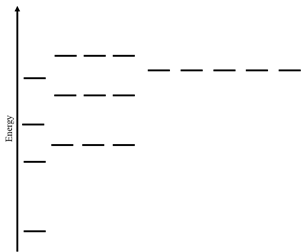
Consider an atom of the alkali metal Potassium.
a) In the energy diagram given, fill in the required number of electrons for a potassium atom and name the occupied orbitals.

b) The valence electron of potassium can be excited to the next highest energy state in the same valence shell. Below, show how the energy level diagram for the excited atom of potassium has changed. Make sure to name all occupied orbitals.
Practice: Ground or Excited State
Identify the following atom or ion and decide whether it is in a ground or excited state:
Z = 26 electronic configuration: [Ar]4s23d3