Wize University Chemistry Textbook > Gases and their Properties
Other Applications of the Ideal Gas Law
Popular Courses
MCAT
General Course
CHEM 1302A/B
Western University
General Chemistry
University Study Guides
CHEM 1A03
McMaster University
CHEM 101
University of Alberta
CHEM 112
Queen's University
CHEM 203
University of Calgary
DAT
General Course
Chemistry
General Course
CHEM 103
University of Alberta
General Chemistry
University Study Guides
CHM135H1
University of Toronto
CHEM 120
University of Waterloo
CHY 102
Toronto Metropolitan University
CHEM 205
Concordia University
CHEM 121
Simon Fraser University
CHEM 120
McGill University
SC/CHEM 1000 3.00
York University
APSC 131
Queen's University
CHEM-1100
University of Windsor
0:00 / 0:00
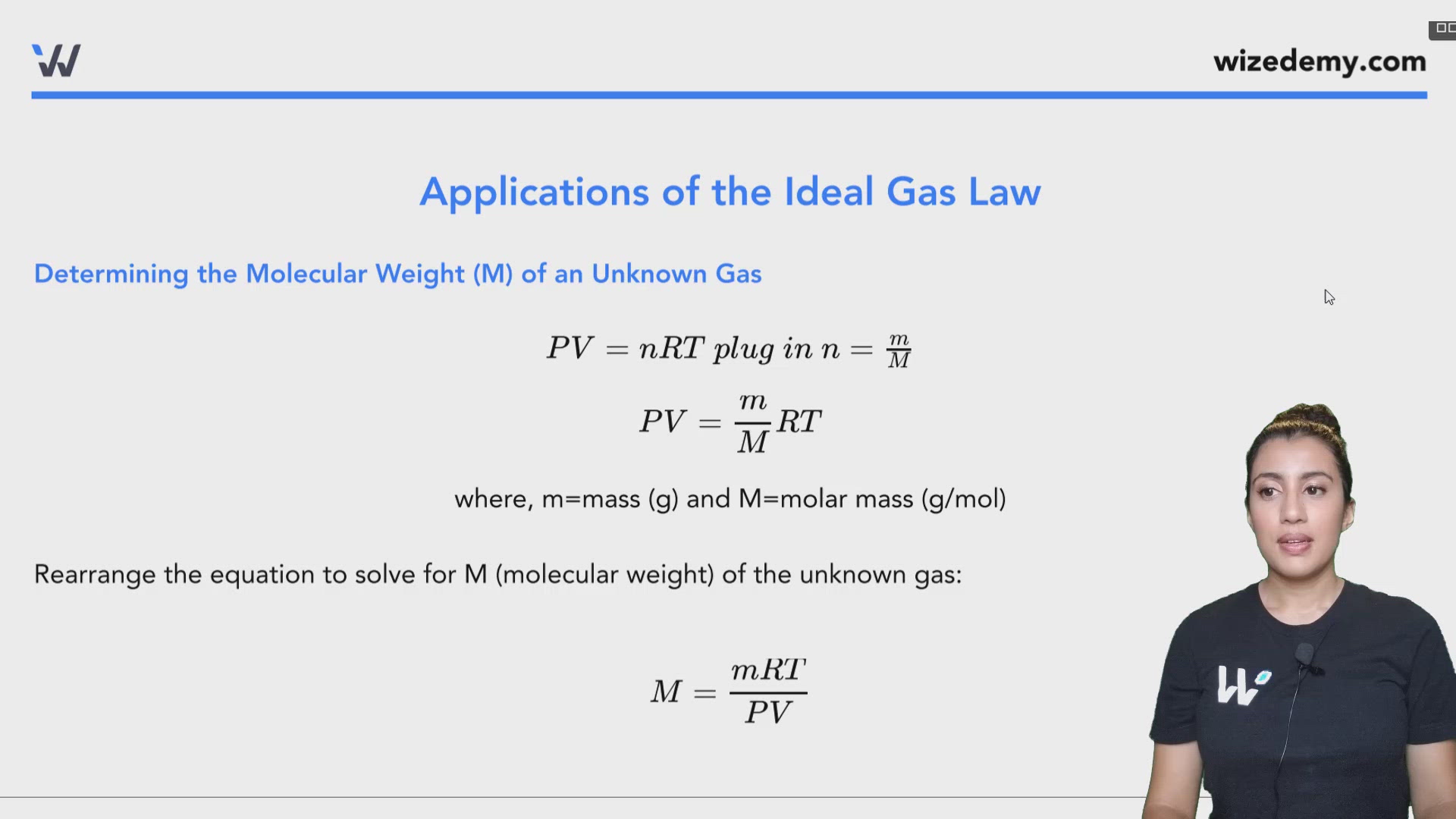
Applications of the Ideal Gas Law
Determining the Molecular Weight (M) of an Unknown Gas
where, m=mass (g) and M=molar mass (g/mol)
Rearrange the equation to solve for M (molecular weight) of the unknown gas:
Finding the Density of a Gas
The equation for density (𝛿) is:
We can rearrange the ideal gas law to find density:
Solve for density:
0:00 / 0:00
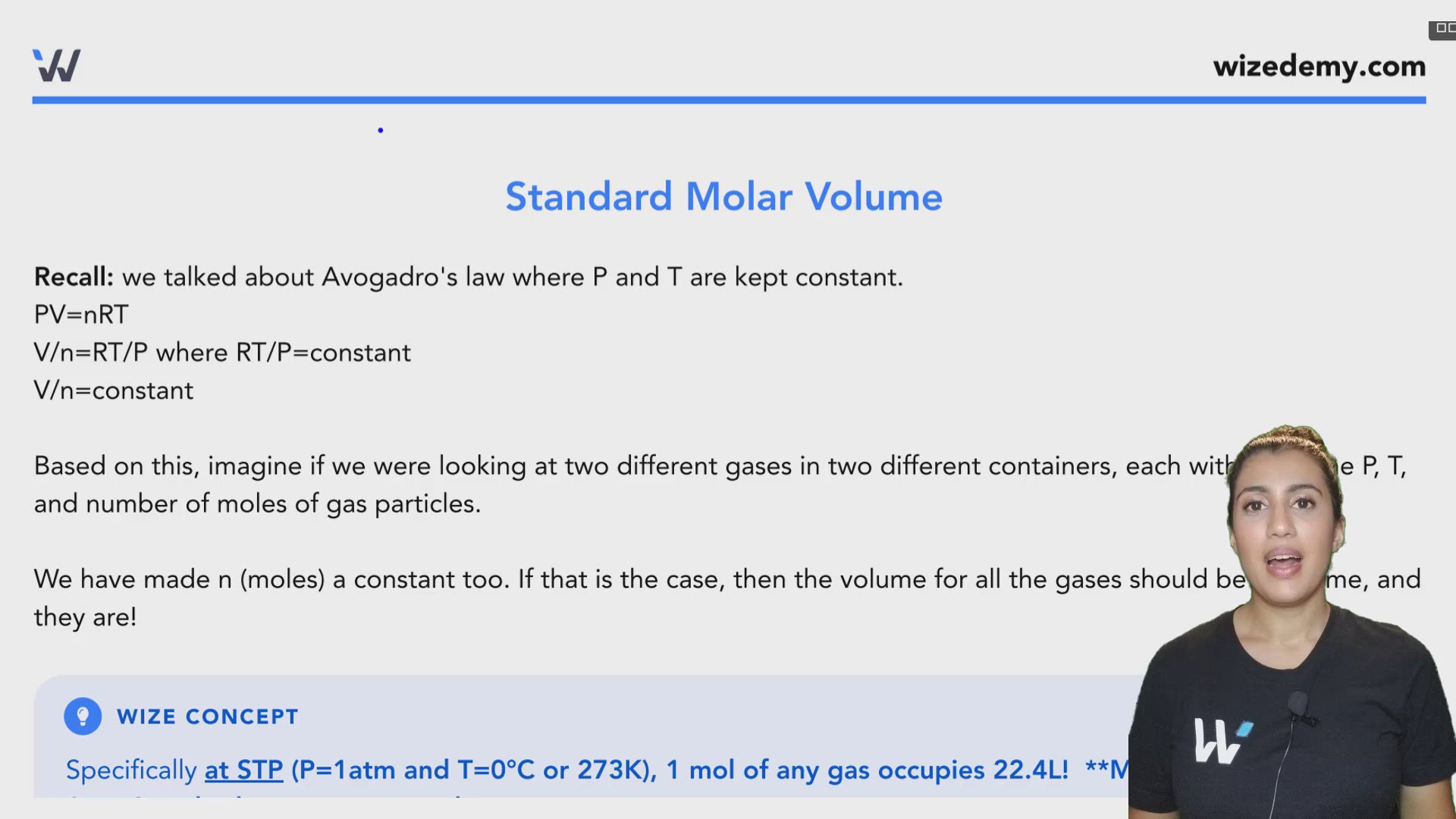
Standard Molar Volume
Recall: we talked about Avogadro's law where P and T are kept constant.
PV=nRT
V/n=RT/P where RT/P=constant
V/n=constant
Based on this, imagine if we were looking at two different gases in two different containers, each with the same P, T, and number of moles of gas particles.
We have made n (moles) a constant too. If that is the case, then the volume for all the gases should be the same, and they are!
Wize Concept
Specifically at STP (P=1atm and T=0°C or 273K), 1 mol of any gas occupies 22.4L! **Memorize this!**
STP=Standard Temperature and Pressure

0:00 / 0:00
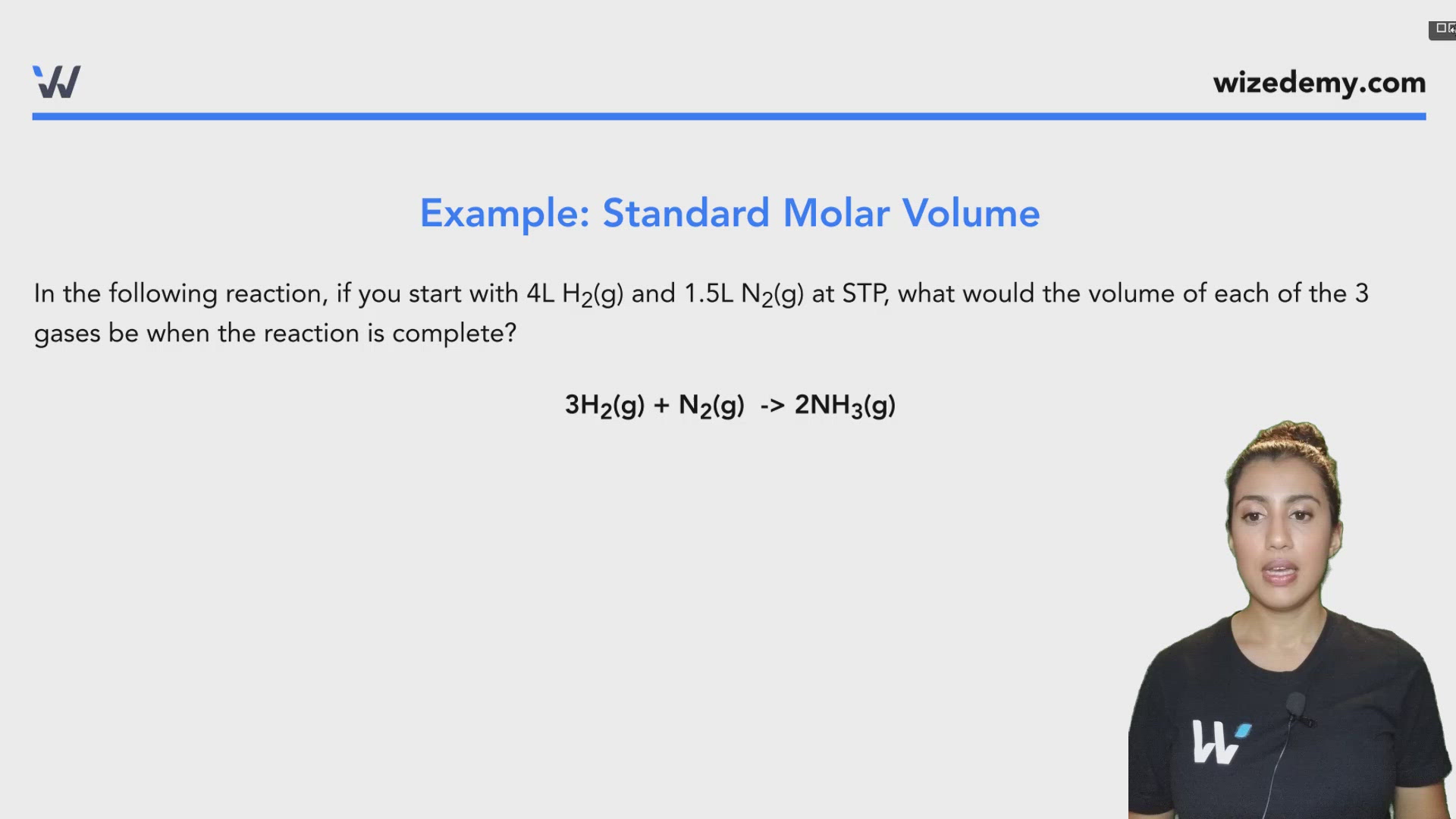
Example: Standard Molar Volume
In the following reaction, if you start with 4L H2(g) and 1.5L N2(g) at STP, what would the volume of each of the 3 gases be when the reaction is complete?
3 H2(g) + N2(g) → 2 NH3(g)
@STP: T = 273 K, P = 1 atm (constant), 1 mol = 22.4 L
We can convert the volumes into moles using 1 mol = 22.4 L:
H2(g):
N2(g):
Now that we have moles of each reagent, we need to determine the limiting reagent.
To do this, divide each number of moles by the stoichiometric coefficient in the balanced equation:
H2(g):
N2(g):
The smallest number is for H2(g) so it is the limiting reagent!
Solve for moles of NH3(g) produced:
Calculate the volume of NH3(g) using 1 mol = 22.4 L
How many L of H2(g) are leftover?
H2 was the limiting reagent and got completely used up!
We just need to find the L of N2(g) that are leftover.
First let's determine the moles leftover.
We started with 0.06696 moles of N2(g)
0.06696 moles - 0.05953 moles = 0.00743 moles N2(g) left over
Finally convert this into volume to determine the volume of N2(g) leftover:
Practice: Solving for Molar Mass of a Gas
The density of an unknown gas at 100oC and 746 torr is 1.994 g/L. What is the molecular mass of this unknown gas?
Practice: Determine the Gas
0.238 g of a gas were placed in a 250 mL vessel. If the gas is heated to 85°C, the gas has a pressure of 7 atm. Which gas is in the vessel?
Practice: Solve for Molecular Weight
A 6.00 L flask is evacuated and weighed, 21.64 g. The vessel is then filled with a gas at STP, after filling the vessel weighs 27.31 g. What is the molecular weight of the gas?