Wize University Chemistry Textbook > Buffers and Titrations
Titration Problems
Popular Courses
MCAT
General Course
CHEM 1302A/B
Western University
General Chemistry
University Study Guides
AP Chemistry Exam Prep Course
AP Exam Prep
DAT
General Course
Chemistry
General Course
CHEM 1AA3
McMaster University
General Chemistry
University Study Guides
Chemistry 12
British Columbia High School
CHM135H1
University of Toronto
CHEM 102
University of Alberta
APSC 132
Queen's University
CHEM 112B
Queen's University
CHEM 130
University of British Columbia
CHEM 1100
University of Manitoba
CHEM 1481
Texas A & M University
CHMA10H3
University of Toronto
SC/CHEM 1100 4.00
York University
CHM 2045
University of Florida
CHEM 1001
Carleton University

0:00 / 0:00
Example: Solving for the pH at Equivalence Point
What is the pH at the equivalence point when 40.00 mL of 0.89 M benzoic acid (Ka = 6.3 × 10⁻⁵) is titrated with 1.0 M NaOH?
Since we are told we are at equivalence point, we had to remember that means that the amount of titrant added is equal to the amount of analyte we initially had.
In our case, it means that the amount of NaOH added (titrant) is equal to the amount of benzoic acid (analyte) we initially had.
Using this information, we know @ equivalence point: moles of benzoic acid=moles of NaOH
Benzoic acid:
V = 40mL
C = 0.89M
Can solve for moles using n = CV
n = (0.89 M)(0.04 L)
n = 0.0356 moles
NaOH:
C = 1 M
Since we calculated moles of benzoic acid, we know that is equal to the moles of NaOH since we are at equivalence point.
n = 0.0356 moles
Use n = CV to solve for volume of NaOH
n = CV
V = n/C
V = 0.0356 moles/1 M
V = 0.0356 L
Now we can write out a chemical reaction @ equivalence point (equal moles of titrant and analyte react):
Benzoic acid + OH- --> Benzoate + H2O
0.0356 moles 0.0356 moles 0 0
-0.0356 -0.0356 +0.0356 +0.0356 moles
0 0 0.0356 moles 0.0356 moles
After this reaction, we only have benzoate (a weak base) and water leftover.
The pH will be determined by the weak base that is leftover.
Write a chemical reaction to show how the benzoate (weak base) that is leftover reacts:
Benzoate + H2O ⇌ Benzoic acid OH-
Instead of moles, since we now just have a weak base reacting with water (there is no strong substance), we have a reaction in equilibrium, so our ICE table needs to have concentrations.
We will then plug in our equilibrium concentrations into our Kb expression for benzoate to determine [OH-] and then pOH and then finally pH!
Solve for the concentration of benzoate:
c=?
n=0.0356 moles
v=must consider a total volume!
v=0.04L + 0.0356L
v=0.0756L
n=cv rearrange to solve for c:
c=n/v
c=0.0356moles/0.0756L
c=0.471M
Benzoate + H2O ⇌ Benzoic acid OH-
I 0.471M / 0 0
C -x / +x +x
E 0.471 -x / x x
Now we can plug in concentration values from the "E" (equilibrium) row in the ICE table into the Kb expression for Benzoate. This will alow us to solve for x (x=[OH-])
At this point we need to solve for Kb. The question gives us Ka=6.3x10⁻⁵
Kw=KaxKb
Kb=Kw/Ka
Kb=1x10-14/6.3x10-5
Kb=1.59x10⁻¹⁰
Plug Kb into the Kb expression:
Here we can check if y/K > 400 and we see that 0.471/1.59x10-10 > 400 so we can simplify:
1.59x10⁻¹⁰(0.471)=x2
x = 8.65x10-6 =[OH-] according to our ICE table!
Next we can solve for pOH:
pOH = -log[OH-]
pOH = -log[8.65 x 10⁻⁶]
pOH = 5.06
Finally, we can solve for pH:
pH + pOH =14
pH = 14 - pOH
pH = 14 - 5.06
pH = 8.94
0:00 / 0:00
Example: Everything You Could Be Asked About Titrations
A 200.0 mL sample of ammonia (Kb = 1.8 × 10⁻⁵) is titrated with 0.700 M hydrochloric acid. It requires 85.71 mL of hydrochloric acid to reach equivalence point.
a) What is the concentration of ammonia in the original sample?
The values given for H+ are values for reaching equivalence point and at equivalence point there are an equal number of moles of acid and base so we first have to calculate moles of H+, then we know that NH3 will have the same number of moles, and then using moles of NH3 we can calculate the concentration of it!
net reaction:
0.2000 L 0.08571 L
0.700 M
Use n=cv
This means n(NH3)=0.0600 since @ equivalence point the number of moles of acid and base are equivalent!
original sample has a volume of 200.0 mL of NH3. Use n=cv to solve for c.
c=n/v
A 200.0 mL sample of ammonia (Kb = 1.8 × 10⁻⁵) is titrated with 0.700 M hydrochloric acid. It requires 85.71 mL of hydrochloric acid to reach equivalence point.
b) What is the initial pH of the sample, before adding acid?
NH3 is a weak base in water – use an ICE table to determine the pH. (Note with just the NH3 in solution this is like a weak base problem, determine the pH of the buffer!!)
initial 0.300M __ 0 0
change -x __ +x +x
Eqm 0.300-x __ x x
A 200.0 mL sample of ammonia (Kb = 1.8 × 10⁻⁵) is titrated with 0.700 M hydrochloric acid. It requires 85.71 mL of hydrochloric acid to reach equivalence point.
c) What is the equivalence point pH?
At the equivalence point, all the NH3 has been protonated by HCl into NH4+. All the HCl added has been deprotonated by NH3 into Cl−.
0.0600 mol 0.0600 mol 0
0 0 0.0600 mol
Solve for [NH4]+ using n=cv
c=n/v
total volume = 200.0 mL + 85.71 mL = 285.7 mL
is a weak acid in water -use an ICE table to determine the pH.
Initial 0.210 ― 0 0
Change − x ― + x + x
Equilibrium 0.210 − x ― x x
A 200.0 mL sample of ammonia (Kb = 1.8 × 10⁻⁵) is titrated with 0.700 M hydrochloric acid. It requires 85.71 mL of hydrochloric acid to reach equivalence point.
d) Solve for pH when 42.86mL of HCl has been added to the sample
hint: what point does this represent on a titration curve?
Notice that 42.86 mL is more or less half of 85.71 mL, i.e. 42.86 mL is the volume halfway to the equivalence point. The halfway to equivalence point is the pKa point, where pH = pKa. For bases, pOH = pKb.
pOH = pKb = − log Kb = − log (1.8 × 10⁻⁵) = 4.74
pH = 14 − pOH = 14 − 4.74 = 9.26
Alternate way to solve is using an ICE table:
I 0.06 mol 0.03mol 0 /
C -0.03 -0.03 +0.03 /
E 0.03 0 0.03
We are left with a weak base and its conjugate acid (buffer system)
Can use the Henderson Hassalbalch equation to solve for pH;
HH: pH=pKa+ log[conj base]/conj acid]
We are given Kb -> pKb=-log(kb)=-log(1.8x10⁻⁵)=4.74
pKa+pKb=14
14-4.74=pKa
pKa=9.26
pH=9.26 +log[0.03 mol/0.03 mol)
pH=9.26
A 200.0 mL sample of ammonia (Kb = 1.8 × 10⁻⁵) is titrated with 0.700 M hydrochloric acid. It requires 85.71 mL of hydrochloric acid to reach equivalence point.
e) What is the pH after 71.43 mL of hydrochloric acid has been added to the sample?
0.0600 mol 0.07143 L 0
0.0700 M 0.0500mol
= (0.700 mol/L) (0.07143 L) = 0.0500 mol
You have 0.0600 mol and 0.0500 mol H+, and NH3 and H+ react in a 1:1 mole ratio.
This is an excess/limiting question. The excess reagent is NH3 and the limiting is H+. The
0.0500 mol H+ reacts with 0.0500 mol NH3 to produce 0.0500 mol NH4+. There is an excess of 0.0100 mol NH3. In solution, you thus have 0.0100 mol NH3 and 0.0500 mol a conjugate acid/base mixture.
A 200.0 mL sample of ammonia (Kb = 1.8 × 10⁻⁵) is titrated with 0.700 M hydrochloric acid. It requires 85.71 mL of hydrochloric acid to reach equivalence point.
f) What is the pH after 90mL of HCl has been added?
0.0600 mol 0.09000 L
0.700 M
= (0.700 mol/L) (0.09000 L) = 0.0630 mol
total volume = 200.0 mL + 90.00 mL = 290.0 mL
You have 0.0600 mol NH3 and 0.0630 mol H+, and NH3 and H+ react in a 1:1 mole ratio.
This is an excess/limiting question. The limiting reagent is NH3 and the excess is H+. The 63.0 mmol H+ reacts with 60.0 mmol NH3 to produce 60 mmol NH4 + .There is an excess of 3.0 mmol H+.
Now calculate the concentration of the H3O+(n=cv, c=n/v)
pH = − log [H3O+] = − log (0.010) = 1.99
A 200.0 mL sample of ammonia (Kb = 1.8 × 10⁻⁵) is titrated with 0.700 M hydrochloric acid. It requires 85.71 mL of hydrochloric acid to reach equivalence point.
g) Draw the titration curve
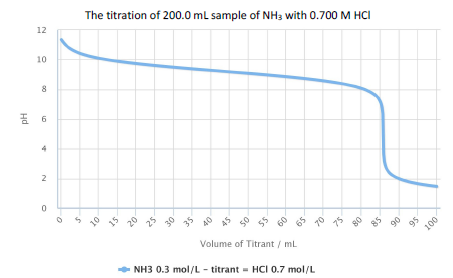
Note that the pH of the equivalence point must be <7 because a strong acid reacted with a weak base (strong acid is stronger so pH is lower @ equivalence point)
The weak base is titrated with the acid so it means we start with weak base (hence the pH ~11 to start with, and slowly start adding strong acid (strong acid added along the x axis)
Finally, at the bottom right of the curve, we have added so much acid that the pH drops to very low ~1.