Wize University Chemistry Textbook > Organic Chemistry Reactions
Reactions of Alkanes
Popular Courses
General Chemistry
University Study Guides
Chemistry
General Course
CHEM 1AA3
McMaster University
General Chemistry
University Study Guides
APSC 132
Queen's University
CHEM 112B
Queen's University
CHEM 130
University of British Columbia
CHEM 1100
University of Manitoba
CHEM 1481
Texas A & M University
CHMA10H3
University of Toronto
SC/CHEM 1100 4.00
York University
CHM 2045
University of Florida
CHEM 1001
Carleton University
CHEM 111
University of British Columbia
CHEM 112
University of Saskatchewan
CHEM 1P91
Brock University
CHMA11H3
University of Toronto
CHM 1301
University of Ottawa
CHEM 1110
University of Manitoba
CHEM 1300
University of Manitoba

Mark Yourself Question
- Grab a piece of paper and try this problem yourself.
- When you're done, check the "I have answered this question" box below.
- View the solution and report whether you got it right or wrong.
Chain Reactions
- A chain reaction is a reaction which, once initiated, proceeds extremely fast because each time a highly reactive intermediate reacts to form product it produces another equivalent of highly reactive intermediate.
- Chain reactions can be split into three types of steps, Initiation, Propagation, and Termination. An example is shown below.
- Initiation produces the reactive intermediates (radicals)
- Propagation consumes on radical and produces another one
- Termination consumes two radicals and produces none
0:00 / 0:00
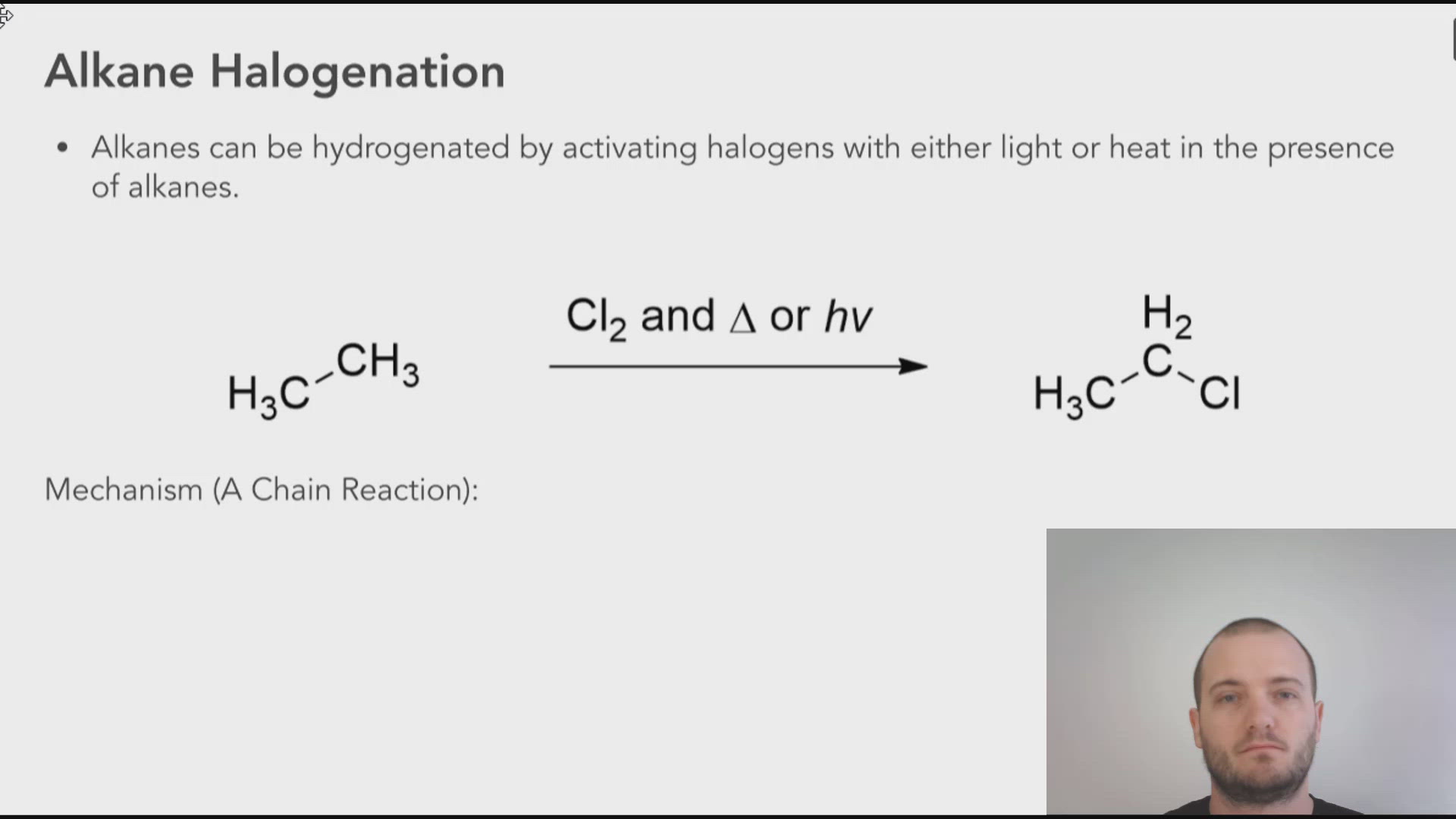
Alkane Halogenation
- Alkanes can be hydrogenated by activating halogens with either light or heat in the presence of alkanes.

Mechanism (A Chain Reaction):
Mark Yourself Question
- Grab a piece of paper and try this problem yourself.
- When you're done, check the "I have answered this question" box below.
- View the solution and report whether you got it right or wrong.
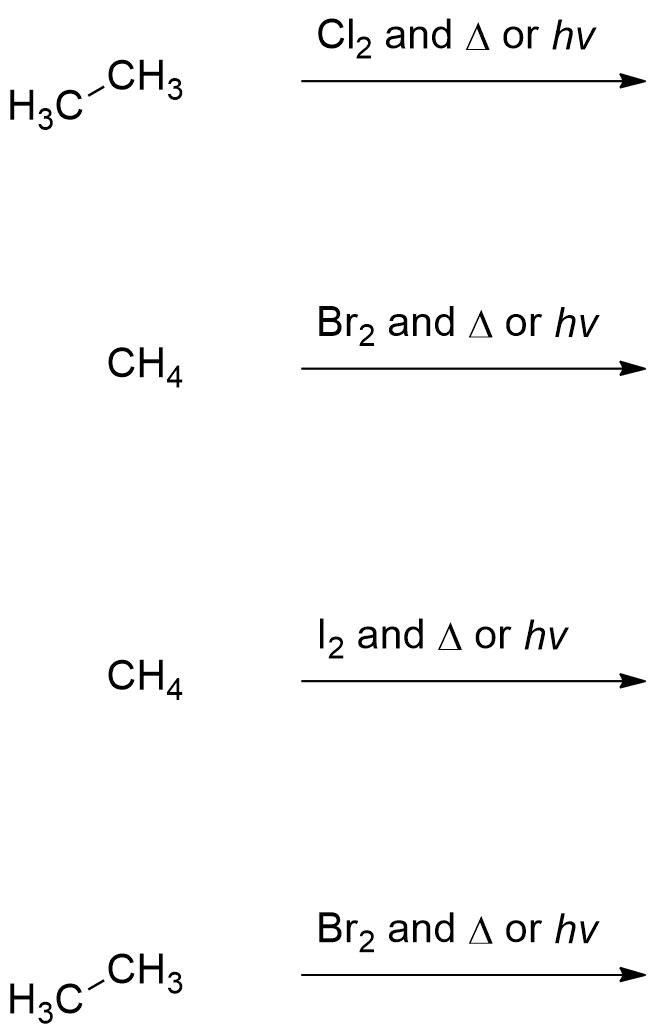
Predict the products of the following reactions
The reaction shown below is part of the alkane halogenation reaction. What type of step is it?
