Wize University Chemistry Textbook > Electrochemistry
Galvanic Cells
Popular Courses
MCAT
General Course
CHEM 1302A/B
Western University
General Chemistry
University Study Guides
AP Chemistry Exam Prep Course
AP Exam Prep
CHEM 1A03
McMaster University
CHEM 112
Queen's University
CHEM 203
University of Calgary
DAT
General Course
Chemistry
General Course
General Chemistry
University Study Guides
CHEM 1E03
McMaster University
ENGG 204
University of Calgary
CHM135H1
University of Toronto
CHEM 154
University of British Columbia
CHEM 102
University of Alberta
CHEM*1050
University of Guelph
CHY 102
Toronto Metropolitan University
CHEM 120
McGill University
CHE 102
University of Waterloo
SC/CHEM 1001 3.00
York University

0:00 / 0:00
Galvanic/Voltaic Cells
- A galvanic cell constructed of two half cells is shown below.
- Before we take a deeper look, let's review what we already know about galvanic cells:
- Do galvanic cells have spontaneous or non-spontaneous electron flow?spontaneous
- Is the ΔG° positive or negative?negative
- According to the equation ΔG° = –nFE°redox, is E°redox positive or negative?positive
- Let's take a look at our 2 half reactions from the table again:
Zn2+ (aq) + 2e– → Zn(s) E° = –0.76 V
Cu2+(aq) + 2e– → Cu(s) E° = +0.34 V
- In order to get an E°redox that is positive, we needed to flip the Zn(s) equation:
Zn(s) → Zn2+ (aq) + 2 e– E°ox = +0.76 V
Cu2+(aq) + 2e– → Cu(s) E°red = +0.34 V
E°redox = 1.1 V
Note: you might see E°cell referred to as the electromotive force or emf. These mean the same thing.
Now let's label the galvanic cell...

1) Which is the reduction half equation and which is the oxidation half reaction?
2) Using the following "Wize Concept," label the anode and cathode in the above diagram.
Wize Concept
The anode is always where oxidation happens.
The cathode is always where reduction happens.
There are different ways to remember this. One way is to remember that anode and oxidation both start with vowels, while cathode and reduction both start with consonants. The other way to remember this is: An Ox Red Cat! Pick your favorite way.
3) Show where the ions are moving (into solution/onto electrode)
4) Which electrode is shrinking? Which is growing?
5) Consider the salt bridge. Let's say it's made of KCl. Which half cell would the K+ ions travel to? Which half cell would the Cl– ions travel to?
Wize Concept
Anions of the salt bridge move to the anodic solution.
Cations of the salt bridge move to the cathodic solution.
This helps complete the circuit and prevent charges from building up by keeping the solution neutral.
6) Draw the direction of electron flow.
- Analogy: Running out of your last exam! Everyone is running in the same direction and to where they want to go (outside of the school!)
Wize Tip
Since the anode is always where oxidation happens and the cathode is always where reduction happens, then electrons will always flow from anode to cathode!
7) Write in the charges (+ or –) for each electrode.
Wize Concept
Since galvanic cells involve spontaneous electron flow, electrons will travel to where they want to go!
Electrons will always go from the anode to the cathode.
But here, since it's spontaneous flow it means that the cathode will have a positive charge (electrons want to go here) and the anode will have a negative charge (electrons want to get away from here!)
We will soon see how this is different for electrolytic cells.
8) Write in the spectator ions (in this case it is SO42–; you might see NO3– in other cases).
- These ions are called "spectator" ions because that's all they are doing...spectating!
- They don't participate in the actual reaction, but help to balance charges.
In a galvanic cell, oxidation occurs at the:

Mark Yourself Question
- Grab a piece of paper and try this problem yourself.
- When you're done, check the "I have answered this question" box below.
- View the solution and report whether you got it right or wrong.
Construct a galvanic cell with the highest voltage given the following half reactions. Determine the voltage produced and express it in standard cell notation.
0:00 / 0:00
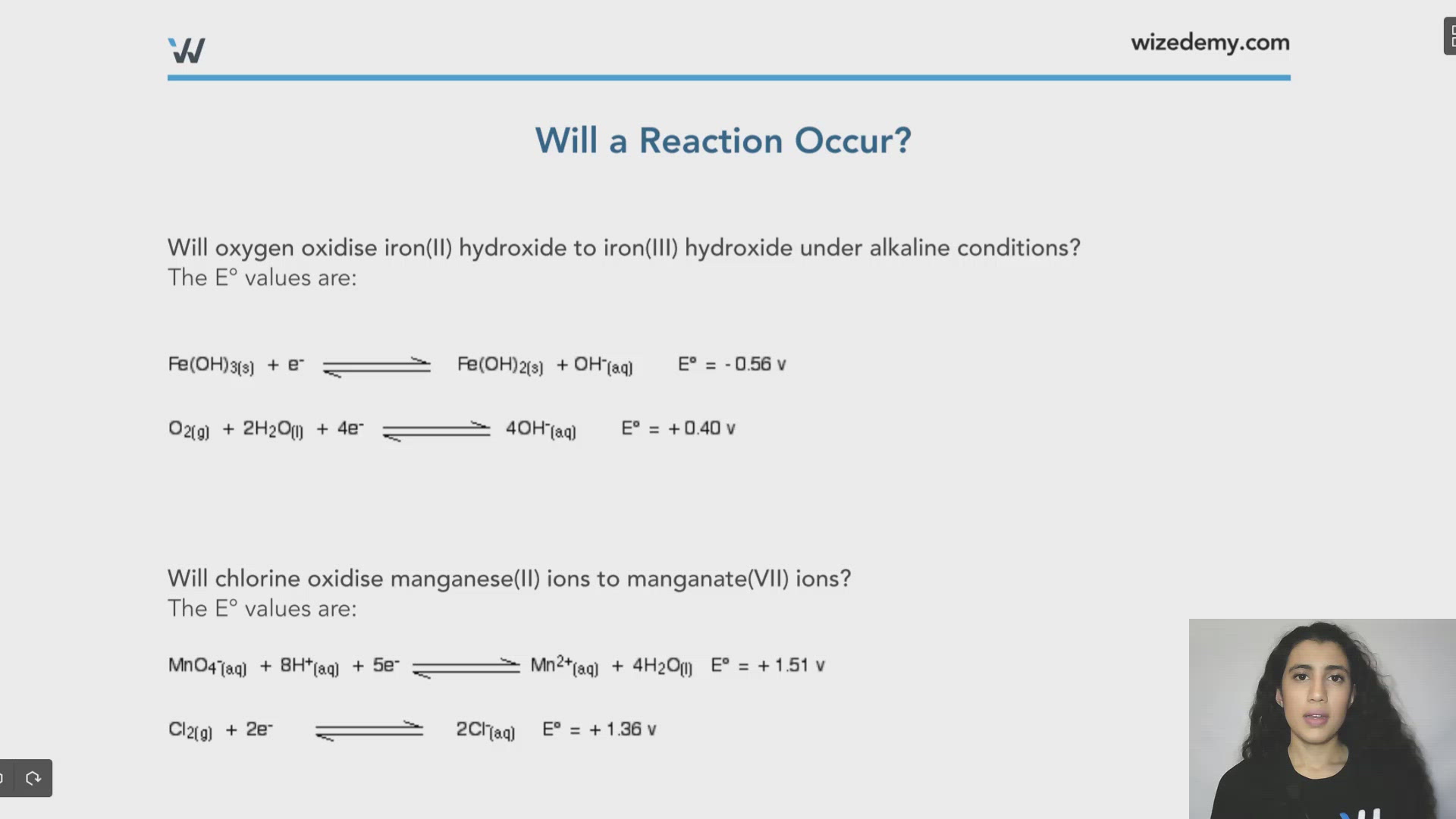
Will a Reaction Occur?
Will oxygen oxidise iron(II) hydroxide to iron(III) hydroxide under alkaline conditions?
E° values are:


Yes
Will chlorine oxidise manganese(II) ions to manganate(VII) ions?
E° values are:


No
Will Zn2+ react with Cu(s)?


No
You are told that I2(s) and Ag(s) do not react. Without using reduction potentials, what does this tell us about their relative reduction potentials?
Let's write out this reaction:
I2(s) + Ag(s) → Ag+(aq) + 2 I–(aq)
How could we have a reaction using the reactants and products in the above equation?
2 I–(aq) + Ag+(aq) + → I2(s) + Ag(s)
What is being oxidized and what is being reduced in our reaction?
oxidized:
I-
reduced:
Ag+
What can we say about the reduction potentials?
Ag+
SRP > I(s)
SRP Let's check:
On SRP table it says:
Ag+(aq) + e– → Ag(s) E = 0.80 V
I2(s) + 2 e– → 2 I–(aq) E = 0.54 V
0:00 / 0:00
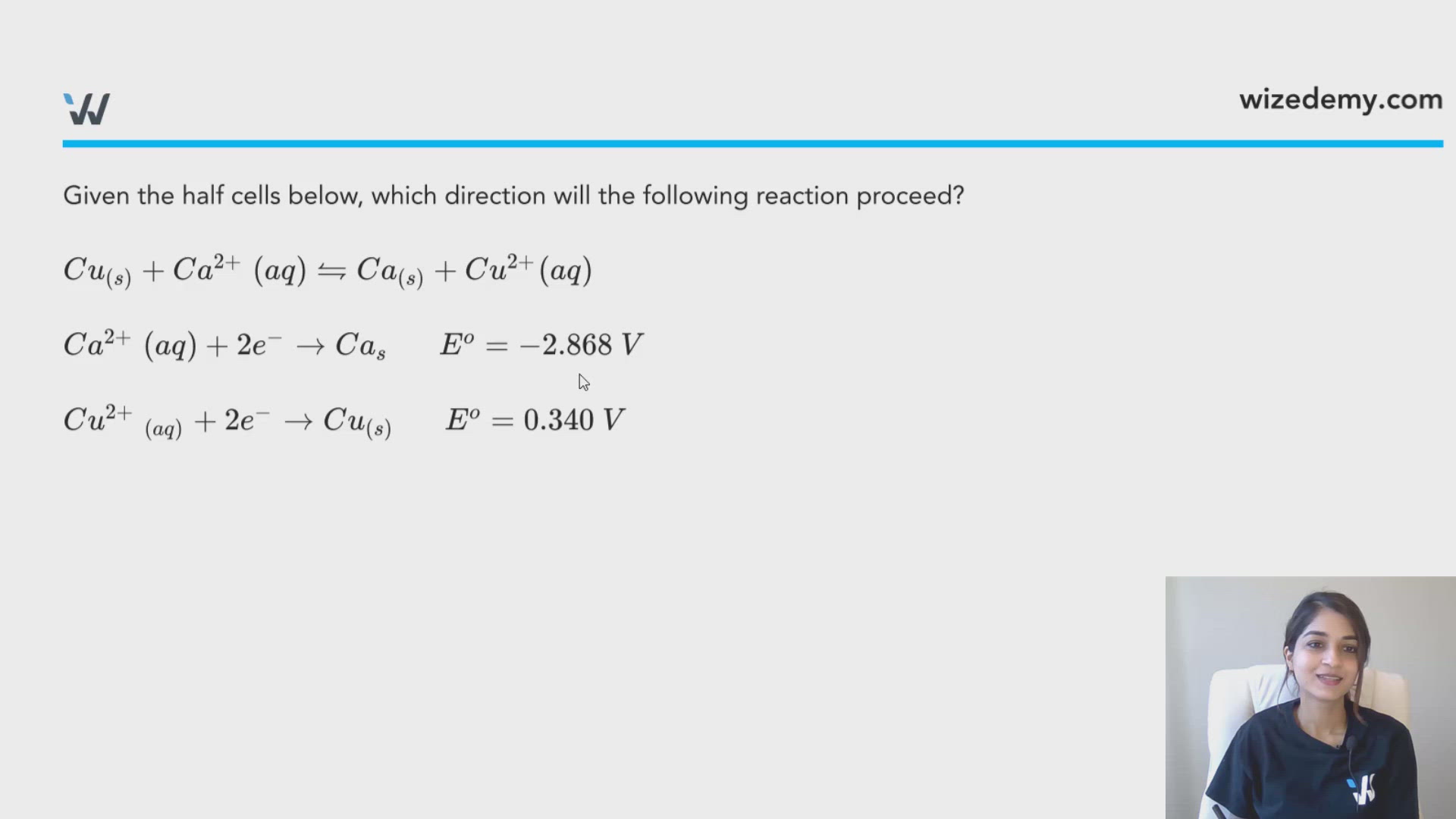
Given the half cells below, which direction will the following reaction proceed?
To determine the direction the reaction will proceed, the direction of spontaneity, we need to find the sign of the electromotive force, ε. Spontaneous processes (to the right) will have a positive voltage.
To build the overall reaction we need to flip the Cu reaction (which flips the voltage)
The reaction is not spontaneous as written because the electromotive force is negative. The reaction will proceed in the reverse direction.
Given the following half cells, what is the maximum voltage of a battery that could be constructed?