Wize University Chemistry Textbook > Kinetics
Arrhenius Equation
Popular Courses
MCAT
General Course
CHEM 1302A/B
Western University
General Chemistry
University Study Guides
CHEM 112
Queen's University
CHEM 203
University of Calgary
Chemistry
General Course
CHEM 1AA3
McMaster University
DAT
General Course
General Chemistry
University Study Guides
ENGG 204
University of Calgary
CHM135H1
University of Toronto
CHEM 102
University of Alberta
CHEM 123
University of British Columbia
CHEM*1050
University of Guelph
CHY 102
Toronto Metropolitan University
CHEM 120
McGill University
SC/CHEM 1001 3.00
York University
APSC 132
Queen's University
CHEM 112B
Queen's University
CHEM 102
University of Victoria

0:00 / 0:00
Arrhenius Equation
- Rates of reaction are highly temperature dependent! Imagine the speed of ice melting at 0°C vs 40°C
- Svante Arrhenius discovered a simple equation that relates the rate of a chemical reaction to the temperature which it is performed at. The Arrhenius equation is shown below.
- k is still the rate constant
- A is called the pre-exponential factor, it is unique for all reactions and is constant across all temperatures. It is related to the probability of a successful collision.
- T is temperature and R is the Gas constant
- Ea is the activation energy, which is shown below graphically

- Activation energy, Ea, is the amount of energy it takes to get to the products
- The Arrhenius equation on its own is not very useful because of the pre-exponential factor A is difficult to calculate. However by dividing one rate by another and rearranging we end up with the following equation. Notice that A has been cancelled out and is no longer necessary.
- We can use this equation to compare the rate of a reaction at two different temperatures.
a. A chemical reaction increases its rate by a factor of 15 when it is warmed from room temperature to 100oC. What is the activation energy of this process? R = 8.314 J/Kmol
0:00 / 0:00
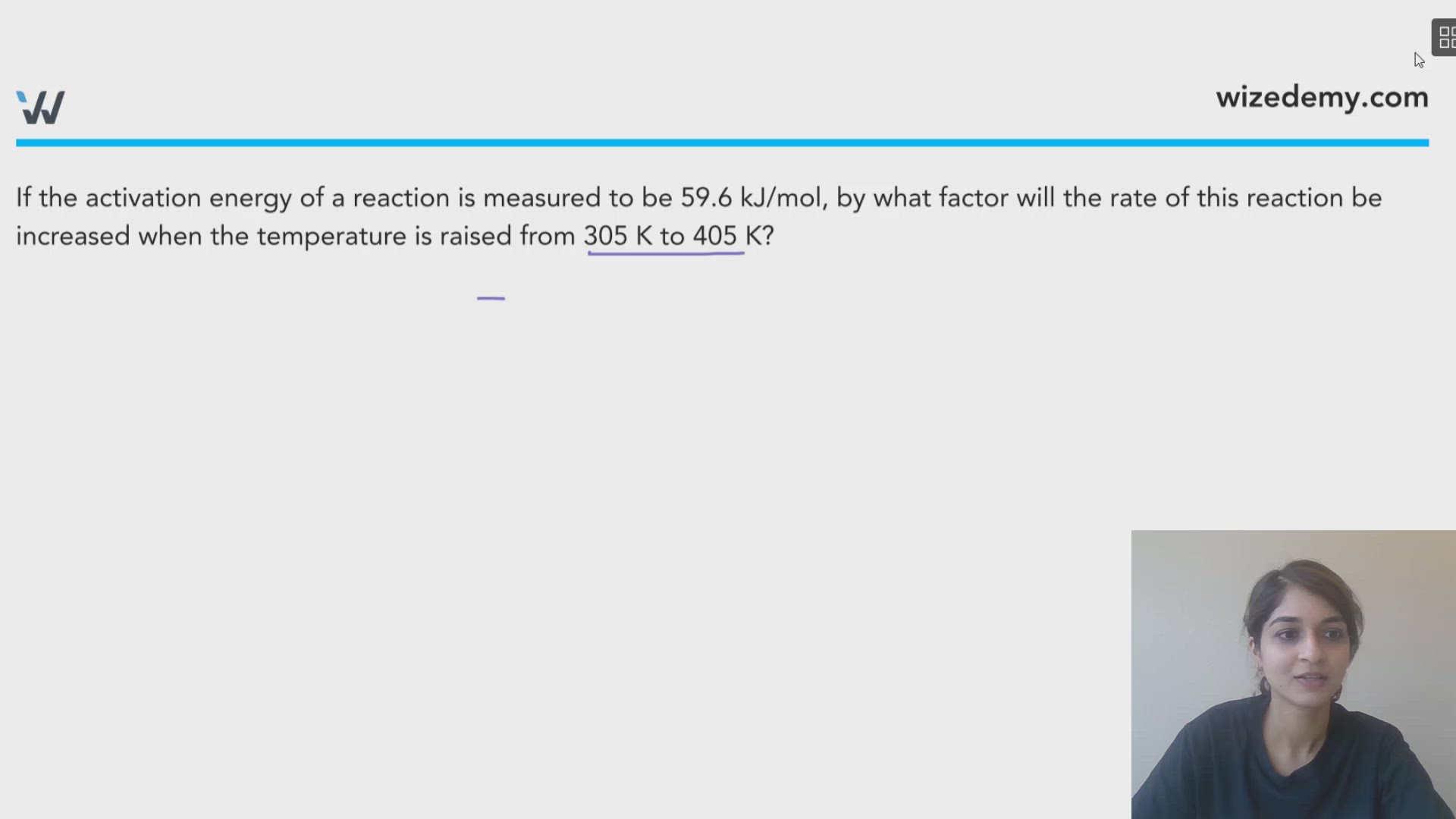
If the activation energy of a reaction is measured to be 59.6 kJ/mol, by what factor will the rate of this reaction be increased when the temperature is raised from 305 K to 405 K?
We start with the adapted Arrhenius equation,
the question is asking for the ratio of k2 to k1
The reaction will be 331 times faster at 405 K than it will be at 305 K. That's quite a bit!

Mark Yourself Question
- Grab a piece of paper and try this problem yourself.
- When you're done, check the "I have answered this question" box below.
- View the solution and report whether you got it right or wrong.
A Schiff base reaction between 3-propanone and aniline proceeds with rate constants of 0.0065 M-1 s -1 and 0.0084 M-1 s -1 at 30oC and 80oC respectively. Determine the activation energy and preexponential factor for this reaction.